

Category Archives: Front Page

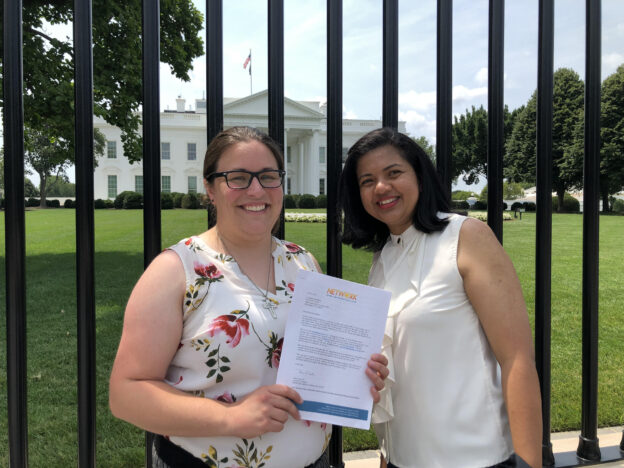
Emily and Ronnate with a letter - Title42

NETWORK Advocates Tell President Biden: End Title 42

NETWORK Advocates Tell President Biden: End Title 42

Audrey Carroll
July 16, 2021

Yesterday, Grassroots Mobilization Coordinator Sister Emily TeKolste, SP and Government Relations Director Ronnate Asirwatham delivered a petition to the White House telling President Biden to End Title 42.

Title 42 has no true medical basis and is causing harm to our immigrant siblings at the southern border. The order also violates the internationally recognized right to seek asylum. Thank you to over 1,600 NETWORK members and supporters that signed the petition urging the Biden Administration to end Title 42 and protect the dignity of immigrants and asylum seekers.

Download the full petition here. 

People Over Profits: Chancellor Merkel Must Release the Vaccine

People Over Profits: Chancellor Merkel Must Release the Vaccine

Andrew Stokely
July 16, 2021

On a typically hot and muggy July morning this week, I headed into downtown Washington, D.C., with a first stop at the historic Lafayette Square by the White House. But I wasn’t there for sightseeing.

Instead, I watched as activists and protestors displayed body bags on the street and launched a giant balloon of Angela Merkel’s likeness.

It was all part of a movement to protest a decision by Merkel, the German chancellor, to oppose Covid-19 vaccine patent waivers. Allowing the waivers is crucial to fighting the pandemic. It would increase the supply of vaccines to countries around the world, especially in places like India and Africa, where many people are suffering and dying as the virus keeps spreading. With Merkel in Washington for a meeting with President Joe Biden, now was the time to make the case for allowing the waiver.

I’m a 17-year-old rising high school senior. If you’re wondering why someone like me was documenting the protest, it’s because I think teens and young people can and should fight for increasing access to global vaccines and encouraging vaccinations here at home. Until the whole world is safe, none of us are safe.

Olivia Rodrigo visited the White House recently to push for young people to get vaccinated. That’s a great first step, but I think it’s also important for my generation to learn and remember how young activists played a major role when the HIV and AIDS epidemic became a public health crisis in the 1980s. “During the first decade of the epidemic, young activists demanded action on the epidemic and successfully advocated for radical changes to the clinical trials and drug approval processes,” according to UNAIDS, an international advocacy group.

We can step up again. This time around, we have social media and we know how to help organize and mobilize protests. We could use everything from TikTok to text messages to get the word out. And just showing up in large numbers can help.

As the protest continued, activists staked out a position across the street from a nearby Johns Hopkins University building, where Merkel was being honored. When she was leaving one of the cars in the motorcade, the protesters yelled, “Release the vaccine!” and, “People are dying!” She ignored them as she went in to accept her award. I wish I could know if she heard the protestors and if she thought about what they said.

But, by the end of the day, I saw that Merkel had not changed her position. I was disappointed. But I also know that change doesn’t always come as quickly as we’d like it to. I want to keep encouraging my peers to speak out about making vaccines available to everyone and the importance of getting vaccinated. I hope that the next demonstration I attend will be one that celebrates this accomplishment.

Andrew Stokely is a member of Our Lady Queen of Peace Catholic Church in Arlington, Virginia and a rising high school Senior at Washington-Liberty High School.

The Moment is Now: Pass H.R.40

The Moment is Now: Pass H.R.40

Mary Novak
July 16, 2021

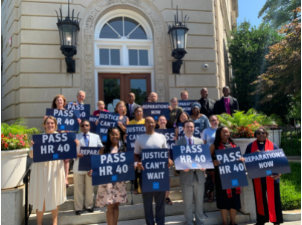
On July 13 2021, I joined faith leaders to call on Congress to pass H.R.40, the Commission to Study and Develop Reparation Proposals for African Americans Act, before the August recess. What a Spirit-Filled gathering with the incomparable Nkechi Taifa, Founder of The Taifa Group; Laura James, Program Coordinator for Grassroots Organizing; Yolanda Savage-Narva Racial Equity, Diversity, and Inclusion Director, Union for Reform Judaism; Diane Randall, General Secretary of Friends Committee on National Legislation; Jarrett Smith, Government Relations Fellow, NETWORK Lobby; Bishop Eugene Sutton, Episcopal Church, Maryland Diocese; Victoria Strang, Policy Advocate with Faith Communities, Human Rights Watch; Reverend Timothy Tutt, Senior Minister, Westmoreland Congregational UCC; and Jim Winker President and General Secretary, National Council of Churches.

What is not named cannot be healed. It is time to name our country’s sickness. Using the frame of the  Catholic tradition — it is time to name our original sin of slavery and move towards repair, reparations. That moment is now.

For the first time, we are talking about reparations in the national conversation. States, local authorities, and religious orders are all moving on reparations. We have been waiting 32 years for this moment. We cannot wait another day or another week. We are  calling on House leadership to bring H.R.40 to the floor. The moment is now.

It is no coincidence the momentum for movement on reparations follows that terrifying day of January 6th. We not only survived that shameful day, but are seeing for what it was: evidence of our need for collective salvation. The moment is now.

We know there is resistance to move towards healing from our collective soul sickness. Resistance comes because healing can be hard and oftentimes painful. We must overcome that resistance because the freedom on the other side is calling us. The moment is now.

My friends:

There is a balm in Gilead
To make the wounded whole
There is a balm in Gilead
To heal the sin-sick soul

That balm can begin now, so let’s do this; let us get this Commission going and pass H.R.40. If not, my friends, we must call on President Biden to make it happen by any means necessary. The moment is now.

Watch the Faith for H.R.40 Press Conference to learn more. Watch on Facebook or YouTube.

Stay engaged and find more ways to take action to advance policies that build our systems and structures anew at www.networklobby.org/ActNow.

Called to Serve our Neighbors at the Border

Called to Serve our Neighbors at the Border

Sr. Cecilia Cavanaugh, SSJ
July 15, 2021

In response to the Biden administration’s changes to federal policy at the U.S.-Mexico border this year, Catholic Sisters began traveling to the border to be of service to the influx of children and families entering the U.S. A few weeks ago, I traveled from Philadelphia, Pennsylvania to McAllen, Texas with three other Sisters of Saint Joseph of Philadelphia, one of our Associates in Mission, and two friends.  

We, the Sisters of Saint Joseph have a special commitment to serving all people who we recognize as “dear neighbor” especially those who are most vulnerable. Eager to serve our dear neighbors migrating into the USA, this is my fourth experience accompanying migrants in their journeys. Being able to “connect some dots” between my past experiences and the present is helpful and inspiring. As I reflect on the first of my two weeks here in Texas, I’m increasingly grateful for encounters I’ve had in recent years. 

Last year, another SSJ Sister and I spent ten days in McAllen. Because of the Trump administration’s “Migrant Protection Protocols,” the Center in Texas was almost empty. Instead, we often packed provisions and drove to Brownsville to cross the Río Grande into the refugee camp in Matamoros, Mexico. Walking through rows and rows of tents housing families in Matamoros, knowing that the policies of my country created these conditions, branded an indelible mark on my soul.  

This week, our group visited another bridge and some wanted to cross. I could not. I realized that my experience witnessing families trapped in Matamoros last year was traumatic and that I’m still processing.  

Now that policies are changing, hundreds and hundreds of people are being served daily. As overwhelming as my experience this year has been, there is a significant difference. There is movement. The families are on their way. Their hope energizes and lifts me up. I recognize my privilege and blessing in both scenarios. I want to be one with these dear neighbors and can bear witness to their experiences, but I will never share the extent of their pain, distress and trauma. 

Last week, I listened to a woman describe the home she was forced to leave in Guatemala and assaults she and her sons experienced on the journey to the U.S. She anguished over finding her way to her sponsor and shuddered when she looked at her monitoring ankle bracelet. As she spoke, I remembered the simple but beautiful homes and subsistence farms I visited during a 2013 trip to Guatemala; the material poverty was in contrast to a deep sense of history, home, and community.   

When I told her I could picture the homes in Guatemala, she burst out, “I miss my chickens. I miss my chickens.” I can’t stop repeating her words. Those animals represent so much about home, familiarity, and belonging. This person did not want to leave her home. I praised her resilience and bravery and promised her my prayer and that I would not forget her. Her story guarantees it. 

Finally, I remember a week spent last March in Tierra Blanca, Veracruz with our Sisters of Saint Joseph of Lyon. I was visiting a shelter near a border where folks cross into Mexico, having already traveled through parts of Central America. I listened to interactions, heard stories, and learned more about their experiences. Having traveled that week from Philadelphia to Mexico City and then by bus and car to Tierra Blanca, I had a privileged view of the length of their journey.  

We drove through train yards where dozens of men waited to jump on a passing train despite the danger from gangs threatening to extort them and the trains themselves, fast and unforgiving. Watching them leave the shelter in the morning and head out — to my country — I prayed that they would know a welcome after their long journeys. Now, I stand at the other end of that route here in the United States. I welcome my dear neighbors, offer clean clothing, necessities, encouragement, a smile. They set off again. I took a young woman and her toddler to the airport and tried to explain this new experience to her — security lines, what to do if her plane was late or canceled. I felt fearful imagining her layover. I watched her set out and prayed for her. Who will help her? 

In his September 2020 message for the World Day of Migrants and Refugees, Pope Francis reminded us of our call to “welcome, protect, promote, and integrate” these valiant, vulnerable siblings of ours. He added six pairs of verbs: to know and understand, to be close to and serve, to be reconciled and listen, to grow and share, to be involved and promote, to cooperate, and to build. So much work of body, mind, and spirit! This cannot be completed or even undertaken over the course of a two-week volunteer stint. Rather, such effort must be undertaken by all of us in all the places where we live and minister. The journey does not end at our borders. 

Cecelia J. Cavanaugh SSJ is a Sister of Saint Joseph of Philadelphia and a former Nun on the Bus.   

Eviction Moratorium Remains Extended to July 31

Eviction Moratorium Remains Extended to July 31

Caraline Feairheller
June 30, 2021

The COVID-19 Pandemic has exacerbated the affording housing crisis — leaving millions of renters at risk of losing their homes. Renters of color in the United States disproportionally face this hardship and are now twice as likely to report being at risk of eviction. On June 24, the Center for Disease Control and Prevention extended the eviction moratorium from June 30 until July 31.

Despite being challenged in the courts, the Supreme Court of the United States upheld the extension of the eviction ban. This 5 to 4 decision will allow government agencies to continue working on getting Emergency Rental Assistance into the hands of tenants who are in need.

Throughout the pandemic, Congress has provided more than $46 billion in emergency rental assistance through the Consolidate Appropriations Act and the American Rescue Plan. Recently, the White House and United States Treasury updated their guidance on the qualifications and possibilities of the Emergency Rental Assistance Program. Renters or landlords apply for this assistance from the state or local entities selected to administer the program, find the right place to apply here.

As clarified by the National Low Income Housing Coalition FAQ on the Emergency Rental Assistance Program, the updated guidelines:

  • Provide ERA funds to families who have lost or are at risk of losing housing by paying for relocation assistance, prospective rent, security deposits, and temporary hotel accommodations.
  • Provide ERA Funds to families who are temporarily displaced living in hotels or motels.
  • Provide ERA funds to families living in federally subsided housing.

Eligibility for Emergency Rental Assistance Funds:

  • If one or more individuals has qualified for unemployment benefits or experienced other financial hardship due directly or indirectly to the pandemic.
  • If one or more individuals can demonstrate a risk of experiencing homelessness or housing instability.
  • The guidelines do not impose restrictions based on immigration status. State and local governments cannot impose their own immigration status or Social Security requirements.

Finally, when ERA payments are being made on the household’s behalf, landlords are prohibited from evicting renters for nonpayment.

NETWORK welcomes the decisions to extend the eviction moratorium and applauds the Supreme Court for prioritizing the health of the nation. The updated guidelines for the Emergency Rental Assistance Program will keep families in their homes. However, the extension of the eviction moratorium and updated guidelines is only a short-term solution to the affordable housing crisis in the United States. Congress must work to pass the American Jobs Plan in order to honor the human dignity of every person by investing in long-term affordable housing.

Read the Full National Low Income Housing Coalition FAQ Sheet Here.

2021 Is the Year to Pass the Equality Act

2021 Is the Year to Pass the Equality Act

Gina Kelley
June 24, 2021

In many U.S. states, members of the LGBTQ+ community can be fired at will, denied a place to live, and refused medical care. Our LGBTQ+ friends, family, and neighbors can legally face disrespect and discrimination because of who they are and who they love. Discrimination has no home in our country or in our communities. No one should be excluded in a society that respects and supports human dignity.

The Equality Act (H.R.5/S.393) would provide consistent and explicit anti-discrimination protections for LGBTQ+ people across key areas of life, including employment, housing, credit, education, public spaces and services, federally funded programs, and jury service.

According to the Human Rights Campaign, the Equality Act does this by “amending existing civil rights law — including the Civil Rights Act of 1964, the Fair Housing Act, the Equal Credit Opportunity Act, the Jury Selection and Services Act, and several laws regarding employment with the federal government — to explicitly include sexual orientation and gender identity as protected characteristics. The legislation also amends the Civil Rights Act of 1964 to prohibit discrimination in public spaces and services and federally funded programs on the basis of sex. The Equality Act would also update the public spaces and services covered in current law to include retail stores, services such as banks and legal services, and transportation services.”

These legal protections would ensure that folks in the LGBTQ+ community can fully belong and participate in our society without the risk of being subject to discriminatory and punitive practices.

The Equality Act (H.R. 5) passed the House of Representatives in February of this year. It joins the long list of legislation that will not reach the floor while the filibuster remains. The Equality Act, like the George Floyd Justice in Policing Act, the For the People Act, and more would help us create a more just economy and a more equitable society, and deserve a real chance in the Senate.

At NETWORK, we affirm that our faith calls us to welcome and love everyone—no exceptions. Additionally, many members of the LGBTQ+ community are people of faith – up to 20% LGBTQ+ Americans are Catholic. People of faith and the majority of voters support laws like the Equality Act, which protect members of the LGBTQ+ community.

Not only is this legislation popular but we know that our faith calls us to practice welcome and inclusion and to see and affirm God in all people. NETWORK Lobby urges the Senate to pass the Equality Act and finally include protections for our LGBTQ+ sisters and brothers into our country’s fundamental civil rights laws.

Orange sign that says "It's in the Constitution: Everyone Counts"

State Voting Restrictions Reinforce the Need for the Democracy Reform

State Voting Restrictions Reinforce the Need for the Democracy Reform

Alex Budzynski
June 21, 2021

Right now, a record number of bills that restrict the vote are moving through state legislatures and becoming law. A recent study from the Brennan Center for Justice found that at least 14 states have enacted 22 restrictive voting bills since January. In particular, Florida, Georgia, and Iowa have introduced overarching bills that further constrict already narrow voting laws. Montana and Arkansas have already ratified four bills apiece, and Arizona has proposed two dozen bills which target voting by mail specifically. Several of these laws are being challenged in court.

The Brennan Center study determined that these provisions stem from “the racist voter fraud allegations behind the Big Lie and a desire to prevent future elections from achieving the historic turnout seen in 2020.” Over 300 restrictive bills have been introduced in 48 states, and 61 bills are currently moving through state governments. With voting rights jumping to the top of state legislative agendas, “the United States is on track to far exceed its most recent period of significant voter suppression” by the end of this year.

States are imposing an assortment of the following provisions making it more difficult to vote in person or to cast ballots in the mail:

  • Shortening the timeframe to request and deliver mail ballots
  • Making it harder to remain on absentee voting lists
  • Eliminating or limiting mail ballots to those who do not specifically request them
  • Restricting assistance when returning mail ballots
  • Limiting the number and location of mail ballot drop boxes
  • Imposing stricter signature requirements for mail ballots
  • Tightening voter ID requirements
  • Expanding voter purges
  • Banning snacks and water at in-person polling stations
  • Eliminating same-day registration
  • Reducing the availability of polling locations and hours
  • Limiting early voting days and times

The principles of Catholic Social Justice insist that all people have a right to participate in our shared public life. Voting should be readily accessible, but these laws make it harder to cast a ballot under the guise of election security. In turn, these bills jeopardize the integrity of our democracy and actively disenfranchise voters.

Moreover, these restrictive laws disproportionately affect marginalized communities, creating hurdles for Black and brown voters, disabled people, immigrants, and low-income folks. A 2019 study published in Scientific American found that voters in predominantly Black neighborhoods waited an average 29% longer than voters in White neighborhoods. Now, states with large minority populations, including Florida and Georgia, have introduced provisions which will continue to suppress minority votes due to technicalities and unchecked intimidation techniques. These policies are rooted in and reminiscent of Jim Crow-era poll taxes and literacy tests. They must be undone to ensure all people have access to the polls.

Organizations across the nation are taking notice of these dangerous and undemocratic pieces of legislation. The Black Votes Matter Fund recently announced their “Freedom Ride for Voting Rights,” a series of events from Jackson, Mississippi to Washington D.C. which will advocate against widespread voter suppression. The organization’s goal “is to increase power in our communities. Effective voting allows a community to determine its own destiny.”

In order to preserve our democracy and uphold the right to vote, we must act. The For the People Act (S.1) is a comprehensive, once-in-a-lifetime bill that protects and expands voting rights, ends partisan gerrymandering, and gets big money out of politics. S.1 would overrule the restrictive laws being passed in states by dictating new, national voting standards that make it easier to vote in person or by mail. NETWORK urges the passage of the For the People Act in the Senate to undo the constricting and oppressive provisions that are being imposed nationwide. The integrity of our democracy is at stake.


Alex Budzynski is a rising senior at Xavier University where he studies communication and public relations. He hails from Fairfax, Virginia, and he is one of the summer volunteers at NETWORK this year.

Celebrating Child Tax Credit Awareness Day

Celebrating Child Tax Credit Awareness Day

Colleen Ross
June 21, 2021
Expanded CTC cartoon 3_unbranded

Monday, June 21, 2021 is Child Tax Credit Awareness Day, a day to celebrate and spread the word about monthly payments that are starting soon that will support children and families across the country.

The American Rescue Plan, which passed in March 2021, included a historic expansion of the Child Tax Credit in 2021. The law increased the maximum Child Tax Credit from $2,000 to $3,000 per child for children ages 6-17 and from $2,000 to $3,600 for children under six, which can be received via monthly payments, with the exact payment varying by parents’ income. NETWORK has long advocated for this policy that uses our shared resources to invest in kids, increase racial equity, and support parents and communities.

In July, monthly payments will start going out to families.

With monthly payments, families can count on this support each month to make ends meet. To help with the costs of raising children, families will begin to receive monthly payments of up to $250 for each child 6-17 years old and $300 for each child under age 6. The Child Tax Credit is fully refundable, meaning that if a family’s income tax bill is less than the amount of their Child Tax Credit, they will get a payment for the difference.

According to the Biden administration, the IRS estimates roughly 39 million households — almost 90% of children in the United States — will begin receiving monthly payments without any further action required. Other eligible families — those who have not yet filed taxes in 2019 or 2020 and who did not sign-up for Economic Impact Payments like the $1,400 rescue payments included in the American Rescue Plan — can still sign-up to receive monthly Child Tax Credit payments beginning this summer. Experts project that the expanded Child Tax Credit could potentially help lift one-half of all children out of poverty if all eligible families sign-up to receive the monthly payments.

The Child Tax Credit will not affect families’ Medicaid, SNAP, TANF Cash Assistance, SSI, or other public benefits, and monthly payments will be delivered via direct deposit to the bank account that the IRS has on file or sent to a family’s mailing address on or around the 15th of every month.

Make sure you get your Child Tax Credit payments!

If a family filed tax returns for 2019 or 2020 or signed up to receive a stimulus check from the IRS with the Non-Filer tool last year, they will automatically get the monthly Child Tax Credit. If they aren’t already signed up, it’s not too late to sign up to get the Child Tax Credit here: https://www.whitehouse.gov/child-tax-credit/sign-up/

Let’s make support for children and families permanent!

This one-year expansion of the Child Tax Credit is a massive advancement in ending childhood poverty. We know it is wrong when children and their families are struggling to make ends meet. It’s not good for families and it’s not good for our communities. We must make the expanded Child Tax Credit permanent in the next recovery package that Congress passes.

We are called to build anew by passing tax policies that make the wealthiest people and corporations pay their fair share – doing this allows us to invest in children and families.

Juneteenth 2021 Events List

Juneteenth 2021 Events List

Caraline Feairheller
June 17, 2021

On June 19, 1865, about two months after the Confederate General Robert E. Lee surrendered at Appomattox, Virginia, six months after Congress passed the 13th Amendment and more than two full years after President Abraham Lincoln issued the first proclamation; Union General Gordon Granger arrived in Galveston, Texas, to inform enslaved Black people of their freedom and that the Civil War had ended. Since then, Juneteenth has been a day of celebration in the Black community and continues to be an act of resistance and resilience in the face of racial oppression that shamefully continues today.

This Juneteenth we must pause and acknowledge the immense gap between the freedom promised in 1865 and the freedom delivered. The events listed below are opportunities to engage with the history and celebration of Juneteenth as well as recognize the work that can and still must be done:

[Virtual] 4 Generations of Black Civil Rights Leaders | June 17 at 8:00 PM Eastern

Hosted by the Center for Common Ground. This event will feature four Black Civil Rights Activists from Georgia and Virginia who are working to ensure that Black voters are able to vote. The event guests are Dr. William Ferguson “Fergie” Reid, Cliff Albirght, Andrea Miller, and Evan Malborough.

[Virtual] A Global Conversation on Reparations | June 18 at 1:30 PM Eastern

Hosted by the Thurgood Marshall Civil Rights Center at Howard University School of Law. Presented in honor of Juneteenth, this program examines reparations from a global perspective, with advocates from the United States, the Caribbean, the UK and Europe discussing the challenges and progress in achieving reparations. In addition, the webinar will share information about international advocacy for reparations, and discuss where and how this work fits within the context of the International Decade for People of African Descent.

[Virtual] Live with Carnegie Hall: Juneteenth Celebration | June 19 at 7:30 PM Eastern

Rev. Dr. James A. Forbes Jr. leads this celebration—along with Tamara Tunie, and special guests Wayne Brady, Martin Luther King III, and Annette Gordon-Reed—to recognize the importance of this historic day and to acknowledge the long road still ahead. In addition to music, dance, and commentary, the evening also recognizes contributions made by prominent African Americans today: Bryan Stevenson, founder and executive director of the Equal Justice Initiative; Robert F. Smith, businessman and chairman of Carnegie Hall’s Board of Trustees; and Congresswoman Sheila Jackson Lee.

[In-Person and Virtual] Juneteenth Now 2021: Get Us Free | June 19 at 5:00 PM Eastern and June 20 at 3:30 PM Eastern

Hosted by the Middle Church and the Riverside Church. This Black-led celebration and fundraiser, is produced by Charles Randolph-Wright and Shanta Thake. Join in-person, or stream virtually, for an evening showcasing a rare LIVE performance by Stephanie Mills who will debut her new single, “Let’s Do the Right Thing.” This ticketed event will be hosted by Rev. Dr. Jacqui Lewis and Rev. Michael Livingston with more talented performing artists including Loretta Devine; Kamilah Forbes; Martha Redbone; Tituss Burgess; Celisse Henderson; Kaliswa Brewster, an ensemble of Riverside Church & Middle Church choirs, spoken word, dance and jazz! Come in-person or watch from home to celebrate a stunning night of fierce resilience. Proceeds from the event will continue to power Black wellness programming at both institutions, as well as support in Middle rising from its devastating fire in 2020.

[Virtual] Night of a Thousand Conversations | June 19 at 8:00 PM Eastern

Hosted by the Grassroots Reparations Campaign More than ever, our nation needs to understand that #reparations are much more than a check.  True repair healing, education and culture shifting, compensation, restitution and guarantees to stop the harm that began with slavery and continues through various forms of discrimination. The Grassroots Reparations Campaign invites you to participate in a Night of a Thousand Conversations. On June 19th, known as Juneteenth, we honor and observe those last to receive the news of emancipation from slavery. Our hope is that between June 19 and August 21 (#ReparationSunday) to reflect on African chattel slavery, its legacy and its impact on your community and find your path to building a culture of repair.

Honoring Pride Month by Ending LGBTQ+ Housing Disparities

Honoring Pride Month by Ending LGBTQ+ Housing Disparities

Caraline Feairheller
June 14, 2021

The month of June marks the beginning of Pride Month. First celebrated in 1970 as a commemoration of the 1969 Stonewall Uprising, the month is both a celebration of LGBTQ+ individuals and the LGBTQ+ community and a recognition of the violence faced by LGBTQ+ communities throughout history – violence that continues to this day. This Pride Month, we call on the Biden administration and Congress to pass federal policies that bring justice and equality for the LGBTQ+ community in the United States.

LGBTQ+ people face multi-faceted and intersecting forms of stigma and discrimination across their lifetime. The inequities faced by LGBTQ+ communities do not only take the form of physical violence but often also stem from discriminatory policies, including our country’s unjust lack of affordable housing. Access to safe, stable, affordable housing is a human right. However, the rising costs of housing paired with the legacy of anti-LGBTQ+ discrimination in housing continues to threaten the physical and mental health of LGBTQ+ people in the United States. Today, LGBTQ+ people experience higher rates of poverty and lower raters of homeownership compared to non-LGBTQ+ people. The lack of explicit legal protections has led to one in five transgender and non-binary people facing housing discrimination and nearly one in ten having been evicted.

It is critical that the Biden administration and Congress support housing policies that honor the dignity of each person and ensure all have access to safe and affordable housing. In order to build anew and cultivate an inclusive community, anti-LGBTQ+ housing discrimination policies and practices must end. In particular, these federal policies must extend protections for Black trans women who face an epidemic of violence and immoral rates of discrimination because at the intersection of racism, transphobia, and sexism. While there is still much work to do, President Biden’s American Jobs Plan is a necessary start to reshape our country’s housing.

The American Jobs Plan would allocate $213 billion to build, preserve, and retrofit 2 million homes by:

  • Creating public housing and addressing capital needs following years of disinvestment in our public housing ($40 billion)
  • Instituting Neighborhood Homes Investment Act tax credits for low- and middle-income homebuyers to build or rehabilitate 500,000 homes in underserved communities ($20 billion)
  • Developing 1 million affordable, resilient, accessible, energy-efficient, and electrified housing units in underserved communities nationwide, including rural and tribal areas ($126 billion)

In addition to the programs and funding included in the American Jobs Plan, NETWORK calls on Congress to increase funding for public housing in order to adequately meet the needs of our country’s families and provide housing vouchers to all who qualify by creating a universal housing voucher program.

Along with increased investments in housing, the Senate should pass the Equality Act (H.R.5), which would amend the 1964 Civil Rights Act to explicitly prohibit discrimination on the basis of sexual orientation and gender identity in housing as well as other areas.

Housing is a basic human right and the foundation for a person’s ability to meet their needs and achieve their God-given purpose. Justice demands that every member of our human family is protected from discrimination; Congress must allocate funding and pass policies that protect the rights of all LGBTQ+ individuals.

Stay engaged and find more ways to take action to advance policies that build our systems and structures anew at www.networklobby.org/ActNow.