

Category Archives: Front Page

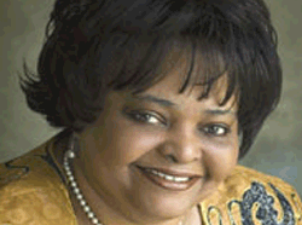
Sister Anita Baird Shares History of Black Sisters in the United States

Sister Anita Baird Shares History of Black Sisters in the United States

Honoring the Legacy of Black Sisters during Catholic Sisters Week
May 12, 2021

“In this moment of dual life-threatening epidemics: COVID-19 and racism, the voice of the Church in America is eerily silent when it comes to the racial unrest in this country.”
– Sister Anita Baird, DHM


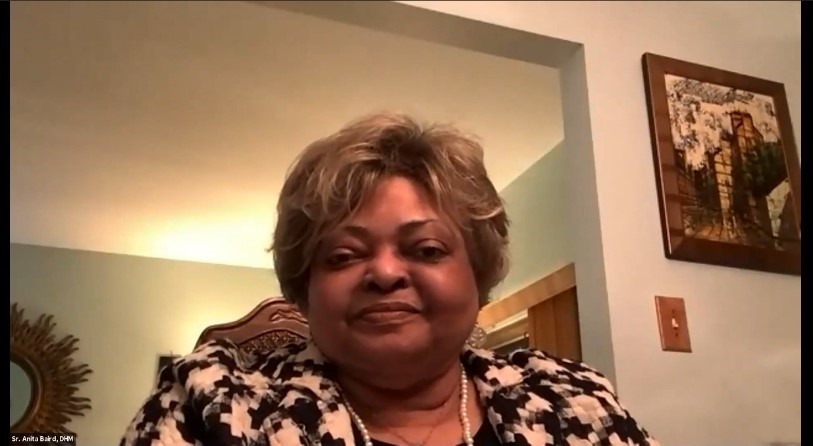
In honor of this year’s Catholic Sisters Week, Sister Anita Baird, DHM spoke to the NETWORK community about the history of Black sisters in the United States and their work today. Sister Anita, a recognized religious leader, community leader, and racial justice activist in Chicago, presented, “This Is Our Story…This Is Our Song: Black Catholic Women Religious Standing in the Breach.” While the hour-long talk was only enough time to brush the surface of the rich and complex legacy and the often painful history of Black women religious, Sister Anita told the stories of several sisters and the 53-year history of the National Black Sisters’ Conference, as well as her personal journey of becoming Catholic and a member of the Religious Congregation of the Society of the Daughters of the Heart of Mary.

As Sister Anita remarked, “Over 500 years of Black Catholic faith and presence in what is now the United States… is a history that was not just erased, but rather, it was often never documented or recognized by the larger Church, even to this day.” Sister Anita went on to share a wealth of insights into both this history and the Church today. While Black Catholics are sometimes seen as “recent newcomers” to the faith, that is an inaccurate and uninformed assumption.

Sister Anita explained that Black Catholics had an active presence in the United States and in the U.S. Catholic Church for more than two centuries before Declaration of Independence was even written. This began in 1526, when the first enslaved African peoples (who were themselves Spanish-speaking Catholics) were brought by force to what is now the U.S. by Spanish colonists, all with the blessing of the Catholic Church.

As Sister Anita’s description of the history of early U.S. Black Catholics continued, including instances where religious conversion was held as a price for freedom from enslavement, I was reminded of Cardinal Gregory’s February 2021 reflection on Black Catholics in the Archdiocese of Washington, D.C. He named the often-unspoken truth that many Black Catholics’ ancestors did not come to their faithfulness by choice, but by cruelty. Sister Anita and Cardinal Gregory’s truth telling led me to reflect on how often white people are encouraged to not name racism in our history or the current reality of race in the Catholic Church and in the U.S.

Sister Anita named the three Black Catholic Women included in the group of six Black American Catholic candidates for sainthood, including Mother Mary Lange, O.S.P. She noted that in 1829 when Mother Lange founded the first African-American religious congregation, the Oblate Sisters of Providence, in Baltimore, Maryland, it was still legal to enslave people in parts of the United States and named some of the challenges and tragedies the Oblates faced. White religious orders in the U.S. did not accept African-American women until the 1940s, and Sister Anita told how Eliza Healy (sister of the first African-American bishop, Bishop James Augustine Healy) joined the Congregation of Notre Dame in Canada and served as a superior and Mother Superior decades before then. Even Sister Antona Ebo’s story, shared by Sister Anita, illustrated the racism present in the Church for Sister Antona and the two other Black sisters who joined the Sisters of Mary in 1946. When Sister Antona Ebo marched alongside Congressman John Lewis in Selma following “Bloody Sunday” and spoke out for racial justice in the years following the Civil Rights movement, she was bearing witness to racism that infected even her religious life.

For herself, Sister Anita knew she wanted to be sister since she was young, but as a Black woman was discouraged from considering religious life. Sister Anita spoke about the day when she saw two Black nuns at a department store and followed them around, in awe. After that, Sister Anita says, “I knew I could be a Black woman religious. I had seen them with my own eyes.”

Today, Sister Anita and the sisters and associates who comprise the National Black Sisters Conference continue to grapple with what it means to be Black Catholics, and continue to take their place at the table. Faithful and prophetic, they expose the racism of the Catholic Church and hold the hope that it can change.

Watch Sister Anita Baird’s talk: www.networklobby.org/sistersweek2021.

Learn about the National Black Sisters’ Conference: www.nbsc68.com.

This article was originally published in Connection. Read the full issue here.

NETWORK Urges Congress to Vote Yes on Pregnant Workers Fairness Act

NETWORK Urges Congress to Vote Yes on Pregnant Workers Fairness Act

Caraline Feairheller
May 10, 2021


Ahead of this weeks vote on the Pregnant Workers Fairness Act (H.R.1065), Government Relations Associate Gina Kelley sent a vote recommendation to the Hill urging Representatives to vote yes. NETWORK Lobby proudly endorses the Pregnant Workers Fairness Act and we ask each member of the House of Representatives to recognize the dignity of life and work by voting yes.

In the aftermath of the pandemic and an economic recession, this legislation is urgently needed. Despite current protections included in the Pregnancy Discrimination Act of 1978, pregnant workers are routinely denied basic, temporary accommodations to ensure a healthy pregnancy. In lieu of reasonable accommodations at the workplace, many pregnant workers face undue pressures to take an often-unpaid leave of absence, which may jeopardize their livelihood.

While pregnancy discrimination effects many, Black and Brown workers carry a heavier burden as they disproportionately occupy jobs with low wages and few pre-existing benefits and protections. Low wage jobs are often more physically and emotionally demanding, which increase the risk for pregnancy complications. Black and Indigenous women are two to three times more likely to die from pregnancy complications compared to white women. We cannot allow this racial and gender inequity to continue and the PWFA takes a step towards ending this cruelty.

As Executive Director Mary J. Novak writes, “This common sense, bipartisan legislation is faithful to the principles of Catholic Social Teaching—and the dignity of the human person in particular—by caring for the health and economic security of pregnant people and their families. Forcing workers to choose between a healthy pregnancy and a paycheck is immoral and the PWFA ends this injustice.”

Read NETWORK’s Vote Recommendation on the Pregnant Workers Fairness Act.

Locating the COVID-19 Vaccine in Your Community

Locating the COVID-19 Vaccine in Your Community

Caraline Feairheller
May 7, 2021

Nearly 200 million people in the United States have at least one vaccine shot in and that number is growing daily. Vaccinations are one of the best tools to slow the spread of COVID-19 and prevent future severe outbreaks. As of April 19 2021, the COVID-19 vaccine is available to all persons 16 and older in the United States. The vaccine is free regardless of access to medical insurance and regardless of immigration status.

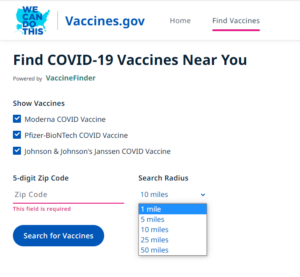
Access to the vaccine should be not a barrier to care, which is why the Center for Disease Control and Prevention (CDC) has created the Vaccine Finder Tool. Vaccines.gov helps you find locations that carry COVID-19 vaccines and their contact information. By entering your zip code into the finder, the website connects you with a number of nearby appoints. Most providers require and appointment and the Vaccine Finder links you directly to the page to sign up.

Vaccines.govCurrently, there are three available vaccines: Pfizer, Moderna, and the Johnson & Johnson vaccine. All three have undergone the FDA’s rigorous standards for safety and effectiveness. Each works by training the immune system to recognize the virus and trains the cells to hold the virus off. As a result, many people experience side effects like soreness of the arm injected, fever, or headache – all of which will go away in a few days. The vaccines have been shown to be highly effective in preventing severe cases of COVID-19 that lead to hospitalization and help to reduce the likelihood of its spread.

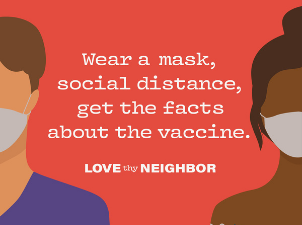
Following the appointment, you get the vaccine, you should still wear a mask and maintain social distancing. At the vaccine appointment you will receive a vaccination card that tells you what COVID-19 vaccine you received and the date you received it as well as a paper or electronic fact that that tells you more about the specific vaccine you are receiving. The COVID-19 vaccine is critical for the safety and health of our communities. As Pope Francis said, “I believe that morally everyone must take the vaccine. It is the moral choice because it is about your life but also the lives of others.”

For more information:

Frequently Asked Questions About COVID-19.

What to Expect After Getting a COVID-19 Vaccine.

After You’re Fully Vaccinated.

NETWORK’s Blog on Talking with Friends and Family About the Vaccine.

Talking with Your Community About the Vaccine

Talking with Your Community About the Vaccine

Caraline Feairheller
May 7, 2021

The COVID-19 vaccines are the safest way to build protection and minimize the severe effects of COVID-19 for you and your community. As the COVID-19 vaccines are new, it is normal for people to have questions. The sheer volume of information, and misinformation, on the vaccines can be overwhelming. According to experts, the best approach to vaccine hesitancy is having trust figures, like family members and peers, address the root cause of the hesitancy. When community members are able to see others in their circle embracing the vaccine and all its benefits, they are more likely to be willing to get the vaccine themselves. It is important we each do our part to limit misinformation by listening to our communities concerns without judgement. As Pope Francis says, “Whenever people listen to one another humbly and openly, their shared values and aspirations become all the more apparent. Diversity is no longer seen as a threat, but as a source of enrichment.”

When talking with friends and families about the COVID-19 vaccines, the U.S. Department of Health and Human Services (HHS) and Center for Disease Control and Prevention (CDC) recommends five key steps:

Listen to their questions with empathy

By listening without judgement, you can identify the root of their concerns. It is important to listen fully and attentively, without interrupting. You can read more on strategies for active listening through the article “Effective Communication: Barrier and Strategies” by the Centre for Teaching Excellence at the University of Waterloo.

Ask open-ended questions to explore their concerns

By asking open-ended questions, you can help to understand what your community is worried about and what sources they are getting their information from. It is important to respectfully ask questions and avoid dismissive language like “That’s a silly concern” or “Why would you be worried about that?”

Ask permission to share information

Once you understand your community’s questions and concerns, ask if you can share information from trusted sources. It is important to not push information on them too quickly and when you do not know the answer consider offering to help look for the information.

Help find their own reason to get vaccinated

Everyone who chooses to get vaccinated does it for a different reason – to protect their community, to visit their family, to return to school. The reasons that someone chooses to get vaccinated will always be those that are most compelling to them personally. It is important to not only focus the conversation on the “why not” of the vaccine but to steer it towards the “why” of the vaccine.

Help make their vaccination happen

Offering to help a community member make a vaccine appointment can help make the path to vaccination easier and less stressful.

The EQUAL Act Helps Us Dismantle and Build Anew

The EQUAL Act Helps Us Dismantle and Build Anew

Joan Neal and Sr. Mara Rutten, RSM
April 13, 2021

The Eliminating a Quantifiably Unjust Application of the Law (EQUAL) Act (H.R.1693/S.79) is bipartisan legislation that seeks to eliminate the disparity in sentencing for cocaine offenses, a major contributor to mass incarceration, and apply retroactively to those already convicted or sentenced.

The EQUAL Act was introduced in the House on March 9, 2021 by Representatives Hakeem Jeffries (D-NY-08), Bobby Scott (D-VA-03), Kelly Armstrong (R-ND-AL) and Don Bacon (R-NE-02). Across the Capitol, Senators Cory Booker (D-NJ) and Dick Durbin (D-IL), both members of the Senate Judiciary Committee, had previously introduced the bill on January 28, 2021.

Before introducing the bill, Senator Booker said, “For over three decades, unjust, baseless and unscientific sentencing disparities between crack and powder cocaine have contributed to the explosion of mass incarceration in the United States and disproportionately impacted poor people, Black and Brown people, and people fighting mental illness… I encourage my colleagues to support the EQUAL Act as a necessary step in repairing our broken criminal justice system.”

While there are many provisions within the justice system that produce discriminatory and racist impacts, the crack/powder sentencing laws are among the most obvious. For many years now, science and experience have shown us there is no difference between use of crack or powder cocaine. Neither one is more or less addictive nor produces more violent behavior in the user. The difference is that crack cocaine has historically been used in more urban communities of color, specifically Black communities, while powder cocaine has more often been found in whiter, more suburban communities. The racial implications couldn’t be clearer.

Furthermore, the sentencing disparity between these two drugs has contributed significantly to the growth of mass incarceration in this country. According to FAMM, in 2019 alone, 81% of those convicted of crack cocaine offenses were Black, even though historically, 66% of crack cocaine users have been white or Hispanic. It is time to end this racist policy and restore proportionality in sentencing.

Events of the past few years have illuminated the systemic inequalities in our country’s criminal legal system. At NETWORK, we cannot continue to tolerate racial profiling, police brutality, the loss of another generation to mass incarceration, or the perpetuation of poverty. As we Build Anew, we affirm the truth that every person is entitled to dignity and equal justice under law. It is time for Congress to act and take a firm stance against institutional racism embedded within the criminal legal system by passing the EQUAL Act (H.R.1693/S.79).

NETWORK Joins Faith Leaders Calling on Congress to Pass H.R.40

NETWORK Joins Faith Leaders Calling on Congress to Pass H.R.40

Jarrett Smith
May 4, 2021

At the end of April, NETWORK Lobby joined a sign-on letter to Congressional Leadership along with 180 faith-based organizations, faith leaders, and advocates to urge Congress to support the passage of H.R.40 – Commission to Study and Develop Reparations Proposals for African Americans Act. H.R.40 is the only bill that will lead to concrete proposals for repairing the damage that the United States government has inflicted on Black people and its passage will allow us to take steps towards dismantling white supremacy and steps towards repair so that we can build anew together.

Catholic Social Teaching is clear: racism is a sin. Our faith teaches us to reject the immoral system of white supremacy and to work for truth-telling and repair. We can no longer deny the sins of the past and its ongoing implications Black people experience every day. NETWORK urges Congress to support and pass H.R.40.

Read the full sign-on letter sent to Congressional Leadership.

Read Jarrett Smith’s blog on passing H.R.40.

Read the statement on H.R.40 from NETWORK’s Executive Director, Mary Novak.

Orange sign that says "It's in the Constitution: Everyone Counts"

Prison-Based Gerrymandering Conflicts with Our Principles and Undermines Democracy

Guest Blog: Prison-Based Gerrymandering Conflicts with Our Principles and Undermines Democracy

Libbey Detcher
April 30, 2021

In the wake of the 2020 Census, gerrymandering – the strategic and partisan redrawing of electoral district lines – is again a concern. Gerrymandering has disastrous effects: it undermines the will of the people drastically alters the United States political landscape. In 2018, the Center for American Progress published a report on gerrymandering and found that the process of unfair redistricting impacted 59 seats in the United States House of Representatives between 2012 and 2016. Today, gerrymandering by politicians and statisticians is generally recognized as a problem that affects voters across the United States, but less familiar is the disenfranchisement produced by prison-based gerrymandering.

Gerrymandering in any form is contrary to the moral responsibility we have to make sure every person is fairly represented and has equal access to participate in political institutions. Prison-based gerrymandering particularly creates a political system that fails to recognize and honor the human dignity of people who are incarcerated.

Prison gerrymandering distorts democracy in a different light than simply redrawing district lines. Since the first federal census in 1790, the United States Census Bureau has counted incarcerated persons as part of the population in districts where they’re incarcerated rather than the district of their permanent address. This artificially inflates representation of rural districts where prisons are located. Simultaneously, it dilutes the political power of districts with higher percentages of incarcerated residents. A law student intern at Yale Law School’s Peter Gruber Rule of Law clinic, Nicole Billington, researched how this little known practice “diminishes the voting power of people in urban districts.”

With people of color disproportionately facing incarceration, prison gerrymandering disproportionately diminishes the political power of communities of color. The vast majority of penitentiaries are located in rural or suburban predominantly white communities, however, most elected officials are unlikely to take their incarcerated residents into account as constituents who they represent and serve. In fact, people who are incarcerated do not have access to public goods or services located outside of the prison such as public transportation or schools.

The Sentencing Project estimates that 5.2 million people in the United States face disenfranchisement because of laws that ban voting for people with felony charges. This is 2.27% of the eligible voting population in the United States. While 1 in 59 non-Black voters face disenfranchisement from these bans, The Project reports that 1 in every 16 African-American voters lose the right to vote as a result.

These policies are a familiar echo of the so-called Three-Fifths Compromise. The policy counted enslaved persons as only three-fifths of a person for a state’s population count while simultaneously denying any person of color the right to vote. This shameful, inhumane policy was in place until the adoption of the Fourteenth Amendment in 1868.

In 2019, the first prison gerrymandering case NAACP et al. v. Merrill was argued before a federal court. Families of incarcerated persons, alongside the NAACP, filed a lawsuit claiming that Connecticut’s prison gerrymandering practices violate the Fourteenth Amendment. The U.S. Circuit Court of Appeals approved the lawsuit.

Nine states have successfully passed legislation to end prison gerrymandering: Maryland, New York, California, Colorado, Delaware, Nevada, New Jersey, Virginia, and Washington State. Additionally, Illinois passed similar legislation set to go into effect by 2030.

Prison-based gerrymandering not only undermines democratic principles but  runs counter to Catholic social teaching. The Catholic faith emphasizes the importance of civic engagement through the political process. Pope Francis tells us, “A good Catholic meddles in politics.” Catholics cannot turn a blind eye to the disenfranchisement of an incarcerated population or the systemic racism baked in to prison-based gerrymandering.

The Prison Gerrymandering Project, The Sentencing Project, Prison Policy Initiative, and the NAACP Legal Defense Fund are a few advocacy organizations working to end prison-based gerrymandering in the U. S. through litigation, state legislation,  the U. S. Census Bureau, and community activism across the country. Congress can put an end to this practice in all states and jurisdictions in one fell swoop by passing the For the People Act (H.R.1/S.1)

Libbey Detcher (She/Her) is a student at Saint Mary’s College in Notre Dame, Indiana. She is majoring in Political Science with minors in Intercultural Studies and Justice Studies.

Pregnant Workers Fairness Act Introduced in the Senate

Pregnant Workers Fairness Act Introduced in the Senate

Audrey Carroll
April 29, 2021

Today, Senators Bob Casey (D-PA), Bill Cassidy (R-LA), Jeanne Shaheen (D-NH), Shelley Moore Capito (R-WV), Tina Smith (D-MN), and Lisa Murkowski (R-AK) introduced the bipartisan, bicameral Pregnant Workers Fairness Act (PWFA). The PWFA has been introduced in the House of Representatives and passed in the House Education and Labor committee in a 30-17 vote on March 24, 2021. NETWORK celebrates introduction of the PWFA in the Senate to advance long overdue family-friendly workplace protections.

In a statement from the Pregnant Workers Fairness Coalition, NETWORK Executive Director Mary J. Novak said, “NETWORK Lobby for Catholic Social Justice celebrates the reintroduction of the Pregnant Workers Fairness Act (PWFA) in the Senate. This common sense, bipartisan legislation is faithful to the principles of Catholic Social Teaching — and the dignity of the human person in particular — by caring for the health and economic security of pregnant people and their families. Forcing workers to choose between a safe pregnancy and a paycheck is immoral and the PWFA ends this injustice. NETWORK Lobby calls on Congress to swiftly pass the PWFA into law and support gainfully employed people bringing new life into the world.”

Read the full statement from the Pregnant Workers Fairness Coalition here.

Read NETWORK’s Letter of Support for the Pregnant Workers Fairness Act here.


Taxes and President Biden’s American Families Plan

Taxes and President Biden’s American Families Plan

Colleen Ross
April 28, 2021

The American Families Plan, the second part of President Biden’s transformational plan for U.S. jobs and families, makes investments into our nation’s children, our education system, and our health care.

While some members of Congress have already begun a strong campaign against the plan’s changes to the individual side of the tax code, it is long past time to modernize the tax code and make it more just.

Here’s a look at the transformational investments in the American Families Plan:

  • Extend the Child Tax Credit increases in the American Rescue Plan through 2025 and make the Child Tax Credit permanently fully refundable.
  • Make the Earned Income Tax Credit Expansion for childless workers permanent.
  • Extend expanded ACA premiums tax credits in the American Rescue Plan.
  • Permanently increase tax credits to support families with child care needs.
  • Expand summer EBT to all eligible children nationwide.
  • Create a national comprehensive paid family and medical leave program
  • Offer two years of free community college to all Americans, including Dreamers.

Read the White House summary of the American Families Plan here.

The American Families plan reverses the biggest giveaways that were passed in the 2017 tax law and reforms the tax code so that all contribute to our shared prosperity in a just tax system, including the wealthiest.  These reforms are urgently needed at a time when economic inequality and the continued persistence of the racial wealth and income gap are harming our country. We cannot be a healthy country while systemic racism and economic inequality continue harming individuals and families in our nation.

For this reason, we support the tax reforms included in the American Families Plan which specifically address the ways that the tax code widens racial disparities in income and wealth. These reforms include:

Increasing the top tax rate to 39.6%

One of the 2017 tax cut’s clearest giveaways to the wealthy was cutting the top income tax rate from 39.6 percent to 37 percent, exclusively benefitting the wealthiest households—those in the top one percent. This rate cut alone gives a couple with $2 million in taxable an annual tax cut of more than $36,400. The President’s plan restores the top tax bracket to what it was before the 2017 law, returning the rate to 39.6 percent, applying only to those within the top one percent.

Enforcing compliance with the tax code

The American Families Plan would invest $80 billion to strengthen IRS enforcement, which has been decimated over the last decade and improve reporting on the income for high-earners. According to ProPublica, millionaires get audited at close to the same rate as workers with less than $20,000 of annual income. The Treasury estimates these enforcement improvements could raise $700 billion over 10 years.

Changing how capital gains are taxed

The biggest source of income for the wealthiest people in the U.S. is the profit they make from the gain on stock or other assets; this is known as capital gains. (This creates the much-talked about reality where Warren Buffet pays a lower tax rate than his secretary.)

The American Families Plan would partially fund the programs it proposes to invest in children and families by taxing income from capital gains like the taxes workers pay on their wages. It does this by closing two major loopholes that create the current system where wealth has a lower tax rate than what many middle-class workers pay on their wages.

Our partners at Americans for Tax Fairness explain how the plan closes these two loopholes:

  • For people making more than $1 million a year, or the richest 0.3% of taxpayers, Biden wants to eliminate the nearly half-off tax discount they currently get when they sell assets at a profit. Instead of paying today’s top tax rate of 20% on the profits from the sale of assets like corporate stock, the rich would pay the same nearly 40% they already pay on their big salaries and other income. The current capital-gains discount is what allows a billionaire to pay a lower tax rate than a teacher or truck driver.
  • Biden also wants to tax the wealthy on the accumulated gains of assets they inherit—gains that now go completely untaxed. The plan would only apply to gains over $1 million per individual, $2 million per couple ($2.5 million per couple when combined with existing real estate exemptions). This reform will narrow the wealth gap, limit the creation of economic dynasties, and raise revenue for services vital to all of us who do not inherit a fortune.
  • Together, these two reforms would raise around $300 billion over 10 years exclusively from rich people. This will narrow the wealth gap and limit the creation of economic dynasties. It will also fund investments in healthcare, childcare, education and tax credits for working families that raise millions of children out of poverty. (The Tax Policy Center estimated a similar plan proposed by the Biden presidential campaign would raise $327 billion.)