

Category Archives: Front Page

Faces of Our Spirit-Filled Network: John Noble

Faces of Our Spirit-Filled Network: John Noble

John Noble
May 3, 2019

Tell us a little about yourself and the work you do.

I’m a Roman Catholic activist and student pursuing a Master of Divinity degree at Brite Divinity School, a Disciples of Christ seminary in Fort Worth, Texas. When I’m not in class, I work part-time as a tutor. I’m also an intern with Pastors for Texas Children, a ministry to Texas schools that advocates for fair and equitable public school funding. I’m passionate about ecumenical cooperation, solidarity, and building a mass movement for transformative social change.

How did you first learn about NETWORK and what inspired you to get involved?

I first encountered NETWORK at a Call to Action conference, where I met Ashley Wilson (NETWORK’s communications manager). I was struck by NETWORK’s commitment to transformative change, and I’ve been hooked ever since. In college, I worked for Iowa Citizens for Community Improvement, who co-sponsored the Des Moines stop of the 2014 Nuns on the Bus tour. I’m also close friends with Sister Jeanie and Sister Elaine Hagedorn, who have been “Nuns on the Bus.” As someone who’s been “NETWORK-adjacent” for a long time, it’s exciting to get involved at a deeper level!

What issue area are you most passionate about?

I’m very passionate about Church renewal and reform efforts. I’m currently a part of the Re/Generation young leaders project with Call to Action, and I work closely with several church reform initiatives like CTA, Equally Blessed, and the Women’s Ordination Conference.

How are you engaging your community on important social justice issues?

As an intern with Pastors for Texas Children, I work to mobilize local faith leaders in support of Texas’ public school system. This involves both direct service ministries and policy change at the statehouse level. I’m also blessed to be at a divinity school that prioritizes justice in their mission. Through Brite, I’ve been involved with several initiatives for gender/sexual justice and immigration rights.

How has your advocacy for social justice shaped your view of the world?

One of my favorite quotes is from Episcopalian activist William Stringfellow, who says that “vocation is simply being a human being.” Social justice advocacy has allowed me to affirm my own human dignity, and to affirm the human dignity of my neighbors.

How does your faith inspire you to work for justice?

Catholic social teaching and liberation theology, particularly thinkers like James Cone and M. Shawn Copeland, have been long-standing inspirations in my faith journey. Through involvement with movements like the Catholic Worker, I’ve learned that the recognition of humanity, through building a sacred and justice-oriented relationship with myself, my God, and my neighbor is what underpins the deepest expressions of my faith.

Who is your role model?

I’ll cheat and name 2: Jennifer Harvey, my undergraduate advisor, and Fr. Terry Moran, a peace and justice activist who encouraged me to apply for the NETWORK board.

Is there a quote that motivates or nourishes you that you would like to share?

“There’s really no such thing as the ‘voiceless’. There are only the deliberately silenced, or the preferably unheard.” ― Arundhati Roy

What social movement has inspired you?

I’m so inspired by the Sunrise Movement, a movement of young people working to end the climate crisis, and the King’s Bay Plowshares 7, a group of anti-nuclear protestors facing jail time for their bold stand against militarism and white supremacy. On a personal note, I had the opportunity recently to join a rally at the Texas Statehouse organized by Texas teachers’ unions, and that was extremely inspiring.

What was your biggest accomplishment as an activist in the past year?

I recently launched a podcast, the People’s Parish, that focuses on the intersections of Catholicism and progressive politics.

What are you looking forward to working on in the coming months?

I’m really excited about my first NETWORK board meeting, for more episodes of the People’s Parish to drop, and to finish my M.Div. program!

NETWORK Strongly Supports the Equality Act

NETWORK Strongly Supports the Equality Act

Siena Ruggeri
April 26, 2019

NETWORK Lobby for Catholic Social Justice urges a yes vote on H.R. 5, the Equality Act. NETWORK is open to all who share our passion. We are proud to raise our voices for our LGBTQ+ friends and colleagues to ensure they live free from discrimination. We know that all people have inherent dignity. No one should tolerate hate or discrimination towards any member of our human family. In our efforts to mend the gaps in our society, we will leave no one behind.

Guided by our Catholic Social Justice values and founded by women religious, we welcome and affirm all LGBTQ+ members of our human community. In the spirit of our founders, our work is guided by relationship and encounter. We have seen the pain, alienation, and violence that our society has inflicted upon members of the LGBTQ+ community. We call upon Congress to end these grave injustices.

We cannot mend the gaps of our society without changing how our nation has permitted discrimination on the basis of sexual orientation and gender identity. Those who identify as part of the LGBTQ+ community live in fear of being denied a place to live, losing their job, barred from bathrooms, and refused medical care because of who they are and who they love. We must act for the common good and heal our nation. We must end the unique oppression LGBTQ+ people encounter in their daily lives.

Passing the Equality Act would offer legal protections in every aspect of the lives of members of the LGBTQ+ community. It builds upon existing federal civil rights laws to explicitly prohibit discrimination on the basis of sexual orientation and gender identity in education, employment, housing, credit, federal jury service, public accommodations, and the use of federal funds. While many aspects of LGBTQ+ equality have been affirmed by the courts, it is important to enshrine LGBTQ+ civil rights protections into law to provide certainty for all people.

As people of faith, we are disturbed by how our beliefs have been used to deny the sacredness and dignity of members of our community. Our scripture tells us that we should walk towards everyone—no exceptions. We are called to radical acceptance and see God in all people. Guided by this prophetic vision of justice, we urge Congress to vote yes on H.R. 5 and pass the Equality Act.

Funding the First Step Act: Critical Programs for Criminal Justice Reform

Funding for the First Step Act: We Need Programs for Criminal Justice Reform

José Arnulfo Cabrera
April 26, 2019

The First Step Act was a bipartisan bill that took the first step forward to getting criminal justice reform, and in December 2018 it became law! All of these returning citizens would not have been incarcerated if the Fair Sentencing Act had been passed before 2010. The act stopped punishment disparities between both possessing and selling crack cocaine and powdered. But the First Step Act does more than that. It reduces the amount of mandatory minimum by creating a new system called a safety valve, which reviews individual nonviolent drug offense cases with no prior criminal background. The bill will also authorize funding for programs that will help returning citizens break the chains of our injustice criminal justice system. In the next four years, Congress has the authority to appropriate $75 million dollars to rehabilitative for individuals who will be released because of the First Step Act.

Every February the President sends his budget request to Congress as they begin their regular appropriations process. The passing of First Step Act was possible because of many Republicans and Trump, who supported it. But when we saw that Trump only requested $14 million in this year’s budget request, we became worried that the Trump Administration wasn’t committed to implementing the full $74 million the First Step Act authorized. At NETWORK, we believe that the budget is a moral document that shows what our government’s priorities are. If the budget does not allocate the full $74 million authorized to carry out the First Step Act, then it is clear that criminal justice reform is not one of these priorities.

Officials in the Trump administration shared that they plan to increase their funding request in the next budget year to $147 million, so it can offset the money that fell short last year. The Department of Justice (DOJ) also stated that more funding will need to be appropriated in order to be able to begin implement the policies in the First Step Act. At a White House celebration of the passing the First Step Act, Trump stated that his administration has the full intention of fully funding the First Step Act. While the funding is very important, there are programs that must begin to in order for the policies to take place. On April 8, the DOJ announced the first programs that the First Step Act seeks to create. The DOJ‘s National Institute of Justice (NIJ) share they choose Hudson Institute to host the Independent Review Committee. This program will assist the DOJ in developing and implementing risk and needs assessment tools and evidence-based recidivism reduction that will help incarcerated individuals become return citizens. This is a good start and does give us hope the First Step Act policies will be implemented.

NETWORK has been on the Hill talking with the staffers of Congress members, along with our partners, to ensure that $75 million will be appropriated to fully fund the First Step Act policies. For all of the correct programs to be implemented, the bill will need to allot enough money for the government to fund them.

“How to Lobby:” Training the Stone Ridge Sophomore Class

“How to Lobby:” Training the Stone Ridge Sophomore Class

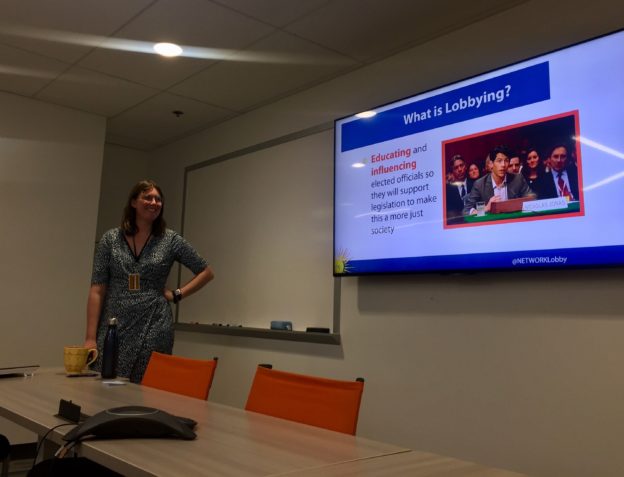
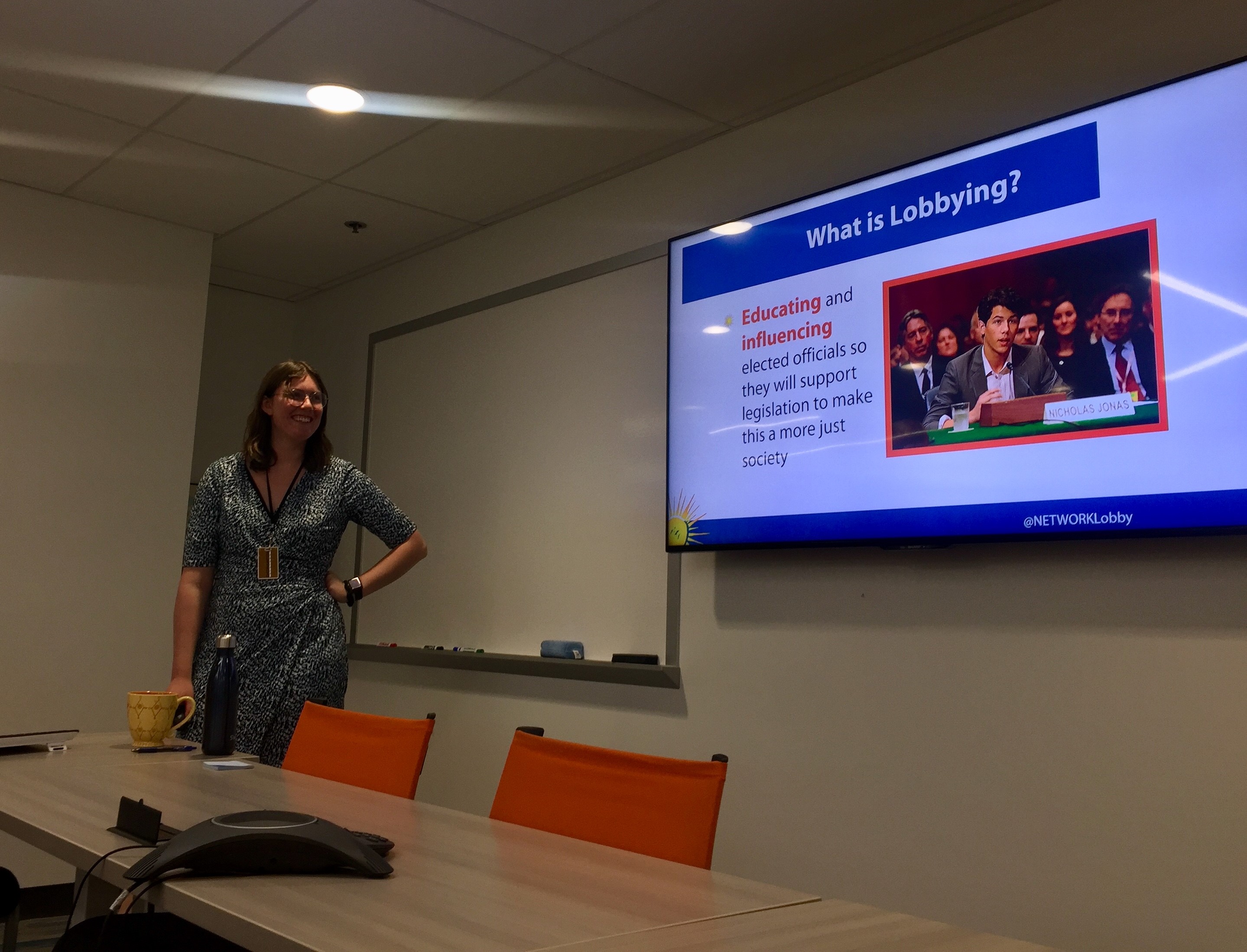
Last week, the Grassroots Mobilization team welcomed the last of the Stone Ridge School of the Sacred Heart sophomore class to our office for a “How to Lobby” Presentation before taking them up to Capitol Hill to visit their federal legislators.  Beginning in October, we (Erin Sutherland and Alannah Boyle, Grassroots Mobilization Associates) have had the opportunity to train and accompany the entire sophomore class at Stone Ridge on dozens of lobby visits.

In each visit, we taught the sophomores about the importance of Family Friendly Workplace policies, including paid family medical and sick leave. Right now, there are two great bills going through both the House and Senate: The Healthy Families Act (H.R. 1784/S. 840) which guarantees workers the right to earn sick days to care for themselves or a family member, and the FAMILY Act (H.R. 1185/S. 463), which provides workers the opportunity to access paid sick leave.  Through Stone Ridge’s Social Action program, a group of approximately ten sophomores visited the NETWORK office every other week for the past seven months. It is only at the end of this program that we see the magnitude of our reach.

Alannah Boyle, Grassroots Mobilization Associate, presenting to Stone Ridge students.

Erin:

“I had not gone on a lobby visit until I started working at NETWORK. For me, when I had heard of lobbying in the past, the word connoted meeting of special interests, of wealthy people in suits, speaking more eloquently on issues than I could.  However, after going to my first lobby visit in coalition (and with coaching from Sr. Quincy Howard, Government Relations Advocate at NETWORK) this past fall, I realized that the only thing needed for a successful lobby visit and sincere conviction in an issue I cared about. Alannah and I tried to pass on these two important skills to our students by staging mock lobby visits with lots of contingencies (what if we need to meet in the hallway, as is common?  Or if the staffer we meet with tries to change the topic of our visit?) to help make the girls prepared and confident for whatever could come their way.  We also talked with the students about how, as women, the right to paid family and medical leave has or will affect us personally at some point in our lives, between becoming a parent, to needing to take care or a relative, or taking time off in the wake of personal trauma.

“Every few weeks, I was humbled to accompany such eloquent and diligent young women to advocate for such important policies. It made me hopeful to see the next generation already engaged in federal advocacy – years before I was!  It also reinforced my belief that lobbying can and should be accessible to all as a way to engage with our legislators on issues that matter to us.”

Alannah:

“Unlike Erin, I had been on a few lobby visits prior to beginning my work here at NETWORK. The first time I went on a lobby visit was as a college student after attending the Ignatian Family Teach-In when I myself was first trained by a NETWORK staff member on how to lobby, almost five years ago. I vividly remember how excited and equipped I felt after completing my first training and attending my first lobby visit. Realizing now that Erin and I have trained almost 100 high school students, and equipped them with these same skills, has been incredibly rewarding. We all have the ability to lobby and advocate our elected officials on issues that matter to us. As constituents, our Members of Congress work for us. NETWORK’s “How to Lobby” training helps to answer the questions that can make lobbying seem scary.”

Advocating for Congress to Pass H.R. 6: The Dream and Promise Act of 2019

Advocating for Congress to Pass H.R. 6: The Dream and Promise Act of 2019

Laura Peralta-Schulte
April 17, 2019

The Dream and Promise Act of 2019, H.R. 6, was recently introduced in the House of Representatives. This legislation establishes a roadmap to U.S. citizenship for (1) immigrant youth and (2) current or potential holders of (a) temporary protected status (TPS) or (b) deferred enforced departure (DED). The bill provides conditional permanent resident (CPR) status and a roadmap to lawful permanent resident (LPR) status and, eventually, U.S. citizenship for immigrant youth who entered the U.S. before age 18, have four or more years of residency, and graduated from high school (or the equivalent). In addition, it provides an opportunity for people who currently have or who may be eligible for TPS or DED who have three or more years of residency to apply for LPR status and, eventually, U.S. citizenship. This common sense legislation mends the gap in access to citizenship and allows our immigrant sisters and brothers to receive legal protections that will allow them to continue to thrive.

Dreamers, TPS, and DED holders have lived in the United States for years. They are an integral part of our society. For example, in 1990, Salvadorans were given TPS and many have lived in the United States since then.  Individuals from other countries were also given similar protection in response to emergency conditions in countries impacted by war, famine or natural disaster.  Likewise, Dreamers have lived the majority of their lives in the U.S. and some have been protected by DACA since 2012. DACA, TPS, and DED programs have allowed these immigrants to work in the U.S. and shielded from deportation.  In return, they have contributed billions to our economy, started American families, and integrated into American culture.

How does H.R. 6 help immigrant youth?

  1. Longer CPR status. Extends the length of CPR status from eight to ten years to give applicants more time to fulfill requirements.
  2. Expands stays of removal. Stays the removal of minors who are not yet eligible for relief but may become eligible in the future and who temporarily unenroll from school.
  3. Better hardship standard. Permits people with CPR to obtain LPR status without satisfying the employment, military, or educational tracks if their deportation would cause “hardship” to themselves or immediate family members (instead of “extreme hardship”).
  4. Apprenticeship eligibility. Includes apprenticeship programs as a qualifying education to obtain CPR status.
  5. No medical examination. Eliminates the costly medical examination for applicants.
  6. Caps fee. Establishes a fee ceiling of $495 for immigrant youth applying for CPR status.
  7. Professional licenses. Clarifies that people with CPR can access professional, commercial, and business licenses.
  8. Career and technical education. Permits people with CPR who obtain a certificate or credential from an area career and technical education school to obtain LPR status.
  9. Criminal and inadmissibility bars. Updates the criminal background bars and inadmissibility requirements.1

Additionally, H.R. 6 has the following provisions that are similar to the Dream Act of 2017:

  1. LPR status. Provides LPR status to CPR holders who: (1) serve in the uniformed services for two years, (2) complete two years at or obtain a degree from an institution of higher education, or (3) work 75 percent of the time in CPR status (with flexible evidentiary burdens such as affidavits).
  2. Removes barriers to in-state tuition. Makes it easier for states to provide in-state tuition to immigrant students.
  3. Federal financial aid. Establishes that CPR-holders are eligible for federal loans, work study, services, but not grants.

How does H.R. 6 help people with TPS or DED?

  1. LPR status. Provides LPR status for people with TPS or DED (and those who were eligible but did not apply) who apply within three years from the date of enactment if they (1) had at least three years of continuous residence (as well as residence since the date required the last time that the person’s nation of origin was designated) and (2) were eligible for or had (a) TPS on Sept. 25, 2016, or (b) DED on Sept. 28, 2016. This includes nationals of 13 countries: El Salvador, Guinea, Haiti, Honduras, Liberia, Nepal, Nicaragua, Sierra Leone, Somalia, South Sudan, Sudan, Syria, and Yemen.
  2. Inspection and admission. Classifies people with TPS or DED as inspected and admitted for the purposes of Immigration & Nationality Act (INA) section 245(a), making it easier to obtain LPR status through existing channels (e.g., a family-based petition).
  3. Stay of removal. Stays the removal (deportation) of individuals while an application is pending.
  4. Caps fee. Establishes a fee ceiling of $1,140 for people with TPS or DED applying for LPR status.
  5. Transparency for TPS. Requires the secretary of the U.S. Dept. of Homeland Security (DHS) to provide an explanation for and report within three days of publishing notice to terminate TPS designation for certain nationals.

How does H.R. 6 help both immigrant youth and people with TPS or DED?

  1. Deported immigrants eligible. Enables certain immigrant youth deported under the Trump administration and people who had TPS or DED who were deported as of September 2016 to apply for relief from abroad.
  2. Protections for detained and non-detained. Allows immigrants in deportation proceedings, including those in detention, to apply for relief under the INA and protects eligible applicants from deportation.
  3. Administrative review. Provides robust administrative and judicial review of denials.
  4. Grant program. Establishes a grant program for nonprofit organizations to assist applicants.
  5. Fee exemption. Provides a narrow fee exemption for applicants who meet certain requirements.
  6. Advance parole and employment authorization. Allows individuals with a pending application to apply for advance parole and employment authorization (a work permit).
  7. Adjustment through existing channels. Clarifies that individuals may apply for LPR status through existing legal pathways, such as through family- or employment-based sponsorship.
  8. Confidentiality provisions. Protects the information submitted by applicants (and all DACA requests) from disclosure.

NETWORK is working to get every Democratic member in the House to co-sponsor the bill and to find Republican co-sponsors as well.

Now is the time for all of us to ask our Members of Congress to support H.R. 6.

Family-Friendly Workplaces Are Crucial for Our Nation

Family-Friendly Workplaces Are Crucial for Our Nation

Tralonne Shorter
March 17, 2019

On March 14, NETWORK Senior Government Relations Advocate Tralonne Shorter spoke at a press conference with Rep. Rosa DeLauro, Senator Patty Murray, Rep. Lauren Underwood, and Rep. Alma Adams about the introduction of the Healthy Families Act. View photos of the press conference on NETWORK’s Flickr account.

At NETWORK we are working every day for the dignity of the common good: urging elected officials, including the President, to join us on our mission to put people over profits. We not only advocate for social justice on Capitol Hill, but we also are a leading example of family-friendly workplace policies that reflect the current and future nature of families and women in the workforce.

Inspired by Catholic Social Justice, we believe that workplace and labor policies must respect the dignity of every human being, and recognize the needs of every human being to be in community with one another. In our advocacy for family-friendly workplace policies, we have focused on guaranteeing that all workers have access to paid family leave and sick leave, ending the gender and racial wage gap, and encouraging flexible scheduling to give employees and employers more tools and resources to create mutually beneficial schedules.

Current bills coming up in Congress include issues that support national paid family and medical leave insurance programs (Family and Medical Insurance Leave [FAMILY] Act), as well as setting a consistent standard for earning sick days (Healthy Families Act). It is our hope that the successful passage of these bills will enable more workers to access necessary time off that would allow them to care for themselves and their families.

The patchwork of existing workplace policies is not a sufficient safety net for workers and their loved ones. Just 17% of workers in the U.S. have access to paid family leave, and only 40% of workers can take paid personal medical leave.[1] The private sector is making strides in offering family-friendly workplaces, but those protections are not enough on their own and often leave out the lowest-paid workers. The United States is the only industrialized nation that does not provide universal paid leave benefits, making time off inaccessible to lower-wage workers. While 92% of the highest wage earners has access to paid sick leave, only 31% of the lowest earning workers can take paid sick time.[2]

The Healthy Families Act and the FAMILY Act would serve as two major solutions to promoting family-friendly workplaces, and upholding workers’ inherent dignity in allowing paid leave. As people of faith, we value an economy that puts people, not profit, at the center. We know that when the people at the economic margins of our society do better, we all do better.

The Healthy Families Act would set a consistent standard for accruing sick days: workers would earn a minimum of one hour of paid sick time for every 30 hours worked, up to 56 hours (seven days) per year. Additionally, the act would enable workers in businesses with fifteen or more employees to earn up to seven job-protected, paid sick days each year. These sick days would allow people to recover from illnesses, access preventive care, provide care to a sick family member, or attend school meetings related to a child’s health condition or disability.

The FAMILY Act would provide workers with up to partial income to take time for their own serious health conditions, pregnancy and childbirth recovery, care of a family member, birth or adoption, or military caregiving needs. The act covers all workers—part-time, lower-wage, and self-employed workers are all eligible. All companies are covered, no matter their size; the paid leave would be funded by small employer and employee contributions that amount to 2 cents for every $10 in wages.

The Healthy Families and FAMILY Acts not only contain provisions that would allow workers to earn paid sick days and family leave to care for themselves or an immediate family member, they also include important protections for victims of domestic violence, stalking, or sexual assault. No one should have to worry about losing their job while recovering from the trauma of intimate partner violence or harassment. These laws ensure every worker has access to the time they need to care for themselves and their loved ones.

We know paid sick days work because we’ve seen them implemented in 10 states and 20 cities around the country. Providing family-friendly workplace protections is necessary to build an economy that puts people, not profit at the center. Catholic Social Justice teaches that workplace and labor policies must respect the dignity of every human being, and recognize the needs of every human being to be in community with one another. The right to work must operate in concert with human needs of community – and our government should institute laws to ensure family-friendly workplaces.

Now is the time for Congress to pass the FAMILY Act and the Healthy Families Act, so that every employer can provide a pro-family friendly workplace that reflects the current and future nature of families and women in the workforce.


[1] http://www.nationalpartnership.org/our-work/workplace/paid-leave.html

[2] https://www.bls.gov/news.release/pdf/ebs2.pdf

Health Equity: Examining How Systemic Racism Has Sickened Our Communities

Health Equity: Examining How Systemic Racism Has Sickened Our Communities

Siena Ruggeri
April 16, 2019

As the NETWORK community undergoes our Lenten journey through racial justice, we are committed to identifying how racism manifests itself through federal policy. While many are familiar with how racial injustices are perpetuated by our criminal justice system and immigration system, the racism embedded in our healthcare system may not be as evident. Our identity, and especially our racial identity, plays a huge factor in our physical and mental health.

While we must continue to fight for accessible and affordable healthcare for all, that alone will not address the deep racial inequalities in health outcomes. When examining health systems, we must examine how our social location affects our ability to be healthy. Health care cannot be ignorant to identity, because our identity and social location affect both our access to healthcare and our ability to have healthy outcomes.

The healthcare system tends to view people in a vacuum, and often fails to consider how culture, environment, or socioeconomic status affects health. For example, someone reliant on public housing assistance may struggle to get enough exercise when they live in an area that lacks recreational facilities like parks or rec centers. A person with a physical disability might lack the accessible transportation options to get to an appointment with a provider. Type 2 diabetes is difficult to manage living in a food desert with limited access to healthy food options. Many LGBT+ people struggle to find providers accepting of their sexual orientation and may forgo care if there are no safe options in their community. For a non-English speaking patient, a language barrier at the pharmacy can result in inaccurate information on how to safely use a prescription.

The data is clear– marginalized populations have worse health outcomes. While the exact causes of these outcomes is not completely definitive, it’s clear that these disparities are  a result of structural barriers. Black women are four times more likely to die as a result of childbirth than white women. Despite a lower incidence rate of cancer overall, African-American women have a higher cancer death rate when compared to white women. While the opioid crisis is too-often framed as a “white problem,” U.S. opioid death rates for African-Americans have increased over twice as fast as death rates for white individuals.

Like many other inequalities, society often individualizes the problem, blaming specific patients for their failure to “take care of themselves.” We have to break out of this culture of individualism. There are systemic inequalities at play. In fact, there’s a term for it— social determinants of health. The quality and accessibility of health care is only one determinant of health outcomes– other social determinants of health play a massive role. Things like the walkability of our neighborhoods, our access to early childhood education, and how much debt we carry have direct impacts on our overall health. Of course, people of color are disproportionately more likely to have poor social determinants of health. We have a shared responsibility to ensure everyone has the opportunity to be healthy– which means examining our solutions to our broken healthcare system through an equity lens.

We cannot improve health outcomes just by looking narrowly at medical systems. We also cannot continue to approach health in a race-neutral way. The opportunity to be healthy will only be fair and just when we interrogate how systemic inequalities have literally sickened communities of color, and when we redesign those systems to be equitable to all.

Infographic courtesy of Families USA: https://familiesusa.org/product/racial-and-ethnic-health-inequities-among-communities-color-compared-non-hispanic-whites

Barmen Today: An Act of Divine Obedience

Barmen Today: An Act of Divine Obedience

Leslye Colvin
April 8, 2019

Responding to the signs of the times, people of goodwill have historically raised their voices on behalf of the common good. How the voice is raised – whether literally or figuratively, individually or collectively – is determined by a number of variables including the challenge and the desired outcome. Examples of these efforts include Mahatma Gandhi’s Salt March, Rev. Martin Luther King, Jr.’s Letter from Birmingham Jail, Marian Wright Edelman’s Children’s Defense Fund, and Bryan Stevenson’s Equal Justice Initiative. NETWORK, founded by women religious to lobby for social justice at the federal level, is a living model of speaking for the common good. In each instance, the action is inspired by the transcendent truth of human dignity and is viewed as an act of conscience, faith, or divine obedience. Depending on the circumstances, speaking truth may be accompanied by the grave risk of physical harm or death. In spite of the risk, people of goodwill are duty-bound to speak.

Many Americans have observed the recent rise in blatantly hateful physical and verbal attacks against people of color, immigrants, religious minorities, and members of the LGBTQ community. Knowing that racist and xenophobic rhetoric are attributable to America’s historic and continuing original sin, having it affirmed by those sworn to protect the Constitution of the United States is a direct threat to the common good. Seven students from the Living School of the Center for Action and Contemplation were drawn together by their shared concerns. Entering a discernment period, they agreed with the prophetic words of Rev. Dietrich Bonhoeffer: “Silence in the face of evil is itself evil. Not to speak is to speak. Not to act is to act.”

In 1934 Germany, Bonhoeffer, theologian Karl Barth, and other Christians were greatly disturbed by the rise of Nazism, and the large number of churches who remained silent in light of the contrast between Christ’s teachings and Adolf Hitler’s agenda. These church leaders responded by raising a unitive in the Theological Declaration of Barmen that has since been embraced by a number of Christian traditions. Inspired by this historical document, the Living School students wrote and released Barmen Today: A Contemplative Contemporary Declaration with the full-support of their teachers: Rev. Richard Rohr, Rev. Cynthia Bourgeault, and Dr. James Finley.

Known as the Barmen Today circle, the small collaborative group echoes Bonhoeffer by stating, “[B]ecause we want to remain faithful to both the Divine which we seek to understand and the Love which we seek to live, we choose to not be silent. We choose to speak and act.” Issued as an invitation to engage in both contemplative practice and nonviolent resistance, the text of the document speaks to common ideals and today’s challenges. Available in English and Spanish, Barmen Today has received more than 11,000 signatories since its release in August 2018.

One of the signatories is songwriter and recording artist Alana Levondoski who was so touched by Barmen Today that she volunteered her talents to write and record “Divine Obedience,” the document’s theme song. According to Levondoski’s lyrics, “There comes a time for Divine Obedience.” Thousands of others join her and the circle in declaring this to be the time for Barmen Today. Will you?

To read, sign, and share, Barmen Today, visit bit.ly/barmentoday. For information on the Living School, see www.cac.org/living-school/. To learn about Alana Levandoski and her work, visit alanalevandoski.com.

Lenten Reflections from a Frustrated Millennial Catholic

Lenten Reflections from a Frustrated Millennial Catholic

Lindsay Hueston
April 4, 2019

I’ve been angry at the Catholic Church for a while.

I couldn’t tell you the last time I went to Mass and left completely and utterly fulfilled — especially in light of the church’s many, many structural failures which have surfaced over the past few decades. I work at a Catholic organization, and still technically consider myself Catholic. I desire a church that works for justice, but am not seeing it. How can these things coexist?

As a result, I’ve stepped back from the church for several months, needing some space and time away. In removing myself from the institution, I have found myself to be walking through a sort of spiritual desert. The institutional Catholic Church as we know it is based on strict hierarchy; my anger stems from the fact that we, as church, cannot seem to step out of that structure in order to move forward. Why are we too often a church that continues perpetuating injustice, instead of overturning oppression?

I see a parallel between my reluctant Catholicism and the way that many in our country disagree with President Trump, but still call themselves American. As angry as I am, I can’t quite sever my ties to Catholicism. I’ve discovered that there is something valuable, even holy, in righteous anger. It spurs change, and enables people to work for justice. It is taxing, though, being angry at a patriarchal system that is terribly slow to change. In the same way, outrage and disagreement with President Trump and his policies are spurring new political engagement in our country.

The church I desire is one of justice and inclusion. The church I wish for is one that promotes anti-racism, supports the LGBTQ community, and removes all oppressions, even as human error often gets in the way. But this does not seem to be how the present Catholic Church works, and it angers me. When thinking about the distance between the church as it is and the church I desire, and my place in the church, the Jesus who flipped over tables in outrage comes to mind. It’s a comforting image: at some point, he was frustrated with his church, too.

I find it ironic that I am having these realizations at the same time as Lent, an intentional time of spiritual reflection and renewal. As the foundation of Lent, Jesus took time alone, went out to the desert, and reflected in a space of relative isolation. That idea resonates with me, and feels familiar — spending time away in order to come back restored.  In this Lenten season of reflection and prayer, I am drawn towards reexamining my faith — present on the fringes of the church as it may be.

What I’ve learned about the desert recently is that it isn’t a barren wasteland, as many portray it to be. Our staff visited the desert in New Mexico in February, and found it full of life. In a space of seeming desolation, things are flourishing. In the desert there is beauty, still: life adapting to circumstances it has been given.

That image is applicable to how I’ve been experiencing my faith lately: seemingly dead and empty, but quietly, blooms a cactus. There is life amidst the apparent emptiness; it’s just different than what we think it may look like.

I’ve realized that my anger is well-founded, and this has allowed me to channel my spirituality into practices that make me feel most whole: journaling, the Examen, building community with those experiencing homelessness. My faith has often felt like the desert: seemingly empty and scorched. But Jesus went to the desert, too. And the desert continues on, with life teeming in small, but important ways.

Faces of Our Spirit-Filled Network: Joe Sanberg


Faces of Our Spirit-Filled Network: Joe Sanberg

Joe Sanberg
April 2, 2019

Tell us a little about yourself and the work you do.

I am a progressive entrepreneur and investor working to end poverty and ensure that everyone can live with financial security and afford life’s basic needs.

I co-founded Aspiration.com, an online financial institution that allows people to bank, invest, and spend in accordance with their values.

In 2015, I helped convinced California lawmakers that our state needed to pass an Earned Income Tax Credit, one of the most effective anti-poverty policies in America. It is a cash back program that rewards work and provides needed support to predominantly single mothers, people of color, and children growing up in poverty. When they agreed but failed to put any outreach money into the program, I created a non-profit organization called CalEITC4Me to ensure every eligible Californian would get the credit they’ve earned. Over the past three years, our innovative ‘surround-sound’ campaign has helped more than 2 million low-income CA families get over $4 billion in tax refunds.

In 2018, I founded Working Hero Pac a people-powered political organization to support elected leaders and candidates who champion policies that support low-income people. This year, I created a national advocacy organization called Working Hero Action.  Its goal is to elevate poverty in the 2020 presidential election while reaching hundreds of thousands of low-income workers who are not yet claiming the EITC that they’ve earned, leaving billions on the table.

What issue area are you most passionate about?

Joe Sanberg at the 2018 Nuns on the Bus: Tax Justice Truth Tour kickoff event

I’m most passionate about the solving the crisis of poverty — poverty of housing; poverty of health care; poverty of education and poverty of freedom from discrimination and prejudice — that afflicts a super-majority of Americans and stymies their ability to live the fullest, most human life as I believe God intends for all of us.

My mission is nothing less than an end to poverty. This country has the tools to do it; what’s missing is the political will. That’s why I’ve been working through Working Hero PAC to support political leaders who share my mission, and Working Hero Action to advocate for policies that will help all Americans afford their basic needs.

How are you engaging your community on important social justice issues?

I am the founder of a California-based organization called CalEITC4Me that connects working families to the resources they need to claim their government refund from their EITC. Millions of EITC dollars go unclaimed every year, simply because so many of the people who are eligible and simply don’t know about it, don’t know how to claim it, or don’t earn enough to have to file taxes. For working families experiencing poverty, that amount of money — up to $6,000 — can be life-changing. So our job is to make sure that every family that’s get the money they’ve earned. In the past three years, our campaign has connected more than 2 million California families with more than $4 billion of tax credits, and this year we’ve expanded to Iowa and South Carolina as well. The movement is growing.

How has your advocacy for social justice shaped your view of the world?

My advocacy for social justice and the impact we’ve been able to create has made me more optimistic about the future, even as I see more and more suffering. My experiences have affirmed my belief that our problems are almost always the consequences of bad choices and failed democracy, where our leaders have strayed from the will of the people. I find hope in that, because that means with better choices and a healthier democracy, we can reverse course and start to solve these problems.

How does your faith inspire you to work for justice?

My Jewish belief in the directive of “Tikkun olam” is my source of energy and inspiration every day, and especially on the hard days. Tikkun olam means that we each have a responsibility to do everything we can and make the best use our abilities to repair the world and help others.

Who is your role model?

Dr. Martin Luther King Jr.

Is there a quote that motivates or nourishes you that you would like to share?

From Dr King’s “Unfulfilled Dreams” speech of 3/3/68: “One of the great agonies of life is that we are constantly trying to finish that which is unfinishable.  We are commanded to do that.”

What social movement has inspired you?

The Poor People’s Campaign

What was your biggest accomplishment as an activist in the past year?

While I don’t want to call it a personal accomplishment, one of the things that I’m most proud of is the fact that our advocacy & activism in California has led to a dramatic expansion of the EITC over the last two years. In 2017, CalEITC4Me led a grassroots organizing campaign that won a massive expansion of the program to include self-reported freelance income—work, done disproportionately by women and people of color. And then last year, in response to our calls, texts, and emails, the legislature expanded eligibility once more to include workers age 18-24 and over age 65, meaning this tax season more working families now qualify for the EITC than ever. Now, as one of the signature proposals of his first term, Governor Gavin Newsom is proposing more than doubling the California EITC to $1 billion. This is an incredible validation of how successful the program has been, and a testament to the work of our community partners.

What are you looking forward to working on in the coming months?

Right now, all my focus is on tax day on April 15. For the next two weeks, Working Hero and CalETIC4Me are going to be doing everything we can to ensure that every eligible family in California, Iowa, and South Carolina files their tax return and receives the cash refunds they’ve earned. Once tax season is over, we’ll turn to our broader mission: advocating for policies to end poverty and help all Americans afford their basic needs, including expanding the EITC and passing policies like the Green New Deal and Medicare for All.