

Category Archives: Front Page

Six Reasons the President’s FY 2019 Budget Widens the Income Inequality Gap

Six Reasons the President’s FY 2019 Budget Widens the Income Inequality Gap

Tralonne Shorter
March 9, 2018

On February 12, 2018, President Trump submitted his Fiscal Year 2019 federal budget blueprint to Congress. This timing is consistent with the traditional release of the President’s budget, but in recent years the budget process has stalled down the road when Congress must agree on spending levels and appropriations bills. To illustrate: when President Trump’s FY 2019 budget plan was submitted in February, we were well into FY 2018 which began October 1 2017, and we should have had a functioning year-long budget firmly in place. Instead, because of months of delays, this was just days after Congress approved the two-year Bipartisan Budget Act of 2018 that lifts both defense and nondefense spending caps and will finally put the FY 2018 federal budget in place slated for approval by March 23, 2018. President Trump’s FY 2019 budget proposal also comes on the heels of Congress’ recent passage of the largest tax reform law since 1986—which raised the deficit by $1.5 million to provide permanent tax breaks for the super wealthy.

The President’s FY 2019 budget calls for considerable defense spending, amounting to $716 billion, while reducing spending for non-defense programs by at least $57 billion below the bipartisan spending caps agreement that Congress just approved. Subsequently, starting in FY 2020, the President proposes roughly $3 trillion in spending cuts (disguised as deficit reduction) over 10 years to entitlement programs that support the Supplemental Nutrition Assistance Program (SNAP), Supplemental Security Income (SSI), Medicare, and Medicaid, among other critical programs people rely on.

Yet again, the President fails to prioritize children, working families, people with disabilities and those simply in need of some help during a difficult time.  If enacted, this budget would exacerbate poverty by placing the burden on the most vulnerable among us while handing out tax breaks to the ultra-rich. The President’s budget proposal is morally deficient and NETWORK Lobby will endeavor to ensure that it’s not passed by Congress as written.

Here are six things every social justice advocate should know about President Trump’s FY 2019 Budget Blueprint:

  1. Proposes massive cuts to Safety Net programs. Despite promises made by Congressional Republican leadership not to attack entitlement programs, deep cuts over the next decade are slated for CHIP, Medicaid, Medicare, Social Security, and Temporary Assistance to Needy Families.  The most significant cut is to Medicaid, which would total $1.4 trillion over 10 years and be converted into a block grant with a per capita cap.  Another concern is funding for the Supplemental Nutrition Assistance Program (SNAP), as the Trump budget proposes a $214 billion reduction over 10 years, including a $17 billion cut in FY 2019. This program nourishes more than 42 million people, including 20 million children, 5 million seniors, and 4 million adults with disabilities in our nation.
  2. Underfunds the 2020 Decennial Census. The next decennial census will take place on April 1, 2020. Despite the Trump Administration adjusted request submitted in FY 2018 for $344 million in increased investments in the decennial census, funding lags behind what is needed to ensure a fair, accurate, and modern census.  Furthermore, delayed appropriations have led to the cancellation of two critical tests in South Dakota and Puerto Rico−the only Spanish-based test.  While the Secretary of Commerce has expressed serious concerns about the efficacy of the 2020 census, the President requests $3.015 billion in FY 2019–which is inadequate to support the volume of work needed for completion by census day. Outstanding issues include preparation for address canvassing, marketing and outreach, and final end-to-end testing which has been scaled back from three locations to only one.  NETWORK requests $3.928 billion for the decennial census activities.
  3. Increases funding to deport and separate immigrant families. President Trump’s budget requests $782 million to hire an additional 750 Border Patrol agents and 2,000 ICE officers and agents. The budget also provides $2.7 billion to fund 52,000 detention beds. Despite frankly impossible campaign promises to make Mexico pay for a border wall, the President’s budget includes a request for $1.6 billion in FY 2019 on top of the $18 billion requested in FY 2018 for the construction a border wall along the southern border.
  4. Eliminates Vital Affordable Housing and Community Development Programs. The President’s budget proposes eliminating the Community Development and Block Grant (CDBG) program ($3 billion), the Choice Neighborhoods program ($138 million), and the HOME Investment Partnerships Program ($950 million). Conversely, the budget includes $2 billion in federal rental assistance programs, including funding to restore 200,000 housing vouchers, sustaining the current level of 2.2 million vouchers that protect elderly and disabled households from rent increases.
  5. Offsets 6-Week Paid Family Leave Proposal Using State Unemployment Insurance Structure. In his budget, President Trump resubmitted a proposal championed last year by his daughter, Ivanka Trump, that would provide workers six weeks of paid family. The budget request includes $700 million in start-up costs for states to assist with developing the infrastructure to establish state-based paid leave programs. The budget pays for this proposal by using Unemployment Insurance as the baseline giving states autonomy for implementation. While most working families don’t currently benefit from paid family and medical leave, many states do not have sufficient reserve funds to support this significant financial obligation without raising taxes.
  6. Imposes Work Requirements for Critical Programs. The President’s budget is callously based on the assumption that there are too many “able-bodied” beneficiaries receiving federal and state-level assistance across 80 different programs. Consequently, President Trump proposes incentives for states to expand work requirements for able-bodied parents with children over age 6, and make it a condition to receive food stamps, Medicaid and public housing assistance. Some states have already imposed stricter work requirements that include no food stamps for those who own a vehicle valued more than $20,000 and require drug testing to qualify for public housing. These requirements are harmful and punitive for families and undermine the purpose of these programs, to assist those who need it the most.

Finding a New Measure of Winning

Finding a New Measure of Winning

Meg Olson
March 8, 2018

There is no doubt about it: 2017 has been a rough year for justice seekers. As I write this, I am sitting with the devastating reality that before leaving on their holiday vacations, Congress passed a bill that will increase taxes for taxpayers in the lowest brackets, cause 13 million people to lose their health insurance, and exacerbate our nation’s already staggering racial wealth gap. And this is just one example of how Congress and the Trump administration are hurting people living in poverty, people of color, immigrants, labor, women, the earth…

Some days I look at my postcard of Dorothy Day’s famous adage and think, “Dorothy, I DO have the right to sit down and feel hopeless! Nothing is working!”

And yet, I know that I need to pursue Gospel justice with joy and persistence and approach situations with hope and welcome. And, as the lead NETWORK organizer, I am called to model this joy, hope, and welcome for you, our members, who reach out on a daily basis, asking what else you can do to pass the Dream Act or save the Affordable Care Act.

If I take a step back from the immediate crisis at hand and look at this past year, I can actually muster up quite a bit of hope. I just have to accept that in these challenging times, I need to adjust my expectations about winning.

In my early days of organizing, I was taught to think of multiple answers to the question, “What does winning look like?” Yes, the ultimate “win” is stopping harmful legislation or passing a bill that supports the common good. However, “winning” also looks like people committing to taking action, strengthening relationships with those who share their values, and building power.

So here’s how I’ve seen NETWORK’s members and activists win in 2017:

  • You’ve committed to taking action by making over 50,000 phone calls to Congress this year; going on more than 40 in-district visits; and attending town halls, rallies, and even protests.
  • You’ve strengthened your relationships with your fellow NETWORK members, with organizations led by Dreamers, and members of other faith based organizations such as Bread for the World and Faith in Indiana.
  • You’re building power in your congressional districts. I know that because our Government Relations team will gleefully tell me when they get back from the Hill, “Congressman Pete King’s Legislative Assistant started our meeting by thanking NETWORK and crediting our members for urging Rep. King to get on Rep. Scott Taylor’s letter to get a solution for Dreamers before the end of the year!” or “Congresswoman Brooks’s staffer said that the Congresswoman told her about the great meeting she had with NETWORK members!”

We’ve got a long road ahead of us to mend the wealth, income, and access gaps in our nation, especially for people living in poverty, women, people of color, and those living in the intersections of those realities. But I have hope that in 2018, NETWORK’s members and activists will commit to taking more action, continuing to deepen their relationships with fellow justice-seekers, and building even more power.

And yes, I believe that we will win!

A Year of Protest, Prayer, and Persistence

A Year of Protest, Prayer, and Persistence

Laura Peralta-Schulte
March 7, 2018

2017 was a tumultuous year for our nation. Following the election of President Trump and with Republicans in control of both the House and Senate, advocates were fearful of what lay ahead for women, people of color, immigrants, and other communities that had been the target of then-candidate Trump’s consistent attacks on the campaign trail.

President Trump began his Inaugural Address talking about “American carnage”, building walls, and making “America first.” The next day, millions of people marched in Washington and around the world to show their opposition to President Trump’s agenda. Sister Simone Campbell addressed the Women’s March in Washington, D.C. asking people of faith to actively engage in the political debate on behalf of the common good. With that historic mobilization, we began the political action of 2017.

Administrative Attacks on our Mend the Gap Agenda

Two areas of NETWORK’s Mend the Gap agenda were under constant attack in 2017:  healthcare and immigration. On both issues, the Trump Administration used all legal means at their disposal to undo the progress of the Obama Administration. For healthcare, the Administration moved immediately to dismantle the Affordable Care Act by changing regulations under the guise of “flexibility” to limit the program. Later in the year, the Administration refused to advertise and engage in ACA enrollment activities, which was an act of sabotage.

On immigration, including in the area of refugee resettlement, the Administration attempted to fundamentally restructure longstanding programs. This began with issuing multiple Muslim travel bans – which were, until recently, stopped by Court challenges – then concluded the year by announcing a historic cut to the number of refugees the U.S. will settle. The Trump Administration also callously rescinded the Deferred Action for Childhood Arrival (DACA) program created by President Obama that has protected Dreamers from deportation and allowed them legal work authorization since 2012. The Administration is currently working to remove Temporary Protected Status for large communities of immigrants including those from Haiti, El Salvador, Guatemala, Honduras, and elsewhere.

Legislative Attacks on Mend the Gap Issues

One of the first and most sustained threats to our agenda came as Republicans in Congress launched their efforts to repeal the Affordable Care Act (ACA). Republican members of Congress have campaigned on repealing the ACA since its passage, so it was no surprise when the House moved to repeal the program. Congress also moved to unravel our broader healthcare system by attempting to fundamentally restructure the Medicaid program into a block grant. This proposal would devastate Medicaid and risk the health of millions of Americans who depend on the program.

What was surprising – and inspiring – was that these efforts failed due to the hard work of a diverse coalition of advocates and the engagement of many people all around the country who responded to the attack with determination. The Republicans had planned to repeal the ACA quickly at the beginning of the Congressional session, but ended up fighting to make changes through the spring and summer until they finally failed in July. Network chaired the national faith healthcare table and played an important role in defeating the effort.

Harmful immigration bills became part of the Republican legislative agenda during the first days of the new Congress. Republicans moved swiftly to increase funding for deportations, detention, and border security as well as pass new legislation to strip sanctuary cities of federal funding. Early on, Democrats united and refused to support a bill that included significant funding to build a border wall. This was an early win for our community, and it became apparent that Republicans would have trouble implementing their agenda because of Senate rules (requiring 60 votes to pass legislation) when operating under regular process. That is why the budget reconciliation process (which only requires 51 votes) has been used to try to pass partisan healthcare and tax legislation.

Crisis set in as the Administration rescinded the DACA program in September. Over 800,000 Dreamers who had signed up for protections and who are fully integrated in American communities, schools, and workplaces face the threat of deportation if Congress does not pass legislation that provides protection. Congress failed to pass this critical legislation in 2017 and it remains a key part of NETWORK’s agenda for 2018.

End of the Year: Tax Cuts or Bust

Because of advocates’ success in blocking major portions of the Republican agenda during the first half of the year, when Congress returned after the August recess, the pressure was on Republicans to deliver a win before the end of the year. They moved quickly to a popular issue for the party: tax cuts. Congressional Republicans worked feverishly for the rest of the year to pass a partisan tax bill that gives significant tax cuts to wealthy people and corporations at a loss of $1.5 trillion dollars for our nation. While there were obstacles to passing the bill, in the end Republicans rallied around the tax bill written by and for lobbyists and their rich donors, marketing it as a middle class tax bill that will spur economic growth and raise wages. Unlike earlier debates, there was little Republican opposition to the tax bill and it moved forward at lightning speed. The bill did not receive any Democratic support.

This was a significant loss for NETWORK for two reasons. First, as part of the tax bill, Republicans achieve a year-long goal of destabilizing the Affordable Care Act by including a repeal of the individual mandate. Experts show that this will increase premiums and potentially lead to 13 million people losing healthcare in the near future. Second, the significant loss of national revenue sets the table for Republican leadership to talk about the need to cut the social safety net programs like Medicaid, Medicare, and nutrition programs next year. Already, President Trump and House Speaker Paul Ryan have indicated that Congress will push for “Welfare Reform” next year.

An Uninspiring Federal Budget Process

Congress did not pass a full federal budget for 2018, deciding instead to put all of their political energy into passing tax cuts for the wealthy and large corporations. Congress adjourned on December 21 after passing a short-term bill to fund the government at current levels through January 19. This sets the stage for further budget action as well as discussions on funding for 2019.

Harmful Neglect of the Common Good

Congress’s single-minded focus on partisan priorities continually got in the way of bipartisan legislation that would have advanced the common good. For much of 2017, NETWORK and partners urged Congress to extend funding for the Children’s Health Insurance Program (CHIP) well before the October 1 deadline. For 20 years, CHIP has been a popular, bipartisan program that brought the rate of uninsured children to the lowest level in our history. Congress failed to renew CHIP funding and only passed a temporary funding for the program until March of 2018 when they will try again to achieve bipartisan consensus.

Overall, there are three important lessons we have learned in the past year. First, Republicans are deeply divided on core Mend the Gap issues like healthcare and immigration; it is possible in certain instances to build bipartisan support to block bad bills and, over time, potentially to develop bipartisan legislation to solve problems. Second, in order to be successful, advocates must organize and engage in Washington and, perhaps more importantly, at home. Third, President Trump and Republicans in Washington are fearful of political losses in 2018 and will prioritize “winning” the political fight and the next election over the common good. As we work to resist against unjust policies and to promote the common good, we continue to find our power in diversity and community.

Read NETWORK’s 2017 Voting Record here.

Women in Justice

Women in Justice

Claudia Brock
March 5, 2018

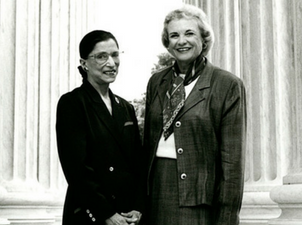
It all started with a campaign promise. While Ronald Regan was running for president, he made an effort to court the female vote by pledging that he would nominate the most qualified woman he could find to the Supreme Court. When Justice Potter Stewart retired in 1981, it was time for President Regan to fulfill that promise. The appointment of Justice Sandra Day O’Connor was historic as she became the first woman to serve on the highest court in the land, almost 200 years after the Supreme Court had been established.

March is Women’s History Month and appropriately the birthday month of both Justice Sandra Day O’Connor (celebrating her 88th birthday on March 26) and Justice Ruth Bader Ginsburg (celebrating her 85th birthday on March 15).  Both the first and second female Justices have made remarkable contributions to women’s history, in their decisions from the bench and in championing the way for other women in law.

In an interview with the New York Times, Justice Ruth Bader Ginsburg said “I always thought that there was nothing an antifeminist would want more than to have women only in women’s organizations, in their own little corner empathizing with each other and not touching a man’s world. If you’re going to change things, you have to be with the people who hold the levers.”

You do not have to look far to find these “women’s organizations” that Justice Ginsburg is talking about. The majority of the nonprofit employees, over 75%, are female, over 75% of K-12 teachers are female, and over 80% of social workers are female. While women have been disproportionally excluded from political, business, and religious leadership roles, concern for community seems to be a powerful stimulus for women pursuing direct service careers.

But women seem to have been galvanized by an environment of support and the inspiration of female trailblazers to expand their concept of community. There are twice as many women running for Congress in 2018 than there were in 2016. Likewise, Justice O’Connor is credited with inspiring a generation of women to attend law school. When she was appointed in 1981, 36% of law school students were female and when she retired in 2006 the number had risen to 48%. Visibility begets action.

I will be attending law school in the fall and while I am so looking forward to my future career as a lawyer I have been  surprised by how many people have asked me, “Are you sure?” when I say I am attending law school. And while this reaction is nowhere near as awful as the dean of Harvard Law School asking Justice Ginsburg and her eight other female classmates (out of class of 500!), “How do you justify taking a spot from a qualified man?” I am still put off by this reaction. I have gotten it from both men and women, beloved family members, and trusted mentors. When I talk about my future plans I am met with a cocked head, squinted eyes, and vocal inflections that communicate both concern and distrust that I have thought everything through.

But yes, I am sure. Just as Justice Ginsburg instructed, I hope to be with the people who hold the levers, and I think I and many other women are working for a day when we hold the levers too and make decisions that take into account the needs of all, not only the powerful.

The Spirit “Flames Out Like Shining from Shook Foil”

The Spirit “Flames Out Like Shining from Shook Foil”

Living Faithfully to the Gospel Challenge to Love
Simone Campbell, SSS
March 1, 2018

Let me state the obvious: 2017 was an extremely challenging year! But let me also say I am surprised that so much of the promised Trump agenda has not come to pass. I am surprised that Senator-elect Doug Jones, a Democrat, recently won the special election in Alabama. I am surprised that the Affordable Care Act (ACA) continues to be the law of the land. I am surprised that what I saw as a “steam roller” a year ago has been slowed. But as I reflect on this past year, perhaps my biggest surprise is how difficult it is to be faithful to the challenge to love… even our “enemies.”

Our fight against the repeal of the Affordable Care Act taught us deeper collaboration with our friends in the faith and secular communities. Telling our stories to our Representatives and Senators protected healthcare for 20 million people. The ACA isn’t perfect and it keeps getting undermined administratively, but we were able to help ensure that it remains the law of the land and our people have access to care.

In the process, I learned that when we work with great focus and determination we, the broad NETWORK community, make an important political contribution. I have learned again that it is fighting for a vision that makes the difference. When we communicate a clear vision of an alternative future, we draw in more people who hunger for something new. But this alone will not create the change we seek.

The challenging additional truth is that we are called to “radical acceptance” of even those we vehemently disagree with. For me, this means holding the person with care and attempting to live the Gospel command to love. I find it very challenging when it comes to our President and Congressional leadership. But I have worked this year to develop empathy for our President who is obviously preoccupied by big words, the “truth,” and his approval ratings, to name just a few concerns. While I vehemently object to his policy agenda, I am attempting to hold his person in my care. This is the huge challenge of a faith response in these difficult political times.

And then, every once in a while, there is a treasured moment of intersection between radical acceptance and fighting for a vision. Here, the fire of the Spirit flames up in a moment of Gospel justice. For me, this happened this past year during the healthcare fight. We advocated for a vision where all have access to healthcare. We struggled to hold every member of Congress in our care. In the midst of this challenge, when lobbying Senator Lisa Murkowski (R-AK), I met her as a person and held her in my care. I believe this “meeting” was an inspirited moment of light. I took in her person, perspective, and struggle.

As we face this new year, fatigued from all of the work of 2017, we are called to take another step into the challenge of Gospel justice. Together, we are called to care for members of Congress, the Trump administration, and their staffs. It is difficult, but love means we must hold all in our care. It is from this place of care that we can fight for a vision that moves us closer to the common good where no one is forgotten or disposable. We’re called to persistently seek the intersection of radical acceptance and fighting for a vision, where the Spirit flames up in our midst and a glimpse of Gospel justice is achieved.

This is work done only in community, where we all take turns having good days and bad. So in this very new year, let us commit to the profound spiritual practice of radical acceptance and fighting for a vision…in short “making fire.” Then we will remember the admonition of Jesuit poet Gerard Manley Hopkins in his poem “God’s Grandeur”:

Oh, morning, at the brown brink eastward springs—
Because the Holy Ghost over the bent
World broods with warm breast and with ah! bright wings.

Black Women and the Making of Catholic History

Black Women and the Making of Catholic History

Mehreen Karim
February 28, 2018

This Black History Month, we looked into our shared history to shed light on notable Black women who have influenced the Catholic Church and community. These Black women and others too often go without their due credit for their teaching and the social change they have inspired. The foundational elements of our faith, especially teachings for justice, can be recognized in the work Black women have done to dismantle racism for centuries. Even through devastating periods of racism and oppression, these women have lived out a deep commitment to justice.

Saint Josephine Bakhita,FdCC (1869-1947)

Impact: Born in rural Sudan, kidnapped and sold into slavery, she converted, gained her freedom, and became a Catholic Sister; canonized in 2000 and named patron saint of Sudan.

The life of Saint Josephine Bakhita reflects the resilience she demonstrated in the face of every trial she experienced. Saint Josephine Bakhita was born in western Sudan, native to the Daju people. As a child, she was kidnapped, sold into slavery, and traded between numerous families. After over a decade of being held in slavery, Bakhita was left in the care of the Canossian Sisters in Venice, Italy. Years after being taken to Italy, Bakhita refused to leave the Canossian Sisters’ convent and was found by a court to have been free since arriving in Italy, since slavery was illegal there.  Josephine Bakhita then became a Canossian Sister and spent five decades as a member of the religious community. After her death, Sister Josephine Bakhita was canonized and became the only patron saint of Sudan. Saint Josephine Bakhita has become an inspiration for many who fight for freedom – both physical determination and spiritual liberty.

Sister Antona Ebo, FSM (1924-2017)

Impact: Civil Rights leader

“I’m here because I’m a Negro, a nun, a Catholic, and because I want to bear witness.”

In response to Bloody Sunday, one of history’s most gruesome assaults against Civil Rights activists, Sister Antona Ebo, a Franciscan Sister of Mary, made her mark as the only Black Catholic sister marching in Selma. Prior to her freedom fighting, Ebo had ambitions to attend nursing school. She was rejected many times until she was the first of three African-American women to enter the St. Mary’s Infirmary School of Nursing in St. Louis, Missouri in 1944. After earning multiple degrees, Sister Antona became a certified chaplain and was a founding member of the National Black Sisters’ Conference in 1968. Her landmark participation in the Civil Rights movement founded the rest of her life’s work in dismantling racism. Sister Antona continued her anti-racism activism for decades after Selma, participating in national movements as recent as the Black Lives Matter movement in Ferguson, Missouri before she passed away in 2017.

Sister Thea Bowman, FSPA (1937-1990)

Impact: Nationally-recognized teacher and scholar who promoted education for Black Catholics

“I come to my church fully functioning…I bring my whole history, my tradition, my experience, my culture, my African American song and dance and gesture and movement and teaching and preaching and healing and responsibility as gift to the church.”

In the heart of protestant Mississippi, a nine year old Thea Bowman converted to Roman Catholicism. As a teen, she joined the Fransiscan Sisters of Perpetual Adoration in La Crosse, Wisconsin. Bowman’s parents rightfully feared for their daughter’s ambitions—moving to a white majority city and religious community would prove to be a challenge for any African American, nonetheless a woman religious. Thea would spend years embracing her African American identity, resisting racism, and changing the way African Americans are received in Catholic society. Bowman spent years teaching at schools and universities until she became a consultant for intercultural awareness for the Bishop of Jackson. Here, Bowman spread her wisdom, joy and African American pride through outreach to diverse communities of the Catholic faith. Thea Bowman created and legitimized a way of worship for Black Catholics. Her life’s legacy will live on in the many institutions founded in her name, most relevantly The Sister Thea Bowman Black Catholic Educational Foundation, which has raised money to put over 150 African Americans through college.

Sister Jamie T. Phelps, OP (Present)

Impact: founding Director of Augustus Tolton Program for African American Ministers at Catholic Theological Union

“I became a woman religious but that did not preclude my also being an educator, psychiatric social worker, community organizer, liturgist, choir director, spiritual director, and theologian.”

No list, no matter how exhaustive, could cover the depth of Sister Jamie T. Phelps’ impact on Catholic culture, society, and academia. Phelps was a teenager when she unsuccessfully attempted to join a high school run by Adrian Dominican nuns. Phelps explains that they were “concerned how she, as a young black woman, would adjust to living in all-white environment.” Only a few years would pass until Phelps returned to the Adrian Dominicans and became a Dominican sister herself. Sister Jamie Phelps continued to exert her mind and heart as she piled on professional and academic merits. After earning a doctorate from Catholic University of America, Phelps explored the intersection of sexism, racism, and economic disparities in Catholic society. Today, Sister Jamie Phelps studies these topics in her published research and teaching at various universities.

Dr. Diana L. Hayes (Present)

Impact: First Black woman to earn an S.T.D. (Doctorate of Sacred Theology)

“I am because we are—because African Americans, we see ourselves as a family.”

In her life’s work and teachings, Diana L. Hayes deconstructed the nuances of spirituality in African American Catholic culture. Hayes is the first black American woman to earn a Pontifical doctorate, Sacred Theology degree (S.T.D.) from the Catholic University of Louvain in addition to three honorary doctorates. She was a Professor of Systematic Theology in the Theology Department at Georgetown University where she specialized in Womanist Theology, Black Theology, U.S. Liberation Theologies, Contextual Theologies, Religion and Public Life, and African American and Womanist Spirituality.

Sister Patricia Chappell, SNDdeN, (Present)

Impact: Current Executive Director of Pax Christi USA

“I never thought I could be a sister because I had never seen a black sister. I had never seen a sister who looked like me.”

As a child, Sister Patricia Chappell could not imagine she would become not only a Catholic sister, but the Executive Director of a large Catholic organization. Though Sister Patricia has only recently entered the national limelight as Pax Christi USA’s Executive Director, she had always been a mover and shaker working for racial justice in the Catholic sphere. In the eighties, Sister Patricia Chappell worked in vulnerable areas of Philadelphia and delivered substance-abuse intervention services to African-American youth and their families. Sister Patricia was president of the National Black Sister’s Conference in Washington and also the co-coordinator of the Sisters of Notre Dame de Namur’s Anti-Racism Team. On the ground, she worked as a program specialist at the Takoma Park Recreation Center in Maryland, in youth centers in Hyattsville, Maryland, and as director of youth ministry at Holy Comforter-St. Cyprian Church in Washington. D.C. As the Executive Director of Pax Christi USA, Chappell steers the organization and the community to work for justice by organizing and speaking out on racism and other issues. Sister Patricia hopes her work and leadership will connect to everyday Catholics and bring more people into the movement.

During Black History Month and throughout the entire year, we recall the spirit-filled lives and ministries of these Black Catholic women and many others. Let us follow their example and their guidance as we work for racial justice in our communities, including our faith community, and our country.

Representative Crowley on Surprises, Challenges, and the Road Ahead

Representative Crowley on Surprises, Challenges, and the Road Ahead

February 27, 2018

Congressman Joseph Crowley represents New York’s 14 congressional district and is Chair of the House Democratic Conference. This year, Congressman Crowley received a 100% on NETWORK’s voting record for the sixth year in a row. (View the 2017 voting record.) His six-year record is the longest out of anyone currently serving in Congress. NETWORK spoke to Representative Crowley to learn about how his Catholic faith and his lived experiences inform his political decisions.

How does your faith inspire your work in Congress?
I was raised to live by the Golden Rule: ‘Do to others as you would like them to do to you.’ This has guided me in life and inspired my work in Congress. It is simple: we need to treat others with the same compassion and empathy with which we all want to be treated, and put forward just and fair-minded policies that ensure opportunity for all. This means doing the right thing and working hard to ensure that my constituents from Queens, the Bronx, and all Americans can enjoy the brighter future they and their families deserve.

What is the proudest vote you have cast this year?
I believe that health care is a right, not a privilege. That’s why I voted against the so-called “American Health Care Act,” which would have stripped access to quality health care for millions, and punished children, seniors, and those with pre-existing conditions. I am very proud to defend the right of Americans to have access to affordable, quality health care, but also know we must do even more to make sure health care is available to all.

What has been the biggest challenge you’ve faced this year?
A big challenge has been President Trump’s attacks on immigrants and refugees, including his heartless decision to end the Deferred Action for Childhood Arrivals program, which has upended the lives of nearly one million talented DREAMers who contribute to their communities and the American economy. These young people have all the qualities our nation was built upon and should be welcomed here.

What about this past year has surprised you the most, politically?
I’ve been appalled by the completely inadequate response to the suffering and pain of our brothers and sisters in Puerto Rico and the U.S. Virgin Islands. President Trump and congressional Republicans have treated the victims of these natural disasters like second-class citizens, when they are as American as you and I. I visited Puerto Rico in the wake of Hurricane Maria and witnessed the extensive devastation there. We need to do more to ensure that everyone living there has the resources needed to rebuild and recover, and I’ve promised our fellow Americans there that the federal government commitment to them will continue for years and decades.

What policy area will you focus most on in 2018?
There are too many important policies to pick just one. But an issue I’m especially passionate about is ensuring that hard-working Americans have access to affordable housing. Housing is one of the most basic human needs and the lack of affordable housing is a crushing burden for many families in Queens and the Bronx and across the U.S. This year, I introduced the Rent Relief Act – legislation to help those struggling to balance the high costs of rent with the needs of their families. It would put money back in the pockets of renters who spend more than 30 percent of their income each month on housing. This is an extraordinary way for us to build the middle class and secure the financial stability of working men and women.

When times seem difficult, what keeps you motivated to continue working for the common good in Congress? 
My constituents in Queens and the Bronx. Meeting with them and hearing directly about their passions, dreams, and hope are always motivating and inspiring. Despite all the challenges we face, I’ll continue to defend our values and provide good solutions for my constituents and all Americans.

How have you seen policies you’ve promoted in the past positively affect your constituents and our nation?
Legislation such as the Affordable Care Act has positively improved the quality of life of my constituents and of millions of people across the nation. The ACA has expanded coverage, reduced costs, and improved our health care system. We need to continue protecting this accomplishment and come together to improve health care so every American has access to affordable and quality care.

You voted with NETWORK 100% of the time for the past six years, which is the longest record for any current members of Congress. How does it feel?
Extremely honored. From protecting and improving our health care system to creating economic opportunity – my positions on our nation’s most pressing issues are always guided by the common good. I’m proud to be an ally of NETWORK in working toward economic and social transformation in our communities.

Do you have any advice for advocates inspired by their faith to engage in politics?
Turn your faith into action and never underestimate the power of your voice. Now more than ever, your engagement is making a difference.

Originally published in Connection Magazine. Read the full issue here.

Working With White Folks

Working With White Folks

Jeremiah Pennebaker
February 24, 2018

 “The White Man’s Burden”

 “Take up the White Man’s burden—
Have done with childish days—
The lightly proffered laurel,
The easy, ungrudged praise.
Comes now, to search your manhood
Through all the thankless years,
Cold, edged with dear-bought wisdom,
The judgment of your peers!”

-Rudyard Kipling

In the year 2018, in the midst of a glorious Black History Month, and the premiere of Marvel’s Black Panther, I have been thinking a lot about my white friends. This blog is for all my white friends “in the struggle.” The white friends who are “really down” and who really “woke.” Not the, “I would’ve voted for Obama for a 3rd term!” type of woke, but the “How do I become an anti-racist white ally?” woke. I feel like this piece has been written, shared on Facebook, and discussed a million times before, and I’m surely no expert on what it means to white and “woke.” But being who I am, I constantly find myself in places with white people trying to figure it out, or trying to do the right thing, and that’s tough for both parties.

It’s tough because I’m not the friendly neighborhood Black dude who has all the answers to being a good white person as my white friends awkwardly fumble around with a list of Buzzfeed’s “Top 10 Tips to Being a Better Ally!” There’s an ever-present tension that exists in these spaces because racial justice work is messy and vague. There’s a blurred line between Black people not being “teachers” and white people’s inability to do the work themselves because of the privilege of living in a world made for white people. I’m not sure how to resolve or even ease this tension. Mostly because it’s not my fault it’s there nor is it my responsibility to fix.

The problem is that white people are more or less going to be in the wrong when it comes to a lot of racial justice work. No matter how many times you watch “MTV Decoded” or how often you retweet @deray you’re going to show up in places as a white person. The impact of the white gaze on racial justice work and allyship is one that I believe that many of my white friends/ allies may not understand. I don’t fully understand either, but I recognize my feelings around white people as they practice allyship.

I admit I often get frustrated discussing race and racism with my white friends because it begins to feel like my emotions and experiences are being appropriated. Even when the topics don’t necessarily pertain to personal experiences, it still feels as if people are talking about me like I’m not there. I recognize that my white friends mean no harm and that they are trying to be good white people, but I often feel like I’m put on display as they decide the best way to fix my problems.

Now the reason that I write this is not to tell my white friends to back off or to stop doing the racial work that they’re doing. I write this to say that even though there are wounds and you will make mistakes, you must continue to do the work. I write this to tell my white friends to recognize how much space you take up in racial justice spaces. I write this to tell my white friends that just because your name tag says “ally” that it’s not an all-access pass to Blackness. I feel that this is partially my fault because of how many “cookout” invites or pats on the back that were handed out for the most miniscule displays of humanity.

I greatly appreciate the work that is being done, and history has shown that unless we find Wakanda, “progress” is dependent on how much white people are willing to budge. Just recognize that the work being done is just meeting the basic levels of humanity. Malcolm X said something along the lines of, “If you stick a knife in my back nine inches and pull it out six inches, there’s no progress. If you pull it all the way out that’s not progress. Progress is healing the wound that the blow made. And they haven’t even pulled the knife out much less heal the wound. They won’t even admit the knife is there.”

Ultimately, I urge you to take up the white man’s (or woman’s or gender non-conforming person’s) burden and gain the “cold, edged, dear bought wisdom.” What Kipling originally intended as a racist call to colonization is now being thrust back upon you, my white friends, as a call to hold and for you to fully recognize that history and how it impacts the way the People of Color you work with may feel your gaze and your presence. The history, the tension, the anger, and frustration that your peers feel are your crosses to bear, but that does not absolve you of doing the work because at the end of the day it is the right thing to do and working through the tension may just help to ease it.


Family Reunification is the Heart of Immigration

Family Reunification is the Heart of Immigration

Sister Bernadine Karge, OP
February 22, 2018

May I share the immigration story of the Gomez* Family whom I met more than 13 years ago?

Mr. Gomez* had come to the United States in the early 1980’s to work to support his wife, and children in Mexico. When the Immigration Reform and Control Act of 1986 (IRCA) went into effect in 1987, Mr. Gomez applied for temporary resident status during the one year application time. He successfully proved that he had entered the U.S. without documents, lived here without documents since 1/1/82, had provided for himself, paid taxes and was a person of good moral character. After the required time as a temporary resident, he became a permanent resident in 1992. One aspect of the 1986 law was that there were no derivative beneficiaries. This means a spouse could not bring in his or her spouse and minor unmarried children into the country as permanent residents when she or he recieved a “green card.”

However, as a permanent resident Mr. Gomez could and did file a petition to bring his wife and unmarried children in 1992. So Mr. Gomez was living legally in the U.S. and his wife and three kids were living in Mexico. What would you do? Leave your wife and kids in another country or bring them here? The latter, no doubt, which is what the Gomez family did-reunite the family. The children attended school here in the U.S. and the sons began working with their dad in the factory when they were old enough.

When I first met the family, in 2005, their number in the second preference visa category was not current. They patiently waited in line for a visa number to become available. Two years later in July 2007, their number became available, but the older son was over 21. Would he be able to immigrate with his mother as a derivative along with his younger brother and sister? Each family member, mom and three kids had to file a separate petition, get a medical examination, do fingerprints and a background check. This cost the family about $5000 in application, medical and biometrics fees before fees increased at the end of July 2007!

In November 2007, the family went for an interview at the immigration office in Chicago. Thanks to the Child Status Protection Act and its intricate formula for protecting “child status” the immigration officer agreed with us that the older son was under 21 for immigration purposes. Mr. Gomez’s wife and the three children were granted permanent resident status at the end of 2007 – 20 years after dad first applied!

The daughter graduated from grade school and high school. She became a U.S. citizen when she turned 18 and graduated from college last June. The sons have married, immigrated their wives and are raising their children in Chicago. Family is the chain that binds us. Family reunification is the foundation of U.S. immigration law.

*Name has been changed to protect the privacy of the family

Sister Bernadine Karge is a Sinsinawa Dominican Sister and a former “Nun on the Bus.”

My Family’s Immigration Story

My Family’s Immigration Story

Monsieree de Castro
February 21, 2018

Allow me to tell you all a (very common) story about “chain migration,” a portion of the immigration system the current administration and members of Congress are trying to eliminate.

In 1977, my father was petitioned by my aunt, who was living in Seattle, to come join her in the United States using the sibling category of family reunification (what some offensively refer to as “chain migration”). The waiting process for family visas can take decades, and my father waited 17 years to have his papers approved for him to come to the United States. It wasn’t until 1994 that we as a family finally stepped foot on American soil for the first time.

It has been 24 years of struggling in a country that more often than not makes you feel unwanted for your brown skin and foreign customs, but also 24 years filled with triumphs and success. My parents have held multiple jobs since we first came to this country, from caregiver to custodian. Today, our family has grown and my siblings and I lead successful lives and are all contributing taxpayers and members of the community. Of my siblings, we currently have a Director working in social services at the Asian Counseling and Referral Service, an IT professional working for Paul Allen’s business/philanthropy, an accountant providing her skills at a hospital, and finally, the youngest and most Americanized sibling, foolishly pursuing her dreams in the most American way possible; living and working in politics in Washington DC hoping to contribute to the country that has given so much to her. Additionally, major props to my awesome parents and each of my siblings who all own their own homes, collectively owning 5 pieces of real estate across the Seattle area (I’m clearly the millennial of the clan, probably eating avocado toast instead of buying a house).

My family’s story is not at all unique. This is the story of millions of Americans who come here seeking the opportunity for a better life. This is the simplified version of the story, leaving out the heartaches of visas that were never approved after years of waiting, and parts of our family that continue to be split apart (no, you can’t “bring in virtually unlimited numbers of distant relatives,” there are countless restrictions). This is also the story of a privileged family that was lucky enough to have a pathway to pursue the American dream and citizenship, and had the economic stability to wait 17 years to have a visa approved.

The current administration claims that the program that allowed my family to come and succeed in the United States needs to be eliminated for the sake of the “economy and the future of America”. But Mr. President, I am CERTAIN that allowing families like mine to be welcomed into this country is ABSOLUTELY NECESSARY for the success of our economy and future of our great nation.

Monsieree de Castro is a former NETWORK associate. She currently works at Robert F. Kennedy Human Rights.