

Category Archives: Front Page

I Am Excited to Educate, Organize, and Lobby with the NETWORK Community

I Am Excited to Educate, Organize, and Lobby with the NETWORK Community

Mary Novak
April 7, 2021
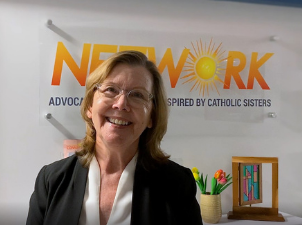
Meet Mary Novak, NETWORK’s new Executive Director
Thursday, April 15 at 4:00 PM Eastern/1:00 PM Pacific.
Register here.

I am honored to be here with all of you as the new Executive Director of NETWORK Lobby for Catholic Social Justice. As I begin this new adventure, I ask — if you are a praying person — for your prayers as I transition into this Spirit-filled community. The NETWORK community is full of committed justice-seekers and has been for 50 years. I am grateful to join you in building our country anew.

Today, we are facing unprecedented challenges pushed to the crisis point by the COVID-19 pandemic. This crisis has also brought us together in a shared experience out of which so many are calling for federal approaches to root out injustice.

We need federal policies that name and dismantle systemic racism, eliminate the wealth and income gap, and allow all people to thrive so that we truly are a “more perfect union.” I’m excited to educate, organize, and lobby with you, the NETWORK community.

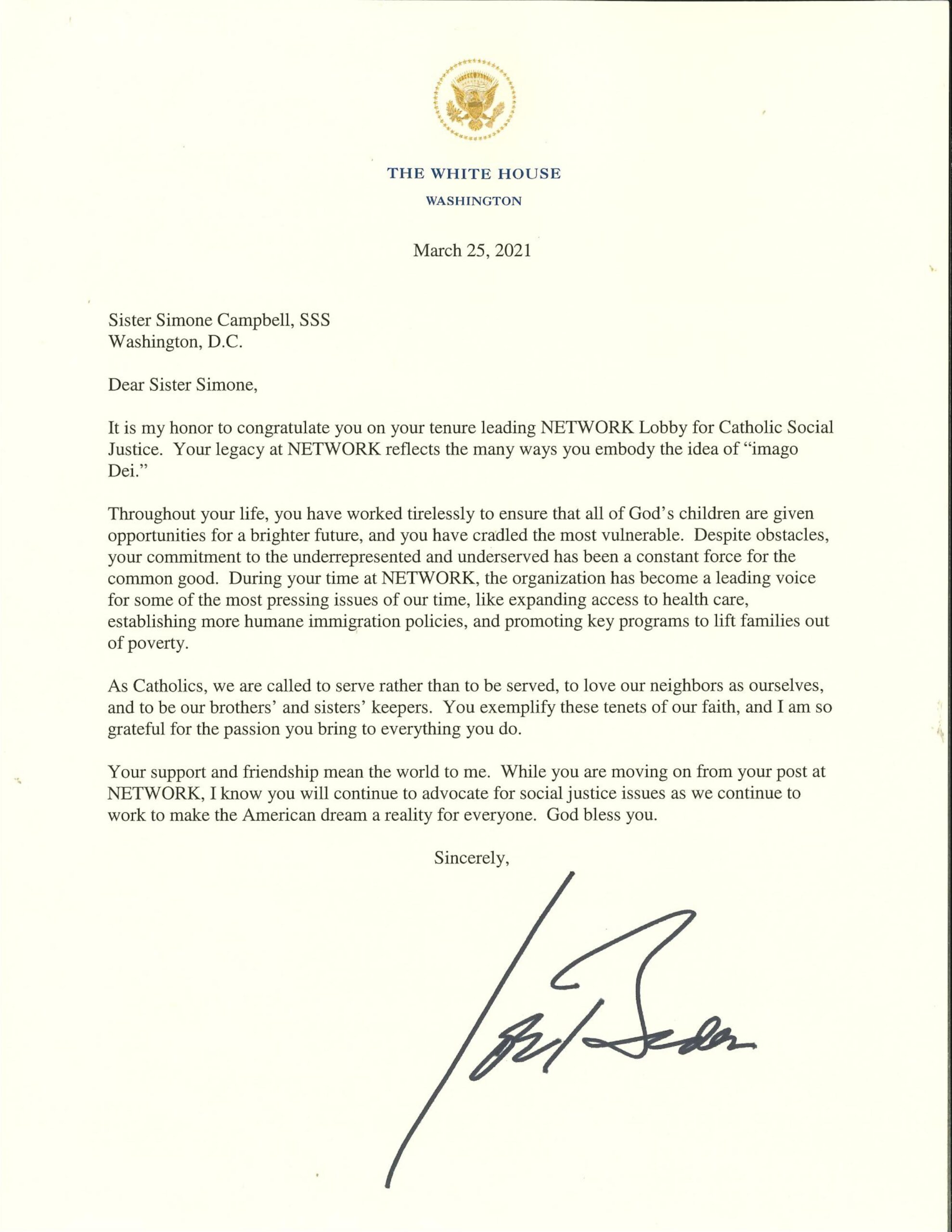
Read President Biden’s Letter to Sister Simone

Read President Biden’s Letter to Sister Simone

March 31, 2021

Last week, President Joe Biden, our country’s second Catholic president, sent the letter below to Sister Simone Campbell as she prepared to step down as Executive Director of NETWORK Lobby.

In it he wrote, “As Catholics we are called to serve rather than be served, to love our neighbors as ourselves, and to be our brothers’ and sisters’ keepers. You exemplify these tenets of our faith and I am so grateful for the passion you bring to everything you do. Your support and friendship mean the world. God bless you.”

Read more:

The Racist Filibuster Must Go for Us to Build Anew

The Racist Filibuster Must Go for Us to Build Anew

Sister Simone Campbell
March 25, 2021

The Senate filibuster — currently 60-vote threshold to close debate on a bill and move to a vote — is a relic of the Jim Crow-era that has blocked democracy reform, civil rights protections, and health care expansion for far too long. Since its inception in 1806, the filibuster has been weaponized against people of color to block bipartisan legislation that addresses structural racism and inequality in the United States. Catholic Sisters and NETWORK advocates do not accept antiquated traditions steeped in a racist past to prevent progress and will mobilize across the country to end the racist filibuster.

Constitutionally, bills require a simple majority to pass — just 51 votes in the Senate.  However, the filibuster is a procedural tool which allows senators to block legislation from receiving a vote at all if there are 41 of them that oppose the bill. For centuries, elected officials in the minority have used the filibuster to stop common good, anti-racist legislation from passing and becoming law. In the 19th Century, white Southern Senators used the filibuster to kill Reconstruction and the earliest civil rights bills in order to maintain white supremacy. In the 20th Century, anti-lynching legislation which was widely popular among Congress and the United States people was consistently blocked by a small minority in the Senate. The use of the anti-democratic filibuster as a tool of white supremacy had direct consequences: racist lynching mobs killed an estimated 4,400 Black Americans throughout our nation’s history. To this day, Congress has failed to pass federal anti-lynching legislation. In the Civil Rights Era, Senators employed the filibuster to prevent desegregation and voting rights legislation from becoming law.

The racist application of the filibuster is a clear legacy of the rule, and it continues today. Senators are exploiting the power of the filibuster to block critical legislation meant to dismantle systemic racism and known injustices in the 117th Congress.  The For the People Act, the Justice in Policing Act, the Equality Act, the PRO Act, are all bills that deserve a vote and stand a real chance of passing but for the filibuster rule.  The filibuster is not protecting voters in the minority party; it protects politicians set on preserving the status quo. We cannot allow an arbitrary Senate rule with no grounding in the Constitution to block legislation that enjoys widespread bipartisan support by voters across the country.

The Senate has a moral duty to use this opportunity to end the filibuster.

Add your name to join the Catholic Sisters and activists of NETWORK calling for the elimination of the Senate filibuster.

Women’s Equality Requires Raising the Wage

Women’s Equality Requires Raising the Wage

Gina Kelley
March 24, 2021

This last year has been a challenging one for all us, but women have carried a heavy burden throughout this pandemic. In 2020, women’s unemployment hit its highest since 1948 with Black and Latina women facing higher rates of unemployment than white women and men. In February 2021, it was reported that women, in particular women of color, had lost 5.4 million jobs—nearly 1 million more than men. Women have also had to leave the workforce as the pandemic has closed schools and childcare facilities leaving many women to take on this essential caretaking role. This pandemic has not created inequalities, instead it has exploited what was already there.

March is Women’s History Month and the 24th is Women’s Equal Pay Day. Equal Pay Day marks the day in the year when women earn what men did the previous year, meaning it takes 15 months for women to earn what men do in 12. On average, women are paid 82 cents on every dollar a man makes meaning that on a typical 9:00-5:00 workday, women start working for no pay at 2:40 p.m. These Equal Pay Days continue throughout the year with Mother’s Equal Pay Day in June, Black Women’s in August, Indigenous Women in September, and Latina Women in September.

Clearly, working women, particularly women of color, are facing a devastating economic reality. While the American Rescue Plan achieved major victories for families across the country, it failed to raise the minimum wage. Raising the wage is essential to closing the gender and racial pay gap that has harmed marginalized communities for centuries.

The Raise the Wage Act of 2021 proposes slowly increasing the minimum wage from $7.25 to $15 over 5 years and ends subminimum wage practices for tipped, youth, and disabled workers over a 6 years. The tipped minimum wage is a currently only $2.13 an hour and creating one fair wage of $15 would greatly benefit women who represent more than two-thirds of tipped workers. Coupled with the Raise the Wage Act, Congress must pass the Paycheck Fairness Act, which provides more remedies for gender pay discrimination.

So what would a $15 minimum wage mean for women?

Of the 32 million workers whose pay would increase from the Raise the Wage Act, 59% are women and more than a quarter have children. That means 19 million women would benefit. Nearly 1 in 4 of those women are Black or Latina. Women, and in particular women of color, are overrepresented in low-wage jobs due to historical gender and racial occupational segregation. According to recent reports, women working year-round, on average, would see an increase of about $3,500 in wages annually. For Black and Latina women, this figure increases to $3,700. 3.4 million Black women and 4 million Latina would see this substantial and transformative pay increase. Additionally, 8 million mothers across the country would see similar benefits giving them the capability and power to support their families. Analysis of 2019 data found that among mothers who would get a raise, 65% are primary or sole breadwinners for their families and an additional 19% are co-breadwinners.

It could not be clearer: women need a fair wage and a chance for economic security. No one can survive on $7.25 and those in opposition to raising the minimum wage are keeping women and Black and Brown communities in poverty. Closing racial and gender wealth disparities and recovering from an economic crisis demands immediate action.  Raising the wage to $15 allows families to have food on the table and a roof over their heads. Women need justice and equality now. This Women’s History Month and this Equal Pay Day show solidarity with working women and join the fight to raise the wage.

Statehood and Self-Determination for Washington, D.C.

Statehood and Self-Determination for Washington, D.C.

Ms. Andrea Renee Reed
March 22, 2021

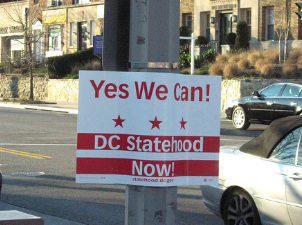
Ahead of the House Oversight Committee hearing on H.R.51 the Washington, D.C. Admissions Act, I sent the following message to all committee members in a letter asking them to support D.C. statehood.

Rep. Eleanor Holmes-Norton and Ms. Andrea Renee Reed, 2010

My name is Ms. Andrea Renee Reed.  I’m a resident and native of DC, a 62 year-old, grateful African-American woman. Growing up in Washington, D.C. was hard. In the 60s there were several assassinations of civil rights leaders such as President John F. Kennedy, then Malcom X, then Martin Luther King Jr., and then Robert Kennedy—all in the prime of their lives. They led with strength, character and faith.  I can remember overhearing adult conversations about events that were filled with disillusionment, hopelessness, and disempowerment.

In the following years, I have witnessed a downward spiral of disenfranchisement and an economic free fall in the District. It felt like our communities were suffering and the politicians were indifferent. Like they were only interested in using the resources of our city without reinvesting them to meet the needs of the community. Which is why I am writing in support of the Washington, D.C. Admission Act (H.R.51/S.51). This legislation guarantees right of voters to participate fully in federal elections. The more than 700,000 D.C. residents, the plurality of which are Black and Brown citizens, deserve full congressional representation and the self-determination that comes with statehood.

I moved around a lot within the District during my younger years but wherever I lived, nobody in the surrounding community owned their own homes. We all lacked ownership in the places we lived.  Every place I stayed, it was a constant struggle for me and for others in these neighborhoods. My entire experience was an attempt to escape.

It was by God’s grace that I met Ms. Carolyn Byrd who supported destitute young Black people by showing curiosity about their dreams and offering encouragement. Ms. Byrd trusted me with the great responsibility of caring for her disabled daughter, LaShonya.  She showed me that I could make choices about the direction of my life and didn’t have to live in a state of reactivity.  I still believe she could have been an effective, powerful community leader or even city council member had she had the resources available to her.  She held a vision for the District and felt ownership of it as a place to grow and to thrive, and she tried to make it better in her own way.

With her encouragement, I realized I could follow my path, so I left the District and lived many places trying to find somewhere that felt like home.  It was also during that time that I slowly and steadily gained independence and confidence.  An awareness of my contributions and capabilities became more clear to me and I also learned that unaddressed, undiagnosed mental illness had contributed to some of my struggles. With a newfound freedom I slowly began to thrive and feel like a whole person with agency. Mental health issues stagnate the abilities of citizens to meet their highest potential for growth and economic development.

Now, many years later, I chose to return to Washington, D.C. looking for healing and to reclaim my roots.  I reside in a safe environment, with a supportive community in the Petworth neighborhood.  It finally feels like home. This community has inspired me to work for change and I can see now where Ms. Byrd found her inspiration to help others. I feel the same call and that’s why I’m writing today.

I can see with new eyes how the District, as a broader community, suffers like I did growing up: discouraged, disempowered, and held down with little control of its path forward.  In addition to many of the same problems I saw growing up, now with gentrification happening, it compounds the lack of ownership for the native population.  Again, a community left out in our own home.

It is 2021, we are tired of being marginalized and having others dictate our path and our goals. Those of us who call the District home refuse to have our choices undermined or overruled by politicians from other states, some with fewer residents than Washington, D.C. We deserve to have statehood status, with proper representation and agency over our own affairs. I believe DC statehood would improve all aspects of residents’ lives including addressing homelessness and the psychological condition of the broader community, generally uplifting our spirits.

We are ready to claim our home—to TRULY take ownership—and be properly represented in Congress. We are capable of managing our own affairs just like other states. It is time to give us our agency and give the power of the vote to courageous heroes like Rep. Eleanor Holmes-Norton who has been speaking truth to power for 30 years.

Ms. Andrea Renee Reed is a member of the Assisi Community, an intentional community in Washington, D.C. committed to living simply and working for social justice.

Announcing NETWORK’s Next Executive Director, Mary Novak

Announcing NETWORK’s Next Executive Director, Mary Novak

Sr. Mary Beth Hamm, SSJ and Rachelle Wenger
NETWORK Advocates and NETWORK Lobby Board Chairs
March 22, 2021

As the Chairs of NETWORK’s Boards of Directors, we are pleased to introduce you to the next Executive Director of NETWORK, Mary Novak. After months of interviews and discernment, the Boards unanimously, and confidently, chose Mary to lead NETWORK into the future.

Mary’s experience as a lawyer, educator, chaplain, and activist, and her passion for justice uniquely position her to build on the historic work of Sister Simone and the entire NETWORK community as we continue to grow. With Mary’s pastoral experience and emphasis on restorative justice, NETWORK will continue to address the pressing issues of polarization, systemic racism, and economic inequality in our country. Read more about Mary.

Mary has worked among Catholic Sisters and Jesuits for decades, most recently serving the community of Georgetown University Law Center and she was also the founding Board Chair of Catholic Mobilizing Network. Mary is well versed in the dynamics of U.S. women religious having served the Leadership Conference of Women Religious as they navigated the Doctrinal Assessment with the Vatican’s Congregation for the Doctrine of the Faith, and she is also a Lay Associate of the Congregation of St. Joseph.

We are excited by Mary’s vision for the future and commitment to advancing justice. In her own words, Mary says, “I believe that Catholic social teaching can be a unifying and universal source of inspiration for the moral imagination we need to promote justice, healing, and the common good.”

In this time of challenges, but also new possibilities, we are so glad to have Mary join our work to build anew. Mary will begin serving as NETWORK’s Executive Director on April 1, 2021.

Please help us welcome Mary to NETWORK! You’re invited to share your thoughts with us on Facebook, and be sure to follow Mary on Twitter.

Read NETWORK’s press release.

NETWORK Supports the Pregnant Workers Fairness Act

NETWORK Supports the Pregnant Workers Fairness Act

Caraline Feairheller
March 18, 2021

In February, a bipartisan group of House lawmakers officially re-introduced The Pregnant Workers Fairness Act into the 117th Congress. The Pregnant Workers Fairness Act (PWFA) was first introduced in 2012 and has been re-introduced in the House in almost every legislative session. NETWORK has previously supported the legislation, but Senator Mitch McConnell’s Senate failed to do their moral duty to protect mothers by not taking up the legislation. Once again, we are proud to support the Pregnant Workers Fairness Act because it modernizes current law and closes the gaps in protections afforded to pregnant workers. This legislation would open doors for gainfully employed women who choose to bring new life into the world.

Despite current protections for pregnant workers from workplace discrimination included in the Pregnancy Discrimination Act of 1978 (PDA), 2 out of 3 women who fight to get pregnancy accommodation lose their case in court. Pregnant workers should not have to choose between their income or their family’s health. However, the failure of current legislation has forced many women to choose and this moral failure is only exacerbated by the global pandemic and accompanying economic recession.

The time is long overdue for pregnant workers to get reasonable accommodations, such as extra bathroom breaks, limited contact with certain chemicals, and a reduction in lifting requirements. Catholic Social Teaching clearly states that, “human work has a special dignity and is a key to achieving justice in society.” Now is the time for Congress to pass the Pregnant Workers Fairness Act and recognize the dignity of labor.

Read Our Letter in Support of the Pregnant Workers Fairness Act

The American Rescue Plan Meets the Moment

The American Rescue Plan Meets the Moment

Caraline Feairheller
March 16, 2021

On March 11th, President Biden signed the American Rescue Plan into law. This historic and widely popular $1.9 trillion COVID-19 relief package is both an investment in our communities’ future and provides immediate relief to struggling families.

Across the country, people navigating these unprecedented health and economic crises know what is needed for their families and communities to thrive. This new law includes funding for vaccine distribution, cuts child poverty in half, and protects essential workers. The American Rescue Plan will help our vulnerable communities survive this deadly pandemic, and all the NETWORK members and advocates who helped pass it should be proud.

NETWORK has consistently called on Congress to uphold their moral responsibility to quickly deliver a robust COVID-19 relief package that prevents more needless suffering. While there is still more work to do, NETWORK celebrates the final relief package, which includes:

Relief Payments: $1,400 emergency payments.

What we lobbied for: Automatic cash rebates, regardless of immigration status, age, or tax filing.

People need money to pay rent and mortgages, utility bills, grocery bills, and so much more. The automatic and immediate cash relief payments included in previous COVID-19 relief packages and in the American Rescue Plan will help individuals and households weather job losses and economic disruption. Specifically, the American Rescue Plan:

  • Provides $1,400 emergency payments to single filers with incomes up to $75,000, head of household filers with incomes up to $112,500, and joint filers with incomes up to $150,000.

The American Rescue Plan makes relief checks available to citizens and family members with Social Security Numbers in mixed status families, giving 3 million people and 2.2 million children access to aid. Unfortunately, undocumented immigrants who are also experiencing the same negative health and economic effects of this pandemic still do not receive a stimulus check under the American Rescue Plan.

Tax Justice: Increases the Child Tax Credit, allows parents to receive it monthly, and raises low-income workers’ maximum Earned Income Tax Credit.

What we lobbied for: Permanently expand the Earned Income Tax Credit (EITC) and a robust Child Tax Credit to reduce children poverty

The pandemic has resulted in many families with young children struggling to keep a roof over their head and food on the table. Alternatively, more than 5 million childless workers are taxed into, or deeper into, poverty. The expanded Child Tax Credit and EITC benefits will cut childhood poverty in half and help mend the racial wealth and income gaps. Specifically, the American Rescue Plan:

  • Increases the current $2,000 per child to $3,000 per child and to $3,600 for children under age 6.
  • Makes the Child Tax Credit fully refundable which ensures that 27 million children currently left out are able to receive the full benefits.
  • Allows parents to receive regular monthly checks beginning on July 1, 2021 so families have access to assistance throughout the year.
  • Raises the maximum Earned Income Tax Credit for adults without children from $530 to nearly $1,500 and raises the income limit for the credit from $16,000 to about $21,000, resulting in additional income support to over 17 million working childless adults.

The increased Earned Income Tax Credit and the increased, and monthly, Child Tax Credit are only approved for one year. Further legislation is needed to make these poverty-reducing policies permanent.

Food Security: Increases and extends Supplemental Nutrition Assistance Program (SNAP) benefits, funds the Women, Infants, and Children (WIC) Program , and extends Pandemic Electronic Benefit Transfer (P-EBT) to include both the school year and summer.

What we lobbied for:  Extend 15% boost in SNAP benefits by, Eliminate SNAP eligibility barriers for immigrants, and expand school lunch programs in order to provide meals when school is not in session.

The pandemic and accompanying economic downturn have led to a rising hunger crisis. The American Rescue Plan combats this rising insecurity through critical investments in SNAP, WIC, and Pandemic-EBT programs. Specifically, the American Rescue Plan:

  • Extends the 15% boost in monthly Supplemental Nutritional Assistance Program (SNAP) benefits to September 2021.
  • Allocates $880 million in funding for the Special Supplemental Nutrition Program for Women, Infants, and Children (WIC). This funding will support WIC outreach, innovation, and program modernization.
  • Invest $5 billion in Pandemic Electronic Benefit Transfer (P-EBT) so families have access to school meals during the school year and summer months.   

The American Rescue Plan makes aid available to children who would have received free or reduced-price meals at a school that is closed are eligible for P-EBT, regardless of immigration status. WIC, The Emergency Food Assistance Program (TEFAP), and home delivered meals are also available to immigrant families. SNAP is only available for certain non-citizens such as asylees, refugees, and some green card holders. Parents who are not eligible for SNAP can apply for their eligible household members.

Minimum Wage: Federal minimum wage remains at $7.25.

What we lobbied for:  Raise the federal minimum wage to $15 by 2025.

NETWORK denounces the fact that the American Rescue Plan failed to raise the minimum wage to $15 an hour. It is well past time to raise the wage and is shameful that low-income workers have gone over a decade without a raise from the federal minimum wage of $7.25. A raise in the wage would take significant steps in addressing income inequality and would lift the pay of nearly 32 million workers. Congress must find a way to take meaningful action to care for our struggling families and uphold the dignity of workers by raising wages.

Housing Assistance: Provides billions of dollars towards emergency rental assistance and other housing-related costs.

What we lobbied for: Extend the federal eviction moratorium and invest $5 billion in emergency rental and utility assistance, as well as $28 billion in funding for housing vouchers.

A growing number of people are staying at home across the nation, without work, and reliant on emergency paychecks designed to stimulate economic growth and pay for last month’s rent. The pandemic has resulted in nearly 1 in 5 renters not being caught on up on rent and with renters of color disproportionately expiring this hardship. Continual investment in housing assistance with help struggling families have a safe place to live as the pandemic continues. Specifically, the American Rescue Plan:

  • Provides $22.5 billion to state and local governments to help low-income households cover back rent, rent assistance, and utility bills.
  • Provides $10 billion for the Homeowner Assistance Fund, which allocates funds to struggling homeowners directly or indirectly impacted by the COVID-19 pandemic.
  • Provides $5 billion for emergency housing vouchers to transition individuals and families who are at risk or are currently experiencing homelessness.

However, the American Rescue Plan does not include a specific provision to extend the national eviction moratorium — which is set to expire March 31, 2021.

Unemployment Benefits: Raises unemployment payments by $300 a week and extends them through September 6, 2021.

What we lobbied for: Extended and expanded unemployment benefits until at least September 2021.

As the COVID-19 pandemic enters into another year, many individuals and families have used the last of their savings. The nation’s Unemployment Insurance (UI) program is one of the primary infrastructures needed to provide financial help and its extension will prevent workers and families from experiencing total financial devastation. Specifically, The American Rescue Plan:

  • Extends the Federal Pandemic Unemployment Compensation (FPUC) through September 6 at $300 in benefits per week.
  • Exempts up to $10,200 in unemployment benefits received in 2020 from federal income taxes for households making less than $150,000.
  • Extends Pandemic Unemployment Assistance (PUA) and Pandemic Emergency Unemployment Compensation (PEUC) through September 6.

The American Rescue Plan is a broad and historic piece of anti-poverty legislation. President Biden and his administration have passed legislation that centers families experiencing poverty and communities of color, who have been disproportionately impacted by the COVID-19 pandemic.  While the legislation is far-reaching and this summary only captures our top priorities, NETWORK Lobby is proud to have lobbied on a bill that will allow us to begin the work of Building Anew.

The Black Church: This is Our Story, This Is Our Song

The Black Church: This is Our Story, This Is Our Song

Taylor Miller
March 9, 2021

In celebration of Black History Month, NETWORK staff took the time to watch and reflect on the 2-part PBS Documentary Series: The Black Church: This is Our Story, This Is Our Song. Below are some of the staff’s responses to the documentary.

What did you think of the documentary?

“The Black Church was interesting and informative; not only did it tell the the history of Black Christian churches in the U.S., but it also told the story of segregation, terror, and economic oppression experienced by Black people throughout history and the Black-led freedom movements that pushed back against white supremacy.” –Colleen Ross, Communications Director

“I think it was powerful, educational and pushed you to learn more about the Black church. What really struck me was that there is a black church quite separate to that of denomination –Black saints, and a Black form of worship which is overarching identity of Blackness/African American Culture regardless of denomination and this has not been celebrated or nurtured enough.” –Ronnate Asirwatham, Government Relations Director

Did any quotes in the film stand out to you? What were the quotes and why?

“In our experience there is no separation between Church and state.” – This stood out to me because the documentary explains that “politics” was at the heart of the Black Church since its inception. That can still be seen today and is a powerful force for justice. –Lee Morrow, Press Secretary/Elections Manager

“[Rev. Dr. Martin Luther King] used the genius of the Gospel not to make this a Christian nation, but to use his Christianity to make this a just nation” -Michael Eric Dyson
I think this quote instructs us still today about how to use faith to work for justice in diverse coalitions.” –Colleen Ross, Communications Director

Would you recommend our members watch this film? Why or Why not?

“Yes. It was great learning and very important for my personal growth.” –Laura Peralta-Schulte, Chief Lobbyist

“Absolutely. I think it provides important historical understanding for how Christian Nationalism became so embedded in white churches and also how spirituality and resistance and music/art all developed side-by-side in the Black church.” –Sister Emily TeKolste, SP, Grassroots Mobilization

“Yes. I believe our members are hungry for more information on racial justice.” –June Martin, Annual Giving Manager

“Yes, because it is a celebration of the Black Church. It informs our white membership without asking our Black membership to endure something unnecessary, like reading White Fragility. From what I’ve seen, I think everyone can learn from and enjoy this program.” –Lee Morrow, Press Secretary/Elections Manager

What questions should have been asked?

“More focus on the Black Catholic story and key issues.” –Laura Peralta-Schulte, Chief Lobbyist

“Why did the slave owners allow praise houses? There was a part of the film which shows slave owners didn’t allow any praise houses or organizing in any manner and then it shows praise houses. So I would like to know how this came about. B) I think there was a misconception in the film that Arabic is only connected to Islam. In the five minutes that they say they discovered Arabic in the church they talk about Islam in the church. But Arabic is a language not a religion and there are many Christians who worship in Arabic (I myself have attended Catholic mass said in Arabic in South Sudan) so the writings in the church could be from a Christian who wrote something in his native tongue.” –Ronnate Asirwatham, Government Relations Director

Have you watched the Black Church yet? Let us know what you thought, or visit www.pbs.org/show/black-church to watch.