

Category Archives: Government Funding

Lent Week 7: Politics by the people, Not the money

Lent 2025: Giving Up Billionaires


Welcome to week 7 of our Lenten series, “Giving Up Billionaires,” as we call on Congress to give up billionaires so our communities can have what we need to thrive. Click here for the rest of our Lenten reflections and actions.

Politics by the People, Not the Money


Sr. Emily TeKolste, SP
April 16, 2025


Most of us, no matter our race, gender, or language, want to be able to shape our own futures and join in making our communities better.

But billionaires, and the lawmakers who enable them, don’t want us to have a say in the decisions that govern our lives. In my reflection on the second week of Lent, you read how Elon Musk had the opportunity to end world hunger for just 2% of his total wealth and refused to do it. But he was more than willing to spend more than $250 million to fund Donald Trump’s election and buy a place in his Administration.

Today, certain Republican lawmakers and their ultra-wealthy backers are trying to amass even more power in our political system, with a bill called the SAVE Act (S.128). The “SAVE” Act endangers the ability of ordinary people like you and me to exercise our freedom to vote. It particularly targets anyone who has legally changed their name, like millions of married women.

Take action
  • Call your Senators at 1-888-422-4555 and ask them to protect our freedom to vote by voting NO on the dangerous “SAVE” Act.
  • Spread the word. Save the image that I’ve placed below to your computer or phone, then share it on social media or email it to friends and family.

Find more LTE and social media guidance in our Lent toolkit.

The Supreme Court’s decision in Citizens United v. FEC (2010) opened the floodgates to unlimited spending in elections. Since the decision, the share of contributions over $10 million to Republican campaigns rose from 4% to 56% of all contributions.

Elon Musk and his billionaire buddies invest in politicians like President Trump knowing they’ll reap many rewards, one of which is the luxury of dodging their taxes. The wealthiest Americans account for a disproportionately high share of tax cheating. Since January, the Trump administration has cut 38% of employees in the Internal Revenue Service (IRS) unit that audits billionaires. This has weakened our ability to ensure that the ultra-wealthy pay what they owe our country in taxes and contribute to our shared national interests.

The Trump administration is a government of the billionaires, by the billionaires, and for the billionaires.

But we believe in government by We the People. We know that the many will overcome the money, and when we act together—across races, faiths, and places—we will build a world where all of us can thrive, no exceptions!

Join us in calling our Senators today at 1-888-422-4555 and telling them to vote NO on the “SAVE” Act!

NETWORK has more shareable content, sample social media posts, and LTE guidance for you in our Lent Toolkit.

Emily TeKolste, SP, NETWORK bio

Sr. Emily TeKolste, SP is NETWORK’s Grassroots Mobilization Coordinator. To read more, check out her column in Global Sisters Report, “The existence of billionaires is immoral.”


Lent Week 6: We Aren’t Falling for Division

Lent 2025: Giving Up Billionaires


Welcome to week 6 of our Lenten series, “Giving Up Billionaires,” as we call on Congress to give up billionaires so our communities can have what we need to thrive. Click here for the rest of our Lenten reflections and actions.

We Aren’t Falling for Division


Sr. Emily TeKolste, SP
April 9, 2025


In the U.S., only one percent of the population earns a million dollars or more per year, and there are just 800 billionaires. Yet this small group of the wealthiest individuals has spent millions to persuade everyday Americans to vote in favor of their interests instead of our own. How have they done that? One answer: by stoking racial fear.

In the 1950s and ’60s, some politicians and their ultra-wealthy backers seized on the discomfort of the Civil Rights Movement to stoke racist resentment. They tried to weaken support for a government that works for the people, so they could instead build a government that works only for the ultra-wealthy.

Some lawmakers and their ultra-wealthy backers today still stoke racial fears by scapegoating our neighbors. The ultra-wealthy try to distract us from the economic problems that their wealth-hoarding creates by pointing the finger at immigrants, transgender people, or working people.

We see this in the Trump administration as they spin lies about diversity, equity, and inclusion (DEI) initiatives to pit white, Black, and Brown workers against each other. And, we see it this week as Republicans in Congress seek $350 billion in the budget reconciliation bill to detain and deport our immigrant neighbors.

Take action
  • Call your House Member at 1-888-897-9753 to ensure that Congress does not pay for more tax breaks for the ultra-wealthy and more funding to detain and deport our immigrant neighbors by cutting Medicaid and SNAP in the budget reconciliation bill.
  • Spread the word. Save the image that I’ve placed below to your computer or phone, then share it on social media or email it to friends and family.
  • Write a letter to the editor (LTE) calling Congress to reject the budget proposal. LTEs are one of the most effective advocacy tactics. Please join us TOMORROW, Thursday, April 10 at 7:00 PM Eastern / 4:00 PM Pacific at our LTE training at our LTE workshop to learn some LTE best practices.

Find more LTE and social media guidance in our Lent toolkit.

The result of these divide-and-conquer tactics has been devastating for most of us, no matter our race or gender. As the ultra-wealthy have amassed power, they have weakened regulations that protect us and our communities and let billionaires off the hook from paying their fair share and contributing to the common good.

These lawmakers and their ultra-wealthy backers hope that we will become too divided and distracted to recognize the real culprits. But we aren’t falling for it! We refuse to fear our neighbors or to fall for attempts to divide us. We know the way through this: to come together across our differences and work to build a world that truly works for all of us–not just the ultra-wealthy. We must demand that our elected officials make the ultra-wealthy pay their fair share instead of giving them tax breaks and taking away our health care, food, and even our immigrant neighbors, to do it.

TAKE ACTION: Call your House member today at 1-888-897-9753 and tell them to protect SNAP and Medicaid and reject funding for detention and deportation and tax cuts for billionaires in the budget proposal! Then, use our Lent toolkit to write an LTE calling Congress to reject the budget proposal.

NETWORK has more shareable content, sample social media posts, and LTE guidance for you in our Lent Toolkit.

Emily TeKolste, SP, NETWORK bio

Sr. Emily TeKolste, SP is NETWORK’s Grassroots Mobilization Coordinator. To read more, check out her column in Global Sisters Report, “The existence of billionaires is immoral.”
Lent Week 5: Congress: Keep Families Together, End Private Prison Profits

Lent 2025: Giving Up Billionaires


Welcome to week 5 of our Lenten series, “Giving Up Billionaires,” as we call on Congress to give up billionaires so our communities can have what we need to thrive. Click here for the rest of our Lenten reflections and actions.

Congress: Keep Families Together, End Private Prison Profits


Sr. Emily TeKolste, SP
April 2, 2025


On a recent call with investors, Damon Hininger, CEO of private detention company CoreCivic, called this “one of the most exciting periods in my career.” He was referring to President Trump’s executive orders targeting immigrants–and Congress’s passage of a bill that would force the detention of some of our immigrant neighbors without due process.

It is reprehensible that President Trump’s actions to militarize our neighborhoods, tear families apart, and devastate our communities is an “exciting” career moment for an ultra-wealthy CEO.

The budget reconciliation bill that is moving through Congress includes more than $300 billion in funding for the Trump administration to detain and deport our immigrant neighbors, and to fund tax breaks for the ultra-wealthy. Republicans in Congress plan to pay for all of that by cutting our Medicaid and SNAP.

Take action
  • Call your House Member at 1-888-897-9753 to ensure that Congress does not pay for more tax breaks for the ultra-wealthy and more funding to detain and deport our immigrant neighbors by cutting Medicaid and SNAP in the budget reconciliation bill.
  • Spread the word. Save the image that I’ve placed below to your computer or phone, then share it on social media or email it to friends and family.
  • Write a letter to the editor (LTE) calling Congress to reject the budget proposal. LTEs are one of the most effective advocacy tactics. If you’d like to receive LTE training, join us on Thursday, April 10 at 7:00 PM Eastern / 4:00 PM Pacific at our LTE training at our upcoming LTE workshop to learn some LTE best practices.

Find more LTE and social media guidance in our Lent toolkit.

Nearly all people in U.S. Immigration and Customs Enforcement (ICE) detention are held in private prisons operated by companies like CoreCivic and GEO Group. In 2022, GEO Group made $1.05 billion from ICE contracts, or 43% of its total revenue. And following Trump’s electoral victory in November, stock prices for private prison companies soared.

That’s why these private corporations are funding politicians who drum up anti-immigrant narratives.

In total, the American Immigration Council estimates that the mass deportations promised by the Trump campaign would cost $1 trillion and take ten years to carry out. With a significant portion of that money going to private contractors who celebrate this as “wins,” it’s no wonder the ultra-wealthy want us to think that immigrants are the problem. They simply deflect blame from where it belongs – among some lawmakers and their ultra-wealthy backers who hoard wealth and power, making life worse for all of us.

While some lawmakers and their ultra-wealthy backers try to divide us with hate and fear, we aren’t falling for it. Immigrants are our family members, neighbors, coworkers, and friends. No matter where we come from, we all work hard and dream of a good life for ourselves and our families. Together, we can reject scapegoating and demand that our elected officials stop caging families and invest in our communities in ways that benefit all of us.

TAKE ACTION: Call your House member today at 1-888-897-9753 and tell them to protect SNAP and Medicaid and reject funding for detention and deportation and tax cuts for billionaires in the budget proposal! Then, use our Lent toolkit to write an LTE calling Congress to reject the budget proposal.

NETWORK has more shareable content, sample social media posts, and LTE guidance for you in our Lent Toolkit.

Emily TeKolste, SP, NETWORK bio

Sr. Emily TeKolste, SP is NETWORK’s Grassroots Mobilization Coordinator. To read more, check out her column in Global Sisters Report, “The existence of billionaires is immoral.”
Lent Week 4: Congress: Keep Our Homes in Our Hands

Lent 2025: Giving Up Billionaires


Welcome to week 4 of our Lenten series, “Giving Up Billionaires,” as we call on Congress to give up billionaires so our communities can have what we need to thrive. Click here for the rest of our Lenten reflections and actions.

Congress: Keep Our Homes in Our Hands


Sr. Emily TeKolste, SP
March 26, 2025


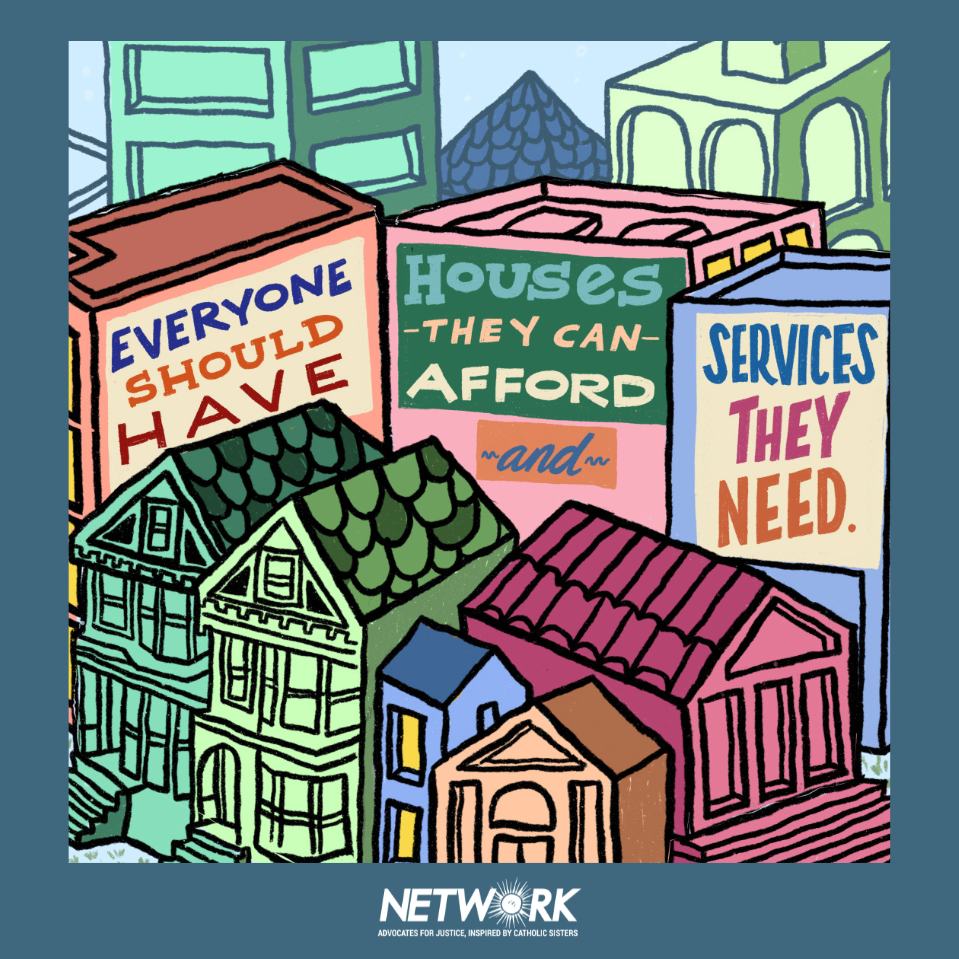
We could end homelessness in the U.S. for ten years for a cost of $200 billion. Over those same ten years, we could generate $1.4 trillion with a 2% tax on wealth over $1 billion.

Here’s the math: With that simple 2% tax on all wealth over $1 billion, we could provide housing for every single person in the United States – and we would still have $1.2 trillion left to invest in our communities!

Yet, homelessness is at a record high, and one in three households are “housing cost burdened” — forced to spend disproportionate parts of our income on rent or mortgage payments. This is because some members of Congress choose tax cuts for their ultra-wealthy backers instead of funding programs that would make housing more affordable for all of us.

Take action
  • Call your House Member at 1-888-897-9753 to ensure that Congress does not cut our Medicaid and SNAP to give tax breaks to the ultra-wealthy and to pay for deporting our neighbors in the budget reconciliation bill.
  • Spread the word. Save the image that I’ve placed below to your computer or phone and share it on social media and in emails to friends and family.
  • Write a letter to the editor (LTE) calling Congress to reject the budget proposal. LTEs are one of the most effective tactics for advocacy we have. Join us on Thursday, April 10 at 7:00 PM Eastern / 4:00 PM Pacific at our LTE training to learn some LTE best practices.

Find more LTE and social media guidance in our Lent toolkit.

The ultra-wealthy and the politicians they fund aren’t just blocking housing solutions, they are also actively making housing more unaffordable by allowing investors to buy up houses in our neighborhoods for their own profit, not to inhabit. In the first three months of 2024, investors bought up to 20% of homes in some markets. These investors drive first-time homebuyers out of the market, forcing them to rent from the investor-owners who hike up the cost of rent.

While those wealthy investors buy up our homes and line their pockets with our money, many of our neighbors are left out in the cold. Currently, there are 28 vacant homes for every one person facing homelessness.

Catholic teaching affirms that stable housing is a basic human right for everyone. Together, we will elect leaders who will prevent the ultra-wealthy from controlling our neighborhoods and hoarding our resources, and instead make housing security a reality for all of us.

TAKE ACTION: Call your House member today at 1-888-897-9753 and tell them to protect SNAP and Medicaid and reject tax cuts for billionaires in the budget proposal! Then, use our Lent toolkit to write a letter to the editor (LTE) calling Congress to reject the budget proposal.

NETWORK has more shareable content, sample social media posts, and LTE guidance for you in our Lent Toolkit.

Emily TeKolste, SP, NETWORK bio

Sr. Emily TeKolste, SP is NETWORK’s Grassroots Mobilization Coordinator. To read more, check out her column in Global Sisters Report, “The existence of billionaires is immoral.”
Lent Week 3: Congress: Prioritize Our Health, not Private Profits

Lent 2025: Giving Up Billionaires


Welcome to week 3 of our Lenten series, “Giving Up Billionaires,” as we call on Congress to give up billionaires so our communities can have what we need to thrive. Click here for the rest of our Lenten reflections and actions.

Congress: Protect Our Health, Not Private Profits


Sr. Emily TeKolste, SP
March 19, 2025


A friend of mine is a primary care doctor who regularly shares stories about insurance executives blocking her ability to care for her patients. For example, they delay her patients’ access to life-saving medications, which puts their health, and perhaps even their lives, at risk. Meanwhile, these insurance executives rake in record-breaking profits for themselves and their wealthy investors.

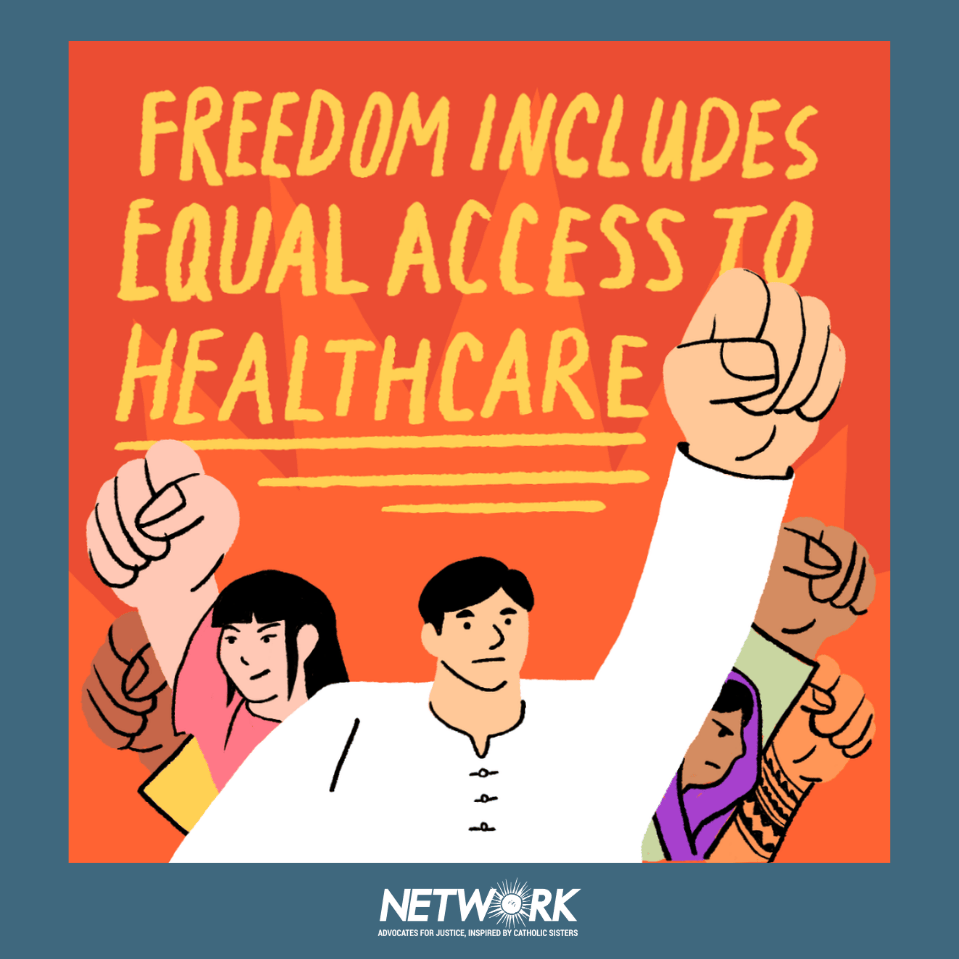
Catholic Social Teaching affirms that ensuring access to quality health care is essential to respecting the dignity of each person. No matter our race, country of origin, or size of our bank account, we value our health and want affordable health care–for ourselves and our families.

But insurance executives are lining their pockets at the expense of our health and using their profits to fund politicians who will protect their money grabs. It’s no wonder that some members of Congress are working on a bill to slash Medicaid funds–because by gutting government-supported health care, they can force more of us onto private plans and turn a bigger profit. Meanwhile, too many of us are left with huge medical bills and denials of needed medical treatment.

Take action
  • Call your House Member at 1-888-897-9753 to ensure that Congress does not cut our Medicaid to give tax-breaks to the ultra-wealthy and to pay for deporting our neighbors in the budget reconciliation bill.
  • Spread the word. Save the image that I’ve placed below to your computer or phone and share it on social media and in emails to friends and family.
  • Write a letter to the editor (LTE) calling Congress to reject the budget proposal–make sure to include your Members of Congress (Representative and two Senators) by name!

Find more LTE and social media guidance in our Lent toolkit.

There is a lasting solution: end the private profit motive and ensure that everyone has quality, affordable health care–for less than we’re paying now. This solution is sometimes known as Medicare for All. With Medicare for All, billionaires wouldn’t be able to continue profiting at our expense through the private insurance industry (which is why they pay to put people in office who will block it).

Until we achieve a common-sense program like Medicare for All, our society fills the gaps with Medicaid, which covers more than 71 million people. Right now, a few millionaires in Congress, backed by billionaire donors and the insurance industry, are working to kick people off Medicaid to fund massive tax cuts for themselves and their ultra-wealthy backers.

We are coming together to insist that a handful of billionaires stop profiting off our health care while families struggle to afford the care they need.

Call your Representative today at 1-888-897-9753 to ensure that Congress does not cut our Medicaid to give tax-breaks to the ultra-wealthy and to pay for deporting our neighbors.

NETWORK has more shareable content, sample social media posts, and LTE guidance for you in our Lent Toolkit.

Emily TeKolste, SP, NETWORK bio

Sr. Emily TeKolste, SP is NETWORK’s Grassroots Mobilization Coordinator. To read more, check out her column in Global Sisters Report, “The existence of billionaires is immoral.”

Lent Week 2: Tax Billionaires and Feed Our People

Lent 2025: Giving Up Billionaires


Welcome to week 2 of our Lenten series, “Giving Up Billionaires,” as we call on Congress to give up billionaires so our communities can have what we need to thrive. Click here for the rest of our Lenten reflections and actions.

Congress: Tax Billionaires and Feed Our People


Sr. Emily TeKolste, SP
March 12, 2025


As a child, I remember receiving the Catholic Relief Services Rice Bowl at church just before Lent. I was urged to donate my spare change or the money I saved from not buying a bag of chips after school so that hungry children in other countries could eat.

In 2021, David Beasley of the United Nations’ World Food Programme presented Elon Musk with a plan to address critical world hunger for $6.6 billion, about two percent of Musk’s wealth at the time. Musk had issued a challenge offering to pay that amount of money if someone presented a plan, but then refused to follow through. Two percent of my wealth is probably close to what I gave CRS as a child. It didn’t make much of a dent in world hunger, but Elon Musk could have fully ended critical world hunger at that moment.

It is a policy failure that the whims of one person can determine whether the world’s 8 billion people have access to food, or not.

In 2021, no billionaire stepped up to fund the UN World Food Programme’s proposal. Today, Congress is trying to cut our communities’ access to food to pay for $4.5 trillion in tax cuts for the wealthiest among us. Families who are already struggling to put food on the table will be even hungrier.

Take action

Call your House Member and tell them to reject cuts to SNAP and tax cuts for the ultra-wealthy. 

Join us as we continue promoting our Lenten campaign, “Giving Up Billionaires for Lent.” Save the image that I’ve placed below to your computer or phone and share it on social media and in emails to friends and family. And check out our Lent toolkit for more ways to share our campaign on social media and write letters to the editor (LTEs).

We must reject these cuts and act to ensure that the ultra-wealthy pay their fair share, so our communities can have what we need.

With just a two percent tax on all wealth over $1 billion, we could end hunger and homelessness, provide universal paid family and medical leave, and offer tuition-free community college in our country. We could also end hunger around the world—and still have money left over!

Take action with us today by calling your Member of Congress and asking them to reject cuts to SNAP and protect our access to food.

NETWORK has more shareable content, sample social media posts, and LTE guidance for you in our Lent Toolkit.


Sr. Emily TeKolste, SP is NETWORK’s Grassroots Mobilization Coordinator. To read more, check out her column in Global Sisters Report, “The existence of billionaires is immoral.”

Giving Up Billionaires for Lent

Lent 2025: Giving Up Billionaires


Welcome to week 1 of our Lenten series, “Giving Up Billionaires,” as we call on Congress to give up billionaires so our communities can have what we need to thrive. Click here for the rest of our Lenten reflections and actions.

Why Catholicism Calls Us to Give Up Billionaires


Sr. Emily TeKolste, SP
March 5, 2025


This year, we’re giving up billionaires for Lent. It’s not like giving up a sweet indulgence like chocolate. When we say we’re giving up billionaires, we mean we are working toward a future where no one is allowed to hoard excessive wealth and power–so that we can live in a world that looks more like the Kingdom of God.

This Lent, we are urging Congress to reject tax cuts for billionaires and to protect programs that provide critical services like access to food and health care in our communities. We’ll be doing this by calling Congress, writing letters to the editor, posting on social media, and sharing about the campaign with others in our lives. 

Let’s put “billionaire-ism” into perspective

Billionaires in the United States hold nearly $7 trillion in total wealth. If you earned $100,000 per year, paid no taxes, and had no living expenses, it would take you 10 years to save $1 million. In 10,000 years you could save $1 billion. It would take you 10,000,000 years to save $1 trillion.

It’s not just that it is wrong that billionaires exist while so many of their fellow Americans face homelessness or don’t know where their next meal is coming from: the existence of billionaires is why so many of us don’t have stable housing or food. Our economic system concentrates resources that should be for everyone into the hands of a tiny group of people. This is a policy failure and a moral failure.

Take action

Join us in spreading the word about giving up billionaires for Lent! Save the “imagine where we can go” image I’ve placed below to your computer or phone and share it on social media and in emails to friends and family. And, consider writing a letter to the editor (LTE) of your local newspaper about why Congress must give up billionaires.

NETWORK has more shareable content, sample social media posts, and LTE guidance for you in our Lent Toolkit.

Catholicism teaches: tax billionaires! 

Catholic Social Teaching offers a principle called the “Universal Destination of Goods.” The Catholic Church has long taught that the fruit of creation was given to us by God, and that private property exists to protect access to the fruits of creation for all people. When private ownership fails to do that, “Political authority has the right and duty to regulate the legitimate exercise of the right to ownership for the sake of the common good” (Catechism, 2406). It is long past time that Congress makes billionaires pay their fair share in taxes.

Giving up billionaires this Lent and beyond 

So this year, we’re giving up billionaires for Lent. Beyond Lent, we’re committed to coming together to elect leaders who will make the ultra-wealthy pay their fair share of taxes so that we can live in a world that looks more like the Kingdom of God: where everyone has clean water to drink, healthy food to eat, a safe place to live, and time to spend with our loved ones.

Over the next few weeks of Lent, look out for weekly emails from me about our “Giving Up Billionaires” campaign, which culminate with our Easter call to tax billionaires out of existence, so that all of us can share in the fruits of creation!


Sr. Emily TeKolste, SP is NETWORK’s Grassroots Mobilization Coordinator. To read more, check out her column in Global Sisters Report, “The existence of billionaires is immoral.”
Legislative Review of 2023

Legislative Review of 2023

One of the Most Dysfunctional, Unproductive Congresses of Modern Times

Laura Peralta-Schulte
February 19, 2024

Laura Peralta-Schulte is NETWORK’s Senior Director of Public Policy and Government Relations.

Following the 2022 midterm elections, 2023 brought “divided government” to Washington, DC as Republicans took control of the U.S. House of Representatives, while the Presidency and U.S. Senate remained under Democratic control.

Policymaking is always more difficult with a divided government because only compromise allows success. The federal system, by design, encourages deal-making and compromise, half-measures, and rare bipartisan achievements. The reactive nature of the federal system often frustrates those seeking revolutionary change.

The first session of the 118th Congress stands out as a year of abject legislative failure. It was a year of squandered opportunity, petty infighting, and deep frustration. The blame for this lack of progress lies directly at the feet of the House Republican Caucus and, by extension, former President Trump.

It is no secret the two major parties have competing visions on key policy issues. The key distinction between the parties is generally informed by what they believe to be the federal government’s proper role. These differences profoundly impact the lives of vulnerable people and the earth, our common home.

NETWORK’s Build Anew agenda requires an active federal government to address the social sins of the day: a broken, inhumane immigration and asylum system, shocking levels of wealth inequality and an ever-growing wage gap, increasing levels of child poverty, destruction of our planet, and more. NETWORK, in Washington and through the actions of our members back home, plays a critical role in bridging the divides to build support for core policy initiatives informed by Catholic Social teaching.

Why does this session stand out as being particularly troublesome? The design of the federal system remains the same; however, the norms of the system — civility and goodwill at minimum to a member’s party — have vanished. The problem did not start this year; institutional norms have slowly eroded, dating back to the speakership of Newt Gingrich and the government shutdowns of 1995 and 1996. The Trump administration accelerated this decay in Washington leading directly to the insurrection of January 6 and an attempted overthrow of the 2020 election.

The schism in the Republican party is most apparent in the House of Representatives and exists between two distinct factions: institutionalists, a quickly shrinking number of Members who respect traditional norms and recognize the need to compromise, and radicals, those who view compromise as capitulation and weakness and act with little regard for the institution or their fellow Republicans.

Tension between the two factions has been displayed in the House since the beginning of the term. This first became apparent during the nomination of Rep. Kevin McCarthy for Speaker of the House. A group of hardline House Republicans blocked McCarthy from securing the speakership to extract policy concessions to their radical agenda. McCarthy won the speakership after 15 humiliating votes. The nomination debate foreshadowed the tumult that was McCarthy’s short tenure as Speaker.

It is critical to note that Senate Republicans, led by Minority Leader Mitch McConnell, have largely rejected chaos, instead opting to collaborate with Senate Democrats to achieve mutual policy objectives. As 2023 came to a close, it was sadly apparent that a core issue that intersects both House and Senate Republicans’ agenda is a strong desire to end the U.S. asylum system and “build the wall.”

The radical nature of House Republican conservatives — in policy and political norms — is nothing less than shocking. Action on key policy initiatives stopped except for must-pass legislation — lifting the debt ceiling and passing two continuing resolutions to keep our government operational. Each bill moved forward only after House Republicans attempted to use the deadlines to alter core human needs programs for struggling families significantly. Then, after failing to develop a consensus among their caucus, the government was kept afloat due to the support of House Democrats under the leadership of House Minority Leader Hakeem Jeffries.

Cuts to poverty programs are being heralded by House conservatives as necessary austerity measures. The great irony is that the same House conservatives proposing to take food from babies are poised to spend billions of dollars for more tax cuts for the wealthy and corporations on top of the $2 trillion spent under President Trump’s Tax Cuts and Jobs Act passed in 2017.

Then-Speaker McCarthy lost his speakership due to passing a bipartisan continuing resolution with the support of Democrats in September. Compromise is the enemy of House conservatives, regardless of the chaos resulting from policy failure. Chaos is a key tactic and desired outcome.

It is worth noting that these radical members are working very closely with former President Trump in the lead-up to the 2024 election. Many are on record as election deniers and supporters of the insurrection. The former president urged these House Republicans to replace McCarthy in September. He rejected several candidates for Speaker to replace McCarthy, ultimately praising the nomination of ally Rep. Mike Johnson. It bears remembering that now-Speaker Johnson led the effort in the House to reverse Trump’s 2020 election loss.

The first session of a new Congress is typically a time when work gets done before the election cycle begins. Unlike previous congressional terms, the 2024 elections have been front and center in the House from day one. House legislative efforts have relentlessly attacked immigrants and U.S. asylum laws, voting rights, and the LGBTQ+ community.

There have been calls for book bans and ending diversity initiatives, attacks on the Internal Revenue Service as they actively work to ensure wealthy taxpayers pay their taxes, and drastic cuts on all key anti-poverty programs, including WIC, SNAP, healthcare, Social Security, Title One school funding, housing vouchers, and so much more. House Republicans also started formal impeachment processes for Department of Homeland Security Secretary Alejandro Mayorkas and President Biden.

The House Agriculture bill provides a great example of the harsh austerity measures radical House members are seeking. After successfully making it harder for older Americans to receive SNAP in the new debt ceiling law, key provisions of the Agriculture bill were nothing less than a frontal attack on communities living with high rates of poverty. The bill had cruel cuts in funding to prevent hunger and food insecurity, including hallowing out key programs for fresh fruits and vegetables for children.

Shockingly, the bill would eviscerate long-standing bipartisan support for the Special Supplemental Nutrition Program for Women, Infants, and Children (WIC) at a time of great need. A lack of funding means waiting lists, poorer health outcomes, and other hardships for new families and their babies.

House conservatives are heralding cuts to poverty programs as necessary austerity measures. The great irony is that the same House conservatives proposing to take food from babies are poised to spend billions of dollars for more tax cuts for the wealthy and corporations on top of the $2 trillion spent under President Trump’s Tax Cuts and Jobs Act passed in 2017.

As the year ends, Congress, due to inaction in the House, has pushed all decisions on major legislation into 2024, making this the most non-productive, dysfunctional Congress in the modern era. The House of Representatives completely failed in their responsibility to the American people. As always, the high cost of inaction falls hardest on the most vulnerable.

This story was published in the Quarter 1 2024 issue of Connection.

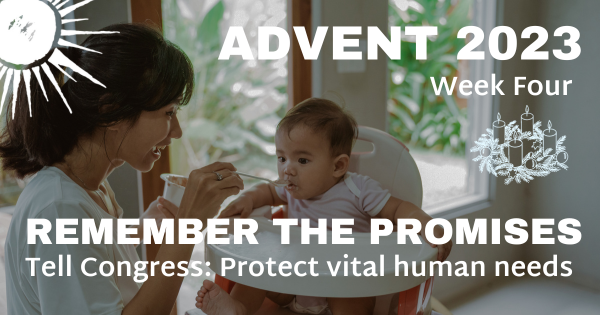
This Advent, Remember the Promises

This Advent, Remember the Promises

Mary J. Novak
December 20, 2023

Read NETWORK’s Advent 2023 reflections here!

Readings for the Fourth Sunday of Advent, December 24.

2 Sm 7:1-5, 8b-12, 14a, 16
Ps 89:2-3, 4-5, 27, 29
Rom 16:25-27
Lk 1:26-28

The Readings for the Fourth Sunday of Advent speak beautifully of God’s promises. Time and again, God delivers great things, and people rejoice at these wonders. God is good, and God is faithful. 

This year, NETWORK had experience with keeping promises and remaining faithful.  

Too often, this has taken the form of making sure Congress did not slash funding to vital human needs programs including SNAP and WIC, even after promising not to in the deal averting a government shutdown.  

A few but powerful extremist Members of Congress called for cuts that would have harmed millions of people in the U.S. by jeopardizing their access to food, housing, and healthcare. And worse, they proposed these cuts as part of their demands to avert a government shutdown. Shutting down the government would have harmed millions more across the U.S. and disproportionately harmed Black and Brown communities. 

We lament the sin of indifference toward our neighbors and communities these cuts would harm. We also lament the dangerous brinkmanship that sees shutting down the government as an acceptable bargaining tool. This approach is corrosive to the very fabric of our democracy, and worse, those who engage in this practice seem to know it. 

Amidst these trials, we also saw beautiful reminders of the faithfulness of God, in our own NETWORK Advocates. Justice-seekers from across the country gathered throughout this year as part of NETWORK’s Thriving Communities campaign to call on Congress to pass a moral budget. Rallies in Erie, Pennsylvania and Youngstown, Ohio, as well as on Long Island and Capitol Hill made the appeal for “Care Not Cuts.”  You joined together and spoke out, and you continue to beautifully model your faithful commitment to the common good. 

The ultimate fulfillment of God’s promise is Jesus, and the Gospel reading this Sunday finds the angel announcing to Mary that she would bear a son. Just as God’s faithfulness resulted in the creation of a family, the Holy Family, so the faithfulness of NETWORK Advocates has allowed countless families to flourish with the assistance they urgently need.  

Call to Action 

So far, the dedication of NETWORK Advocates has paid off in protecting vital human needs programming. But we must stay alert because the human needs programs we are called to care about are still very much at risk. Funding for the Supplemental Nutrition Program for Women, Infants, and Children (WIC) is not finalized till January. 

TAKE ACTION: Tell Congress to keep their promise and fund this vital program. 


Build Anew Series – Tax Justice

Build Anew Series — Part 5
Tax Justice

Virginia Schilder
October 20, 2023
Welcome back to our Build Anew Series, with weekly posts covering the people, policies, and values at the heart of the issues we work on. This week, we’re talking about tax justice, and specifically, the need to bring back the expanded Child Tax Credit.   


It’s budget time in Congress, and many of our representatives are pretending that we have a scarcity of funds with which to fund our government. But that’s patently untrue. There is a simple reality: If the wealthiest Americans and corporations paid their fair share of taxes, we would have more than enough to pay for all the public programs our communities not only need, but deserve. To visualize this, I invite you to try out NETWORK’s tax justice calculator tool, in which you can build your own federal budget with programs you care about and see how equitable tax policies can fund them. The United States has one of the greatest — and

most dangerous — degrees of wealth inequality in the world. The concentration of wealth into the hands of an ultra-wealthy few is facilitated and maintained, in large part, by our tax system. For example, consider Jeff Bezos, Amazon’s Founder and Executive Chairman, who enjoys a net worth of $155 billion, but did not pay a single cent in federal income taxes in 2007 or 2011.

A just tax system is a foundation of a just society, and a multi-faith, multi. In our past Build Anew Series piece on Economic Justice, we talked about how we as a collective have enough resources to ensure that everyone has what they need to thrive — it is only a matter of distributing those resources justly. Taxes can help us do that.

Congress now has less than 30 days to pass a FY24 federal budget. As part of NETWORK’s Congress, Keep Your Promise! Campaign, we’ve been urging our leaders to ensure that vital human needs programs like food, housing, and health care assistance are fully funded in the budget, and that the necessary policies are enacted to ensure that the wealthiest individuals and corporations contribute their fair shares.

A central part of a just tax system in the current budget process is the expanded Child Tax Credit (CTC). An expanded CTC combats child poverty, supporting families as they provide necessary care and resources for their children. The expired, temporary expanded CTC in 2021 (the American Rescue Plan increased the child tax credit for one year) was a resounding success. The child poverty rate was dramatically reduced to a record low 5.2%. It kept roughly 2.1 million children above the poverty line ― including an estimated 752,000 Latino children, 649,000 white children, 524,000 Black children, 89,000 American Indian and Alaska Native children, and 56,000 Asian children ― and lessened differences in poverty rates between children of all races and ethnicities (Center on Budget and Policy Priorities). Our children need it back!

In this week’s installment of the Build Anew Series, we’ll learn more about the CTC and the urgency of strengthening it in the ongoing appropriations process. First, let’s learn more about tax policy in the U.S., and why a just tax system is critical for a ju st nation.

Facts and Figures on Taxes in the U.S.
  • Refundable tax credits moved 7.5 million people out of poverty in 2019, according to the Supplemental Poverty Measure.
  • A 2019 Congressional Research Service report calculated that the 2017 Tax Revision law reduced federal revenue by about $170 billion in FY 2018, with corporations benefiting most from the tax cuts.
  • According to the U.S. Treasury Department, the wealthiest 1% of Americans may be evading as much as $163 billion in income taxes each year — many doing so legally via our unjust tax laws.
Present Realities

Our unjust tax code is directly related to the economic instability experienced by individuals and families across the U.S., and it affects the wellbeing of our country overall. Taxes enable us to have the public services we all want and benefit from, and to make the investments in people and neighborhoods that are needed for our communities to thrive. If we want good schools and accessible higher education, safe and efficient transportation infrastructure, a strong health care system, and healthy communities with affordable housing, clean water, and food security, we need to collectively contribute to funding them.

Decades of tax cuts for the wealthiest people and corporations have harmed our communities. Our tax code actively creates economic inequality — one of the most pressing problems in the United States. Our tax code treats income from capital more favorably than income from labor, which means that those at the very top — whose income largely relies on investments rather than work — end up paying a lower effective rate. This tax structure enables the wealthiest people and corporations to pay little to no taxes at all, hoarding resources that they gained off the labor of everyone else. The 2017 Republican Tax Law benefitted corporations by substantially lowering effective corporate tax rates and by generating a flood of stock buybacks and dividends for corporate shareholders. Meanwhile, the law reduced federal revenue by about $170 billion in FY 2018.

Most nefariously, our tax system maintains the racial wealth gap. In 2016, the median income of white households was $117,000, while Black households had only $17,000. This vast racial inequity is not incidental, but is a direct result of the Trans-Atlantic slave trade, Jim Crow, and centuries of racist federal policies — particularly policies that shaped our tax code. Our tax system continues today to maintain the wealth of the white ruling class. For example, our tax code privileges white couples in the structure of the married joint filing bonus; it rewards how wealthier white folks spend money (with tax incentives for buying a home, but not renting); and it facilitates the largely un-taxed intergenerational transfer of wealth in white families across history. The outcome is what we see today: our nation’s wealth concentrated in the hands of a tiny minority of white folks.

Tax justice means ensuring that wealthy individuals and corporations contribute a fair share, so that we can support the public services that help our communities to thrive. It hurts everyone in our country when we have insufficient funding for public programs, assistance for families experiencing homelessness or hunger, or the infrastructure we all rely on every day. A just system of taxation recognizes that we are one community with responsibilities to one another, and our wellbeing is tied together.

Learn more at NETWORK’s Tax Justice For All page.  

Our Values

“The obligations of justice and love are fulfilled only if each person, contributing to the common good, according to his own abilities and the needs of others, also promotes and assists the public and private institutions dedicated to bettering the conditions of human life.” —Gaudium et spes

One of the key principles of Catholic Social Justice Teaching is, “Rise above individualism for the good of the whole community.” This means rejecting an ethic that places individual gain above collective flourishing, and instead taking seriously our call and responsibility to promote the wellbeing of our neighbors. Taxes are a key way in which we can do this.

A just tax structure affirms the moral responsibility of each person to contribute to the community according to their ability. Material prosperity never arises in a vacuum. The resources that wealthy individuals and corporations have accumulated are generated by the labor of workers and supported by social goods like roads, bridges, schools, and fire departments that we collectively fund. Therefore, paying taxes is a serious ethical responsibility for those with abundance. It is also the responsibility of governments to use tax dollars in ways that meet the real needs and goals of our communities.

A just tax code can be a structure through which the values of sharing, reciprocity, and participation are lived out. These values were modeled by the community of Jesus’ early followers, of whom it is written:

“No one claimed that any of their possessions was their own, but they shared everything they had… And God’s grace was so powerfully at work in them all that there were no needy persons among them. For from time to time those who owned land or houses sold them, brought the money from the sales and put it at the apostles’ feet, and it was distributed to anyone who had need.” —Acts 4:32-35

As a community, the apostles model the Catholic notion of “the universal destination of goods:” the deep conviction that resources are to be shared — used to respond to need and to better the community. Scripture emphasizes the moral responsibility for those with means to share: “Anyone who has two shirts should share with the one who has none, and anyone who has food should do the same” (Luke 3:10-11). Yet, it is important to remember that in today’s society, in which unjust economic structures enable the accumulation of wealth often through the exploitation of workers, paying taxes is not just a matter of charity and sharing. Rather, it is a matter of justice — returning to communities what has been unjustly extracted.

This is why a just tax code is a moral obligation. Tax structures can serve to widen the gap between the ultra-wealthy and the rest of us, or they can work as a mechanism of justice. In the U.S. Bishops’ pastoral Economic Justice for All, the bishops insist that, “The tax system should be continually evaluated in terms of its impact on the poor.” This also means that families below the poverty line should not bear the burden of paying income taxes. Pope John XXIII put it plainly: “In a system of taxation based on justice and equity it is fundamental that the burdens be proportioned to the capacity of the people contributing.”

The Catholic tradition teaches that paying taxes is part of one’s responsibility to contribute to the common good. We are called to equitably share resources so that each person has what they need to live well, and that our society as a whole has the structures and programs that help all of our communities flourish.

The Child Tax Credit

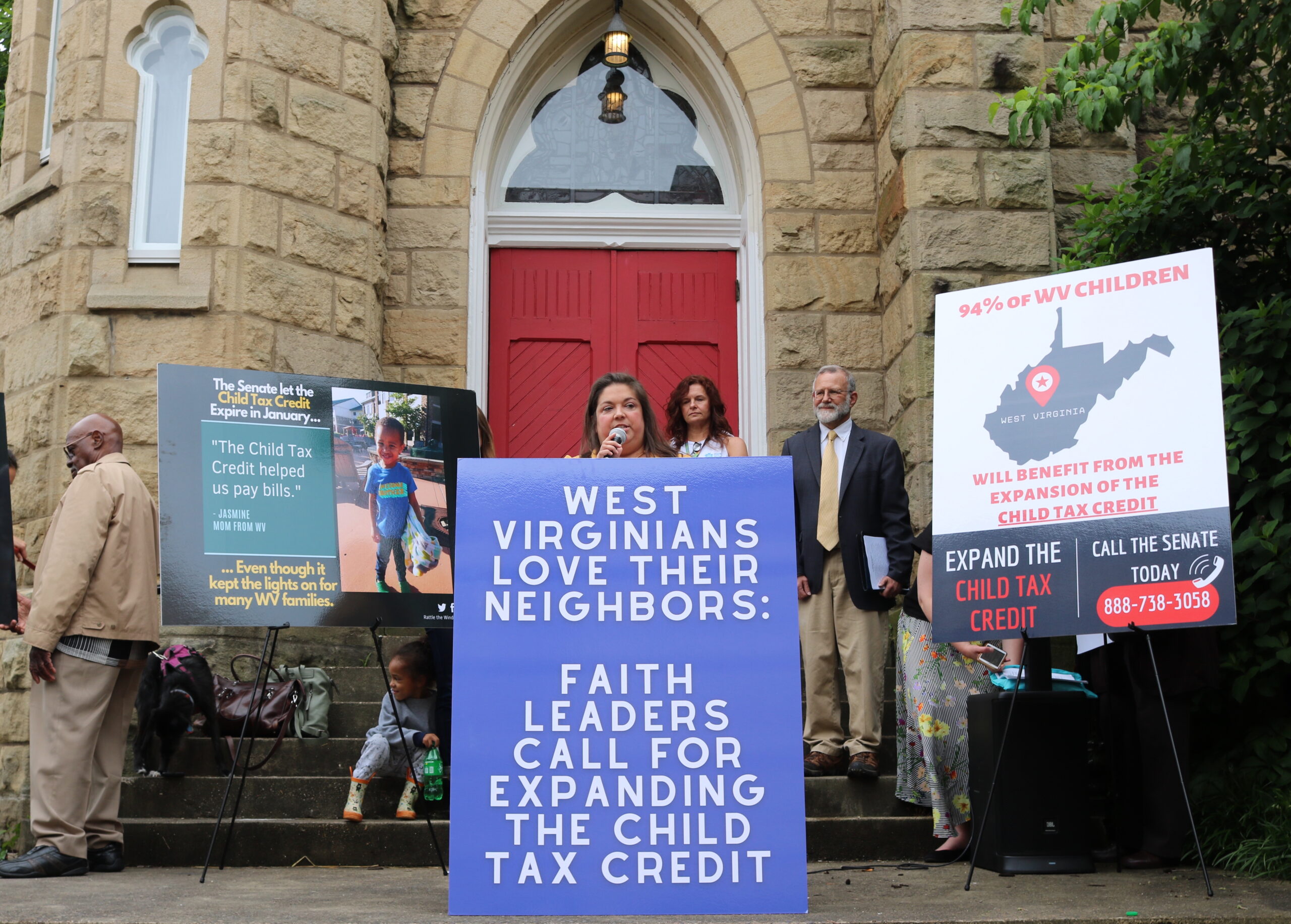
Advocates and faith leaders in West Virginia gather in May 2022 to call for a continuation of the expanded child tax credit.

The Child Tax Credit (CTC) was enacted in 1997 and currently provides a tax credit of up to $2,000 per child. Studies overwhelmingly demonstrate that the CTC directly reduces child and family poverty. In 2018, the CTC lifted 4.3 million people, including 2.3 million children, out of poverty. However, the current CTC law provides the greatest benefits to higher income families, in effect penalizing the lowest wage workers in our communities.

In 2021, as part of the American Rescue Plan, the CTC was increased to up to $3000, and penalties on low-income families were removed. This expansion finally allowed all families to benefit from the full CTC, regardless of their income. The 2021 expansion was an incredible success: it extended the CTC to the families of 27 million children who previously did not have access, and it reduced the national child poverty rate from an anticipated 8.1% down to 5.2%(!).

Lived Experience

Nakkita Long is a mom in Winston-Salem, NC with a master’s degree in criminal justice. She shares,

This past year (2020) has been devastating for my family in ways that I cant even explain…. Giving $300 to families may not seem like a lot, but when you’re working minimum wage or you’re underpaid, it’s everything. It’s the difference between where you live, what you eat, and how your family enjoys leisure.   

For my family, the child tax credit has benefited me because my daughter started college in the middle of the pandemic, and my son is starting kindergarten. I was able to buy my daughter a laptop so she could do her studies at home. I was able to do things with my family that I wasn’t able to do before because my income was low, I was living paycheck to paycheck. 

Look at the cost of living, and look at what people actually need to sustain themselves on a daily basis. For my family, just the basic needs of bread, lights, water, having a car to get back and forth to work, have been a challenge for me. And the benefits of incentives such as the child tax credit, extended unemployment, free child care, free college, is astounding, and it takes my family to a different place as far as what we can do successfully and how we can grow. It’s important to understand that giving people what they deserve… empowers those families to build businesses, become homeowners, invest in their communities, attend great schools, become great leaders, and do great things in society.”  

From the Domestic Human Needs Story Bank

Despite this success, Congress decided to allow the 2021 CTC expansion to expire – with detrimental impact to our most vulnerable children. Child poverty has risen, and an estimated 19 million children are deprived of all or part of the CTC simply because of their families’ low wages. This has had a disproportionate impact on Black and Brown families, affecting approximately 45% of Black children and 39% of Latine children. It has also hurt rural communities, as 33% of children in rural areas have been negatively impacted by the expiration of the CTC expansion.

This is why we need to bring back the expanded CTC. A strong CTC helps provide essential resources for child care and other support services, and thus enables parents to work. It also promotes healthy children, as lifting children out of poverty is directly related to improved health and education outcomes. We know how well the expanded CTC works! To support flourishing families and protect the youngest and most vulnerable members of society, Congress must expand the CTC to its 2021 levels. Our children need and deserve it.

Click here to learn about how you can take action to demand that Congress enact a strong, expanded Child Tax Credit. And to learn more about the CTC, check out NETWORK’s CTC leave-behind.

Join us again next week for part 6 of the Build Anew Series on democracy, a follow-up to the third installation of our White Supremacy and American Christianity series this Saturday. And don’t forget to stay tuned on Instagram (@network_lobby) and Facebook for our Build Anew video series!