

Category Archives: Front Page

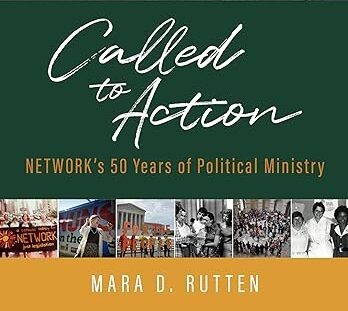
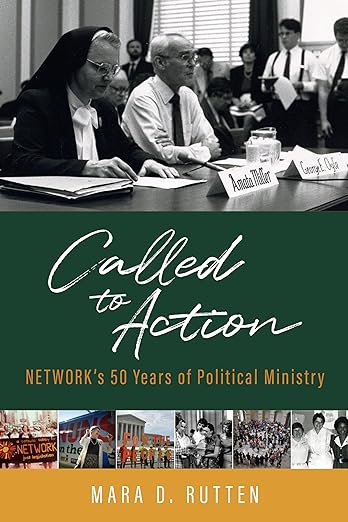
Called to Action: NETWORK’s 50 Years of Political Ministry

“Called to Action: NETWORK’s 50 Years of Political Ministry” by Mara D. Rutten

Book Review

Review by Sr. Susan Rose Francois, CSJP

In her book, “Called to Action: NETWORK’s 50 Years of Political Ministry,” Mara D. Rutten offers a well-researched, engaging, and comprehensive history of the nation’s first Catholic Social Justice lobby. Through first-person interviews, archival documents, and narrative storytelling, Rutten documents the creative and faithful response of Catholic sisters to the call of the Second Vatican Council to read and respond to the signs of the times through the birth and development of this collaborative political ministry. In the process, she also weaves together a variety of seemingly disparate yet intersecting threads—the renewal of religious life, feminism, social concerns, single issue politics, church and state, and the role of the laity. The resulting work not only creatively tells the story of NETWORK, but also gives the reader an insightful perspective on the tapestry of social, political, and ecclesial life in the United States during the past half century.

No doubt, some readers may have lived through much of this history themselves, perhaps even as supporters and participants in NETWORK’s early efforts to seek systemic change and justice in the world through advocacy for economic justice, led by women religious who had personal experience accompanying people most impacted by unjust public policies. Rutten makes these early days come alive, managing the difficult task of painting a dynamic picture of organizing meetings and policy debates through the judicious use of first-person accounts and archival materials. As a relative late-comer to this movement inspired by Catholic sisters—I am the same age as NETWORK and was a Nun on the Bus in 2016—I found myself enthralled and invested in the narrative. Moreover, Rutten highlights a clear thread of intentionality and integrity throughout the journey, even amidst challenges and controversy in both political and ecclesial spheres.

Rutten begins her narrative later in the story, with the 2012 appearance of then Executive Director Simone Campbell, SSS on The Colbert Report, following the Vatican’s naming of NETWORK in the document announcing the doctrinal assessment of the Leadership Conference of Women Religious. While not explicit, when read in the larger context of the time, the Vatican officials’ concern seemed to be the focus of NETWORK’s advocacy—applying Catholic Social Teaching to issues of social and economic justice—as well as “promoting certain radical feminist themes.” Careful readers will see this as a reference to the reality that NETWORK was not actively advocating on the issue of abortion.

“Called to Action” gives critical context here, carefully outlining the initial and subsequent discernment by NETWORK founders and leaders to center their advocacy work on the “bottom drawer issues,” including hunger, housing, and militarism. The term refers to the discovery by founding NETWORK Director Carol Coston, OP that the top three and a half drawers of lateral files in the US Bishops Conference covered the issues of federal aid to parochial schools and abortion. All other social concerns were crowded together in the bottom half of the fourth drawer. This was where NETWORK felt called to focus their efforts. This had the result of avoiding duplication of efforts. It also led to criticism of NETWORK from various audiences over the years. Nevertheless, generations of NETWORK leaders and staffers held fast to this commitment to promote Catholic Social Teaching and highlight the critical bottom drawer issues affecting quality of life in service of the common good, taking the message from the halls of power to the highways and byways.

Another narrative theme is the application of the call to universal holiness and the dignity of all persons, particularly women, to NETWORK’s operations and advocacy. On the advocacy side, this led to lobbying for the Equal Rights Amendment and health care access. Rutten’s storytelling here both lifts up the unique role of NETWORK in this work and describes some of the pitfalls, detours, and frustrations along the way. In terms of operations, from the beginning NETWORK sought to create an internal system of pay equity and shared collaborative leadership. Rutten carries this thread throughout the history, all the way to the current leadership model of lay women and men with a small number of women religious.

“Called to Action” is filled to the brim with a who’s who of courageous, creative, and faithful people who have carried out this innovative political ministry over the past fifty years—too many to name here. Built on a solid foundation, inspired by sister spirit and fueled by the call and response of the laity, NETWORK continues to focus on the bottom drawer issues in service of the Gospel. Here’s to the next 50 years!

“Called to Action: NETWORK’s 50 Years of Political Ministry” is available for purchase on Amazon for $14.99 and $6.49 on Kindle.

Advent 2023 Week 3 Calls Us to Bring Rejoicing

This Advent Calls us to Bring Rejoicing

Jarrett Smith
December 12, 2023

Readings for the Third Sunday of Advent, December 17.

Is 61:1-2A, 10-11
Lk 1:46-48, 19-50, 53-54
1 Thes 5:16-24
Jn 1:6-8, 19-28

The readings on the Third Sunday of Advent are meant to be a time of rejoicing and gladness amidst solemn anticipation. This spirit could readily apply to expanding the Child Tax Credit (CTC). The prophet Isaiah speaks of God bringing glad tidings to people in poverty, healing the brokenhearted, proclaiming liberty, and giving freedom to imprisoned people. A “year of favor” is one way to describe the year that Congress passed the expanded CTC and lifted a record number of children out of poverty. Across the U.S. millions of families were able to flourish where they had previously been held back or held down by lack of basic resources. This was a resounding victory for justice-seekers who envision a world in which all people have what they need.

Read NETWORK’s Advent 2023 reflections here!

When Congress allowed the expanded CTC to expire at the end of 2021, child poverty rose from 5.2 percent in 2021 to 12.4 percent in 2022. This hit Black, Brown, and Indigenous families especially hard, and this staggering setback was about one thing: the choices of Congress.

It is reckless policy, and morally repugnant, to extend tax breaks to corporations without also enacting robust expansion of the CTC. Congress must pass a Child Tax Credit that allows the 19 million who do not qualify for the entire credit to get the entire credit phased in faster. And it must apply to all children in the household.

In recent years, NETWORK has sought to tell this story and spread it far and wide. In doing so, we have centered two justice-seekers — Fr. Bryan Massingale and Dr. Robert P. Jones — whose voices cry out in the desert of white supremacy as it manifests itself in U.S. Christianity. In October, we hosted the third of our White Supremacy and American Christianity dialogues with them, this time focusing on how “a consistent ethic of hate threatens our democracy.”

Read NETWORK’s Advent 2023 reflections here!

For people of faith, especially Christians, it should be especially clear that a policy that helps so many children out of poverty should receive enthusiastic support and not be allowed to expire. In the Gospel this Sunday, John the Baptist refers to Jesus as “one among you who you do not recognize.” Similar to the judgment account in Matthew 25, we so often fail in our policy choices to recognize Jesus in those who are marginalized and harmed.

As we look to the Third Sunday of Advent, the church also celebrates the feast of Our Lady of Guadalupe on December 12. This feast celebrates the love that Our Lady has for all of her children. What better way to translate that love into concrete action in the world than for Congress to pass a CTC that supports the most vulnerable?

Call to Action:

Send a message to your Members of Congress. Tell them to pass a fully refundable, monthly Child Tax Credit so all of us have what we need to take care of ourselves, and our families.

Visionary Goals

Visionary Goals

Devoting Ourselves to Transformation Brings Out Our Best

Sr. Emily TeKolste, SP
December 11, 2023

Sr. Emily TeKolste, SP is NETWORK’s Grassroots Mobilization Coordinator.

When I was a kid, I was mildly obsessed with NASA — particularly the Apollo missions to the moon. Because of this, I admired President Kennedy, who set a goal to send astronauts to the moon and inspired the American people to champion his vision. In a speech at Rice University, he said, “We choose to go to the moon in this decade and do the other things, not because they are easy but because they are hard. Because that goal will serve to organize and measure the best of our energies and skills.”

As I grew older, I started to encounter the work of Dr. Martin Luther King, Jr. and many other visionary leaders who rallied our country to come together across division. They saw the fight for racial and economic justice as inextricably intertwined. They strove to build and sustain what Fred Hampton called a Rainbow Coalition, recognizing that our fates are linked.

Today, we benefit from the many fruits of their visions. We carry cellphones in our pockets that exist because of the vast technological leaps provided by the research and brilliant intellect that went into the Mercury, Gemini, and Apollo missions and beyond. We have landmark legislation, the Voting Rights Act and Civil Rights Act, that have moved us closer to racial justice because of Black-led, multiracial, multi-faith campaigns that withstood white supremacist violence to create a better world for us all.

We have made astounding progress thanks to the work of so many visionary leaders — people just like you and me who stood up and proclaimed that we could live in a better world if we could come together toward a common goal.

Over the past decade, though, it seems like we’ve lost so much ground. Supreme Court decisions have stripped the Voting Rights Act of vital protections. Leading candidates for public office stoke racism and misogyny with no negative consequences. And many family bonds are frayed along ideological lines — with people unwilling to recognize the humanity bestowed by God in their loved ones, and all too willing to stop talking to one another.

Several years ago, I encountered the words of Civil Rights icon and public theologian Ruby Sales in her interview with Krista Tippett of On Being. She said “I really think that one of the things that we’ve got to deal with is that — how is it that we develop a theology or theologies in a 21st-century capitalist technocracy where only a few lives matter? How do we raise people up from disposability to essentiality?” She goes on to say that this goes beyond the question of race, recognizing the basic dignity and the very real pain that so many people — Black and white — are experiencing in our world today.

When it comes down to it, most of us — no matter what we look like or where we get our news — want the same things. We want to live in safety. We want to love and be loved. We want enough food to eat and some comfort in our lives. We want to contribute to our families and communities. We want meaningful work — whether paid employment, care for family, or volunteer work (care for community). And we want that work to pay us fairly so that we can support our families and contribute to our communities.

Lately, though, it seems that people cling so tightly to political parties and identifying labels that we can’t seem to find common ground on anything. A few wealthy individuals and greedy politicians seek to divide us along ideological lines by strategically stoking a history of racial bias so that they can distract us while they dismantle our democracy and manipulate the economy to serve their interests.

The results of this strategic use of division and racism are stark: a real and ongoing threat of political violence, multiple days this summer of new domestic and global record-setting high temperatures, unaffordable housing costs, and a wealth gap between the rich and the poor that’s greater today than it was in the Gilded Age that preceded the Great Depression.

These things hurt all of us!

But it doesn’t have to be this way. We are people of hope. We believe in human dignity and are capable of treating everyone around us with the dignity they deserve. By doing so, we can begin to open up a path for transformation for those close to us, and to people in our community. When we begin by transforming our own hearts and minds, we can bring others along with us and, together, transform our whole political climate.

What if — instead of naming our enemies as each other — we come together to achieve a common goal as visionary leaders did in the past? This will require the best of all of us, much like we did as a nation when we took on the space race. What if we embraced a race to end poverty, a race to house the unhoused, a race for compassion and humanity? Not because they are easy, but because they bring out the very best each of us has to offer.

This story was published in the Quarter 4 2023 issue of Connection. 

Advent Calls for Renewal

This Advent Calls for Renewal

Joan F. Neal
December 8, 2023

Advent 2023, Week Two Reflection: Disavow and Dismantle White Supremacy

Readings for the Second Sunday of Advent, December 10.

IS 40:1-5, 9-11
PS 85:9-10, 11-12, 13-14
2 PT 3:8-14
MK 1:1-8

The readings on the Second Sunday of Advent remind us that the purpose of Advent is to show us that we can start again, that new beginnings are possible. The Gospel and the first reading this Sunday feature the words of Isaiah, fulfilled in John the Baptist, a voice in the wilderness proclaiming Jesus’ entry into human history. Here, God is doing something entirely new. Human history is starting over again, and we get a second chance to hear the Word of God and follow it.

Read NETWORK’s Advent 2023 reflections here!

In the U.S., we could use this restart to our history. White supremacy and Christian nationalism were built into our systems and structures by people with a vision of America as a place for only a certain kind of privileged, white Christian. This white supremacy has endured for centuries and is contrary to the Gospel. Jesus showed up to transform the structures and habits that cut us off from God — to bring liberty to captive people and let the oppressed go free. Sadly, these structures still show up in how we treat one another: economic inequality, lack of access to affordable healthcare, and violence and oppression against Black, Brown, and Indigenous people, etc.

In recent years, NETWORK has sought to tell this story and spread it far and wide. In doing so, we have centered two justice-seekers — Fr. Bryan Massingale and Dr. Robert P. Jones — whose voices cry out in the desert of white supremacy as it manifests itself in U.S. Christianity. In October, we hosted the third of our White Supremacy and American Christianity dialogues with them, this time focusing on how “a consistent ethic of hate threatens our democracy.”

Read NETWORK’s Advent 2023 reflections here!

We know and recognize the truth and that truth can set us all free. It requires facing our history, repenting and repairing the wrongs. NETWORK’s conversations with Fr. Massingale and Dr. Jones offer a sobering perspective into the founding sins of the U.S. But where we start doesn’t always have to be where we end. This week’s second reading reminds us that as we await new heavens and a new earth in which righteousness dwells, we must conduct ourselves in holiness because, “God does not delay his promise,” and “is patient …, not wishing that any should perish but that all should come to repentance.”

This Advent, let us all heed the call of the prophetic voices of our day and set about educating, organizing, and lobbying to disavow and dismantle white supremacy and Christian nationalism–in our communities and our churches.

Call to Action:

To assist with the ongoing work of dismantling white supremacy, NETWORK created a Reflection and Discussion Guide that you can download. It is a companion to the latest White Supremacy and American Christianity online conversation. We hope that it equips you, advocates and supporters, in personal reflection and your own conversations. We encourage you to consider hosting screenings and discussion groups to help educate your community about white Christian nationalism — an ongoing threat to a multi-racial, multi-cultural democracy where all people can thrive.

Where in your community does the path still need to be made ready for the way of the Lord? 

The Need for Welcoming Communities

The Need for Welcoming Communities

Congress Can Invest in Welcoming Asylum Seekers Across the U.S.

Jenn Morson
December 5, 2023

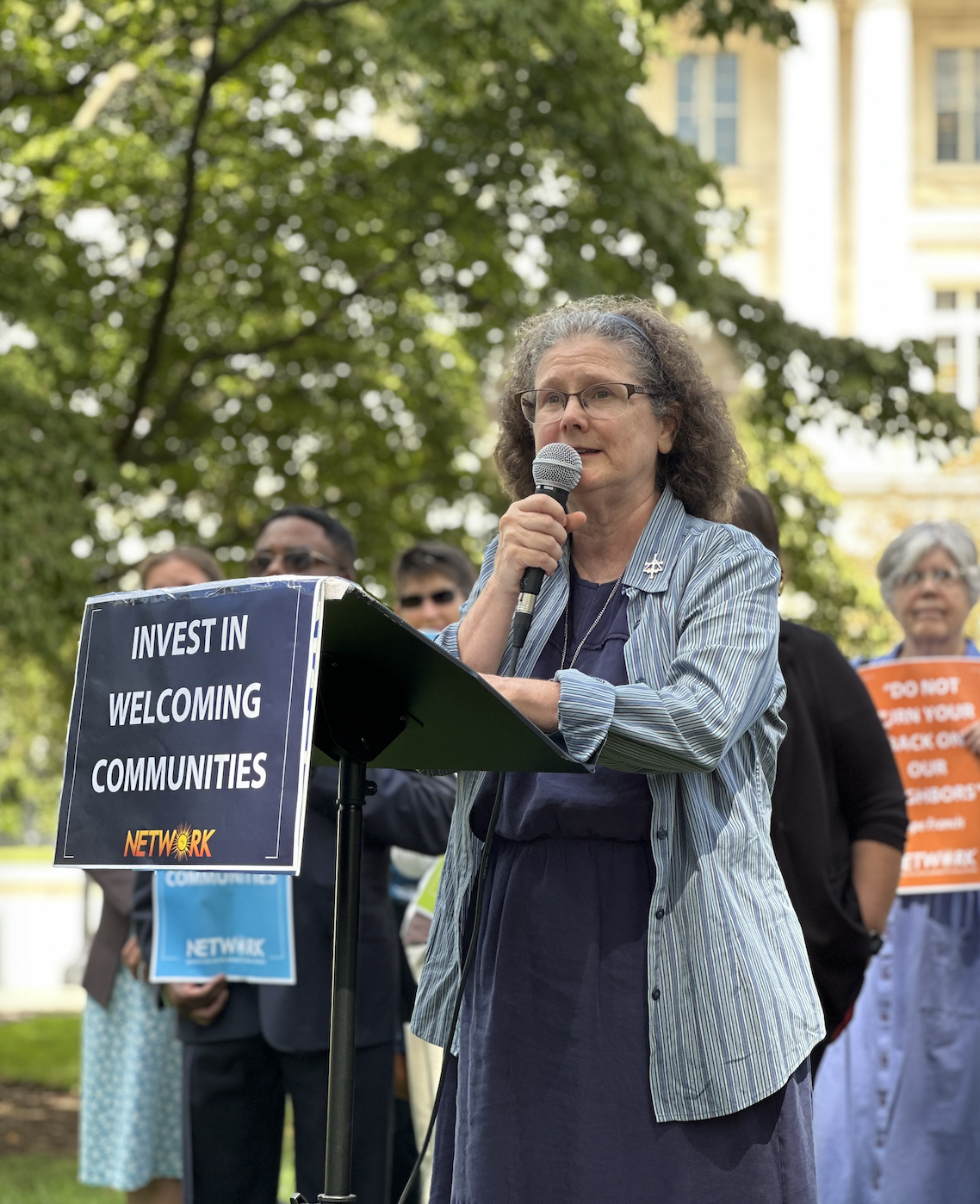
Sr. Susan Wilcox, CSJ, of Brooklyn, N.Y. shares her account of coordinating and serving meals to people seeking asylum who had been bused to New York. She noted how her efforts would benefit from Congress funding the Shelter and Services Program (SSP), which would shift the U.S. response to asylum seekers from militarization at the border to investment in communities across the country who offer a welcoming response to asylum seekers.

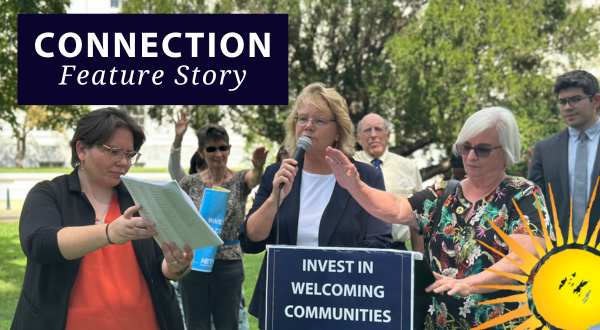
“Immigrants and Asylum Seekers Welcome Here!” read the signs held by a handful of supporters stationed behind the podium as several speakers, including three supportive members of Congress, gathered to deliver a letter to Congress signed by over 7,000 Catholics. Gathered September 13 on the U.S. Capitol grounds, members of NETWORK Lobby and other organizations including the International Mayan League, Church World Service, and Women’s Refugee Commission joyfully and emphatically laid out their hopes for a shift in how the U.S. government approaches its response to asylum seekers.

In her opening remarks, Ronnate Asirwatham, Government Relations Director of NETWORK, stated that the purpose of the gathering was to call on Congress to invest in welcoming communities. “Who are welcoming communities?” Asirwatham said, “To put it bluntly, welcoming communities are our community. People who welcome are all of us. It is very natural to welcome. We welcome each other, we welcome strangers, we welcome people seeking safety, and people passing through.”

“While it is most natural to welcome, it seems today that the voices against welcome, especially against welcoming people seeking asylum, [are] getting louder,” Asirwatham warned. “State and federal governments are moving to criminalize welcome. In Arizona, people are being arrested for leaving water out in the desert. In Florida, people are afraid to take their neighbors to the doctor because of pushback. And in Texas, people seeking safety are being pushed back, and Texans wanting to provide them water are not being allowed to.”

In spite of these obstacles, Asirwatham comforted those gathered, saying, “We are not going anywhere. Congress will hear us. Congress must act and enact laws and policies that support us, the American people, that allow us to thrive and reap the benefits that welcoming our fellow human beings allow. This is why our message is simple: we are asking Congress to invest in welcoming communities. We are simply asking Congress to invest in us.”

Gathered Together

Asirwatham introduced many compelling speakers who gave testimony of their own advocacy work as they also encouraged Congress to invest in welcoming communities. Speakers at the press conferences were optimistic despite the strongly worded letter calling for a renewed sense of justice.

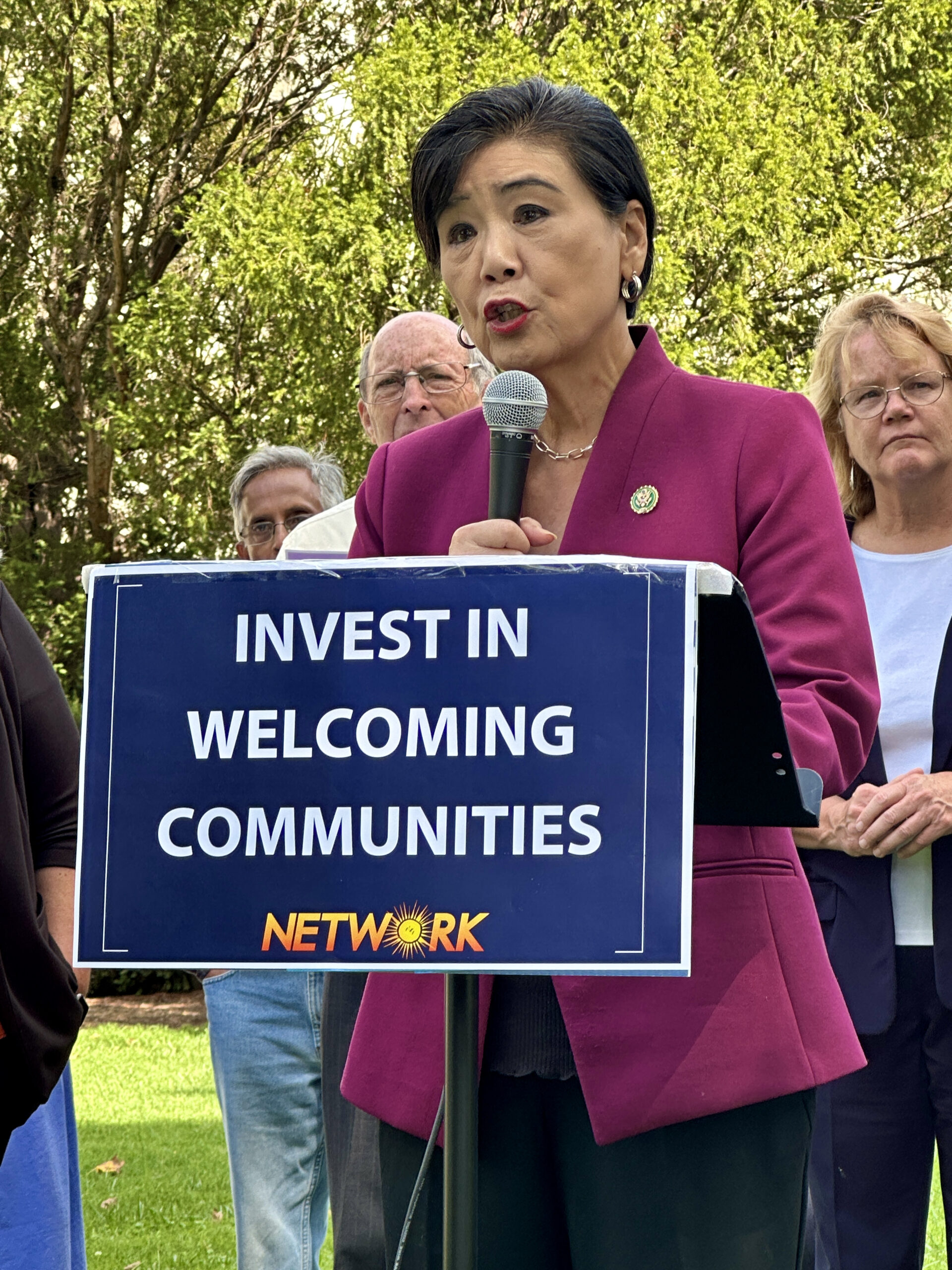
Rep. Judy Chu (CA-28) speaking at the gathering

U.S. Congressman Joaquin Castro (TX-20) addressed the crowd, thanking NETWORK for being a voice of compassion, conscience, dignity, and reason for human beings. Castro’s own mother previously served on the board of NETWORK. “Your voice and your activism is needed more today than ever,” Castro said. “We need to remind politicians who use migrants as political scarecrows — because that’s what they do, they use them as scarecrows to engender fear and resentment among the American people — we should remind our fellow Americans and mostly politicians that America became the strongest nation on earth not in spite of immigrants but because of immigrants.”

“Instead of embracing our rich immigrant heritage, too many politicians have used our immigrant communities as political pawns by fearmongering and peddling harmful, dangerous, political rhetoric. And the human cost is immense,” said Rep. Judy Chu (CA-28) in her remarks.

Lifting up the leadership and vision of Pope Francis, Rep. Luis Correa (CA-46) said, “One human being suffering around the world is one human being too much.”

In her moving testimony that referenced her own plight as a refugee from Guatemala, Juanita Cabrera Lopez, Executive Director of International Mayan League, gave a message of hope: “I know firsthand what it looks like when a community invests in welcome and justice, and I know it is possible today because many communities are already doing this work.”

Regarding the immigration of Indigenous Peoples, Cabrera Lopez said, “Our ask remains the same. We need long-term investment to continue welcoming asylum seekers, particularly Indigenous asylum seekers.” Cabrera Lopez concluded her speech with a call for investing in shelter for newly arriving families and youth.

Sent Forth

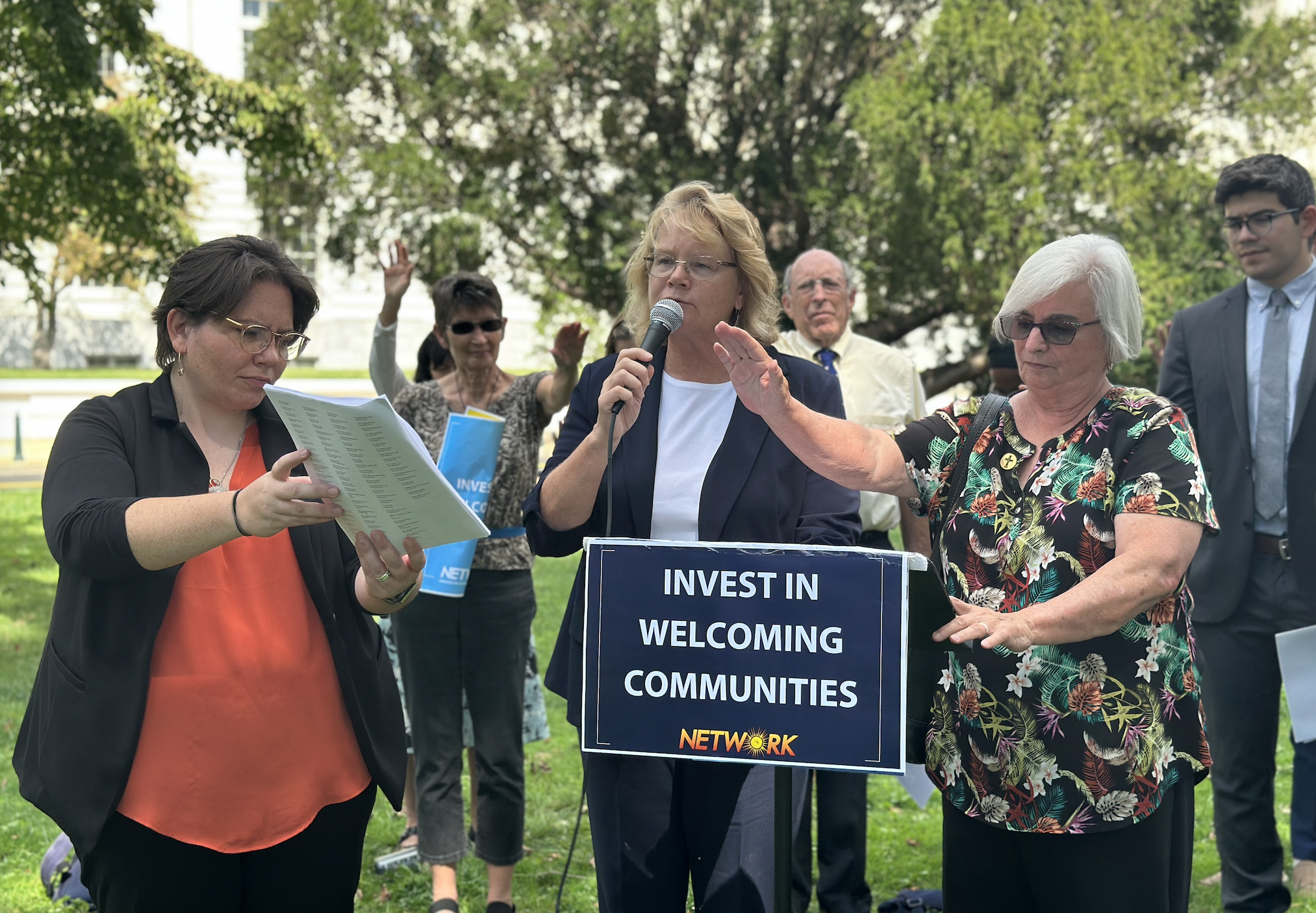
Sr. Eilis McCulloh, HM, holds up a copy of the letter signed by over 7,000 Catholics from all 50 U.S. states calling on Congress to invest in communities who welcome asylum seekers, while Sr. Karen Burke, CSJ, and Sr. Alicia Zapata, RSM, pray a blessing over the letter at the conclusion of NETWORK’s Sept. 13 action on Capitol Hill.

Sister Eilis McCulloh, HM, encouraged those gathered to extend their hands in prayer over the letter to Congress, as Sister Alicia Zapata, RSM, and Sister Karen Burke, CSJ, prayed in gratitude for the signers of the letter while also offering prayers for immigrants, organizations that support immigrants, and for the openness of members of Congress to the message of the letter.

“May this letter, which carries the stories of our immigrant siblings and our hope for immigration reform, be one way that we share in Jesus’ mission to ‘welcome the stranger’ and advocate for immigration policies that invest in communities,” they prayed.

The letter, which was co-sponsored by Hope Border Institute, Kino Border Initiative, the Maryknoll Office for Global Concerns, and St. Columban Mission for Justice, Peace, and Ecology, was addressed to key House and Senate members. It begins with Pope Francis’ 2015 remarks to Congress, in which he urged those gathered to welcome the stranger. The signatories are asking Congress to appropriate funds for supporting immigrants and communities while divesting from programs which militarize the border and criminalize immigrants.

In order to accomplish these goals, the letter urges Congress to fully fund the existing Shelter and Services Program at $800 million in 2024, and to distribute the funding equitably.

Additionally, the letter requests that any funding made available is done so via grant or contract rather than as a reimbursement. Additionally, the letter urges Congress to take back all funding for the border wall construction that has not yet been spent and cut funding for Customs and Border Protection and all other militarized border enforcement agents and technologies, as these agencies are overstaffed and overfunded.

NETWORK and its partners remind Congress that seeking asylum is a human right that should not be restricted, and invite them to embrace the Catholic belief of the inherent dignity of every person and make this a guiding principle to immigration policies, moving away from militarization and towards care.

In the words of Sister Susan Wilcox, CSJ, “We are doing the work. We have the solutions. We just need a little help.”

This story was published in the Quarter 4 2023 issue of Connection. 

Build Anew Series – Looking Ahead

Build Anew Series — Part 10
Looking Ahead

Virginia Schilder
December 5, 2023
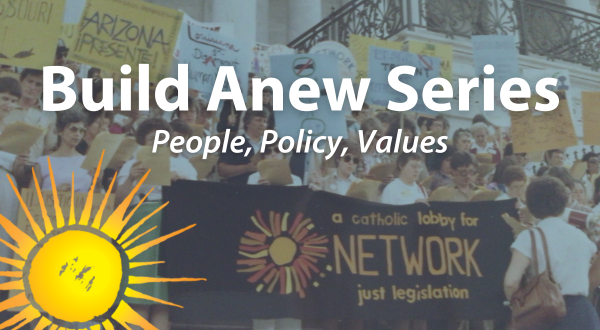
Welcome back to our Build Anew Series, with weekly posts covering the people, policies, and values at the heart of the issues we work on. This final post wraps up the Series and looks ahead to more work together in 2024, including the launch of Y.A.L.L.: Young Advocates Leadership Lab. Thank you to everyone who has joined us in reading, watching, and taking action!    

Well friends, here we are: our TENTH and final part of the Build Anew Series!

Thank you to everyone who has been with us on the Build Anew Series journey. Over the past few months, we dove into each issue of NETWORK’s Build Anew Agenda. We learned from the some of the people most directly impacted by these policy issues, we confronted some tough policy facts, and, rooted in the Catholic Social Justice tradition, we reflected on the moral dimensions of these social realities.

Equipped with that knowledge, reflection, and compassion, we took action — from urging President Biden to establish an H.R. 40 Reparations study commission; to calling our Representatives in Congress to protect and expand SNAP; to learning more about Medicaid unwinding; and to watching White Supremacy and American Christianity part 3.

The Franciscan Sisters of Perpetual Adoration (FSPA) and NETWORK work together in political ministry for climate justice advocacyYou may have noticed that one of our key issue areas was missing from the series posts: climate justice. Earlier this year, NETWORK added climate justice to our work, thanks to an extremely generous gift from the Franciscan Sisters of Perpetual Adoration. Climate justice is connected to all of the issues in the Build Anew agenda, like food, health care, immigration, taxes, the economy, and more. As we move into the new year, join us in integrating climate justice more deeply into our advocacy!

2024 will also bring the launch of our exciting new initiative, Y.A.L.L.: Young Advocates Leadership Lab. Y.A.L.L. will equip and resource emerging Catholic and other faithful justice seekers to be leaders in working for a multiracial democracy. If you’re a young person (like me!) and found that even just one of these issues touched you or spoke to you or your community’s lived experience, we invite you to reach out to NETWORK’s Grassroots Mobilization and Education Specialist Chelsea Puckett to learn more about Y.A.L.L.

The Build Anew Series brought us back again and again to our foundational Catholic social teaching: that every single person has dignity and our flourishing is intertwined — meaning no one can be left out of our circle of care! To build anew, our society and communities to be more life-giving for all of us means cultivating solidarity, a daily conversion to loving our neighbor by working for their wellbeing. We are called to join in the Spirit’s liberating action all around us, and together, we have the power to build anew!

Thank you so much for joining us! Continue to be part of our community of justice-seekers by following NETWORK on social media (like Instagram (@network_lobby) and Facebook) and becoming a NETWORK member.

Advent 2023, Week One Be Vigilant

This Advent Calls for Vigilance 

NETWORK Lobby offers Advent reflections

This Advent Calls for Vigilance

Sr. Eilis McCulloh, HM
December 1, 2023

Advent 2023, Week One Reflection: A Call for Vigilance

Readings for the First Sunday of Advent, December 3

Is 63: 16B-17, 19B; 64:2-7
Ps 80: 2-3, 15-16, 18-19
1 Cor 1: 3-9
Mk 13:33-37

The readings on the First Sunday of Advent call for vigilance. In the Gospel, Jesus instructs his disciples to be alert and watchful, careful not to be found sleeping when the time is nigh.  

This year, the NETWORK community has had countless opportunities to stay awake and to practice the virtue of vigilance. At a moment’s notice, we have called on faith-filled justice-seekers to protect the rights of asylum seekers in the United States. From the racist and problematic U.S. Customs and Border Protection’s CBP1 App, to the threat to cut funding to programs that serve asylum seekers, some Members of Congress continually proposed drastic changes to the asylum process. And how did you respond? Nearly 10,000 of you signed on to our letter calling on Congress to invest in welcoming communities. You have also called your Members of Congress and visited them. 

To receive all of NETWORK’s Advent 2023 reflections in your email inbox, sign up here!

We cannot grow complacent; we must stay awake and vigilant. Just this week, some Members of Congress are trying to decimate the asylum system in order to pass a funding bill. We cannot ignore their attempt to re-institute an asylum ban.  

In this Sunday’s first reading, Isaiah tells us the story of the people who longed for God to come down from on high with a force that would shake the mountains, but, instead, we are reminded that “we are the clay and you are the potter: we are all the work of your hands.” To participate in the building up of Welcoming Communities, we, too, seek to do the work of God. With the Psalmist, we turn our face to God, eager to have God show us the way to the building up of the Kin-dom here on Earth.  

To do this, we must all participate in the work to bring more abundant life to all of God’s people, because the hope for abundant life does not end at our borders. It does not stop to decide if someone has the proper documents. Abundant life is God’s hope for all of us—and we will continue to be vigilant and respond to any threat to take away someone’s chance at abundant life. 

To receive all of NETWORK’s Advent 2023 reflections in your email inbox, sign up here!

Fortunately, we are not alone in this work. Fortunately, the NETWORK community lives out this mission together. Our Spirit-filled community of justice-seekers has significantly influenced elected officials this year to ensure the federal government makes room for the people most in need in our communities.   

We draw strength and encouragement from living this shared mission together, and we draw our hope from the God who, according to St. Paul, remains faithful and will keep us firm to the end. 

Advent 2023, Week One Be Vigilant

Call to Action:

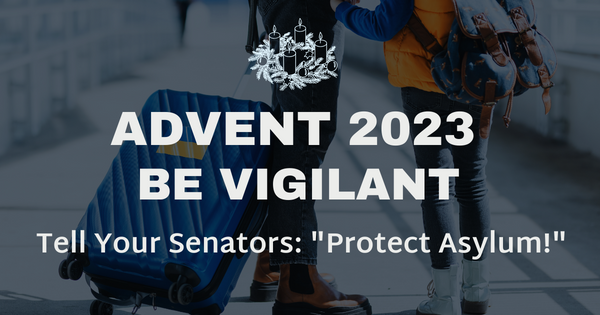
Congress is now back in session, and their first order of business is passing a package to meet the President’s supplemental funding request for aid for Ukraine, Israel, and Taiwan. Unfortunately, some Members of Congress are pushing to decimate asylum in the U.S. as a condition of this deal.

Tell your Senators to protect asylum in the United States and not give into demands to change asylum law in order to get a funding deal passed. 

To receive all of NETWORK’s Advent 2023 reflections in your email inbox, sign up here!

The legislative priorities not passed before the end of the 117th Congress will continue to be priorities of NETWORK in 2024 and beyond!

Build Anew Series – Housing

Build Anew Series — Part 9
Housing

Virginia Schilder
November 30, 2023
Welcome back to our Build Anew Series, with weekly posts covering the people, policies, and values at the heart of the issues we work on. This week, we’re talking about housing.   

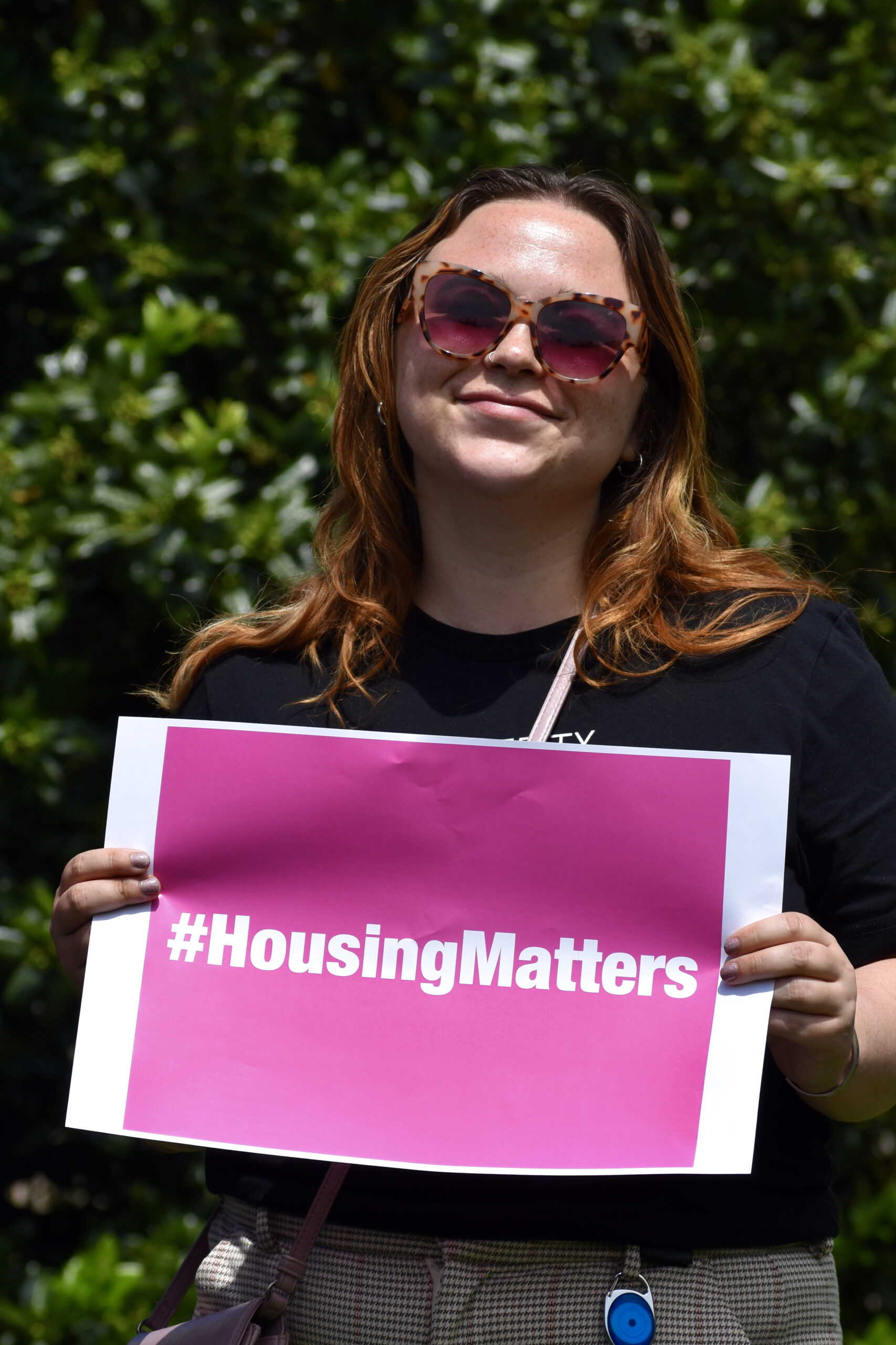
Everyone can agree that food, water, shelter, and health care are the most fundamental necessities of life. Yet, the United States, the wealthiest country in the world, is facing a long-term trend of increasing houselessness. From 2015-2022, the unsheltered population increased by 35 percent — which means an additional 60,560 people in this country are without shelter. In 2022, the numbers of unhoused persons (over 420,000) and chronically unhoused persons (nearly 128,000) reached record highs.

Leaving so many of our neighbors out on the street is a policy choice. A structural refusal to control rent prices and designate and maintain affordable housing is a moral issue. The housing crisis most affects the people already made vulnerable by unjust systems, including the elderly, children, Black and Brown communities, LGBTQ+ persons, Native Americans, and families in poverty. The COVID-19 pandemic only worsened these disparities.

We know that housing is an essential part of the wellbeing of ourselves and our families. Access to affordable housing creates stability and unlocks a greater ability to get and keep a job, to pursue education, to stay out of the criminal legal system, to tend to one’s health, and to care for oneself and loved ones. We all deserve the basic security of a safe and stable place to live. This is why NETWORK supports a housing first model, and why we must engage federal policy to build anew our systems of ensuring housing security for all.

Present Realities

In our profit-driven housing market, millions of people experience housing insecurity every year. The largest problem renters and potential homeowners face today is a lack of affordable housing. In the United States, a record number of over 40 million renting and homeowning households are cost burdened, spending more than a third of their income on housing. When so much of a family’s income must go towards housing, they have to cut back in other areas. Cost-burdened renters or homeowners may experience hunger, struggle to pay for transportation, find it harder to pursue educational or professional opportunities, and experience higher rates of eviction and foreclosure. Rising rents and housing costs are worsened by stagnant wages, the decreasing public housing stock, and the poor condition of remaining units. (Since the 1990s, the U.S. has destroyed almost a quarter-million public housing units, and replaced only a fraction.) Meanwhile, rent prices for new privately developed housing are unattainable for low-income families.

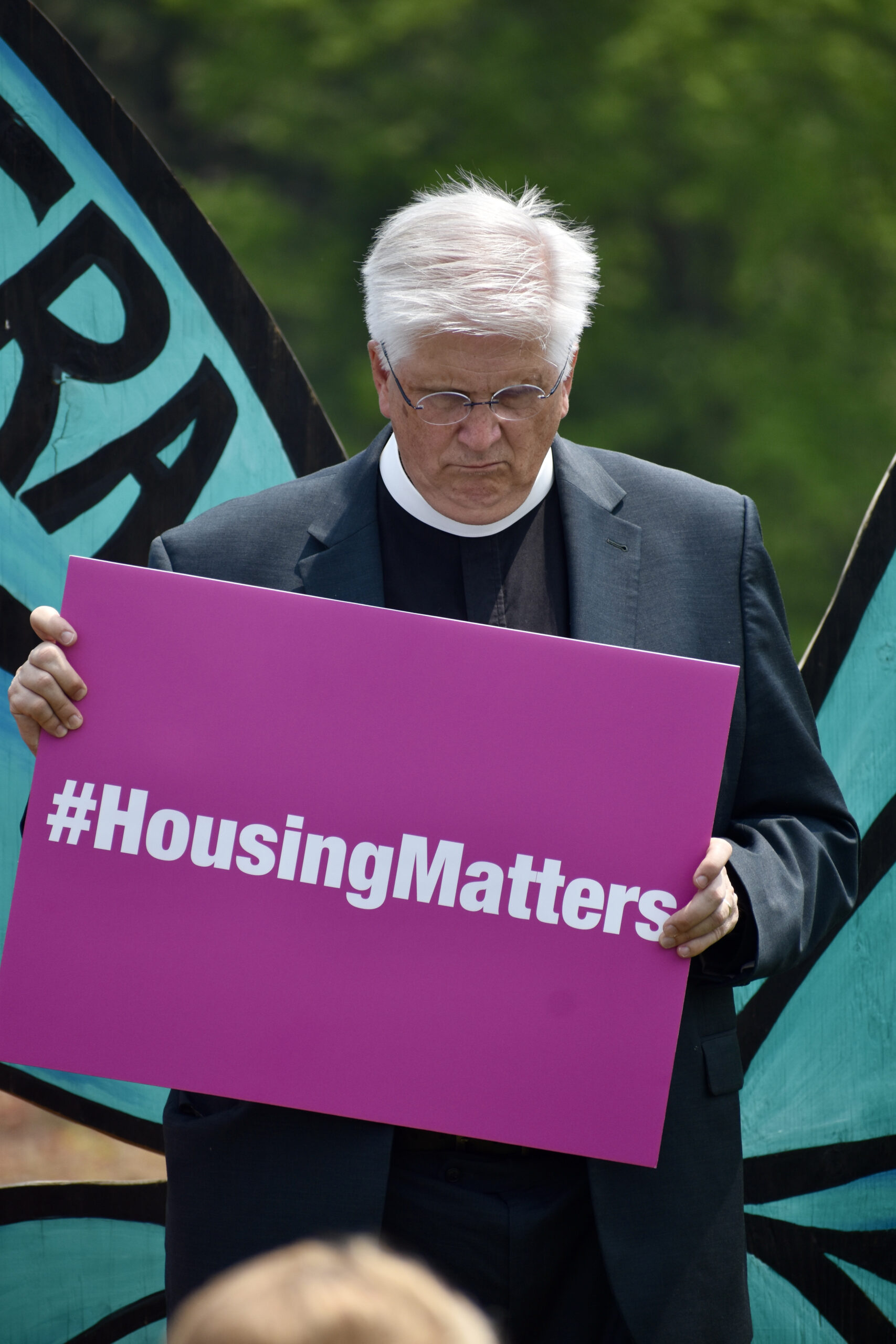
Peter Cook, executive director of the New York State Council of Churches, participates in a NETWORK “Care Not Cuts” rally NETWORK on Long Island on May 22.

For people of color in the U.S.—especially for Black families—banks, the real estate industry, and local, state, and federal policies have enforced centuries of legal segregation and housing discrimination. Practices such as forcing Black families into higher-cost and lower-quality segregated housing (often in neighborhoods near toxic waste sites or highways with poor air quality), denying federally backed mortgages, and preventing the racial integration of white neighborhoods, have had devastating impacts on economic, education, community safety, and health outcomes. The legacies of redlining, environmental racism, and exclusionary zoning persists. Today, more than 50 years after the Civil Rights Movement won the passage of the Fair Housing Act, the gap between white and Black homeownership (which exacerbates the racial wealth gap) is even larger than it was in 1960 before the legislation went into effect.

Even before the COVID-19 pandemic, more than half a million people in the U.S. were experiencing houselessness, disproportionately in Black, AAPI, and Native American communities. With housing costs already stressing families’ financial security, layoffs and other unexpected costs during the COVID-19 pandemic caused many to fall behind on rent and mortgage payments, leading to evictions and foreclosures where state or federal eviction moratoriums failed to protect vulnerable households. Before the national eviction moratorium went into effect (temporarily), the expiration of state eviction moratoriums in 27 states led to tens of thousands of additional COVID-19 cases and deaths.

Access to safe, affordable housing is absolutely critical for every person and supports our country’s overall health. Housing creates stability that helps people pursue education, employment, and health, as well as eliminate contact with the criminal legal system, comply with the terms of their probation, and reduce their risk of recidivism. By failing to ensure housing for all members of our society, we harm family development and deprive millions of the stability of a secure shelter. Lack of housing is a matter of life or death, and one disproportionately faced by communities of color. This is immoral. We must respond to this urgent need and build anew with housing policies that dismantle systemic racism in housing and ensure equitable access to safe and affordable housing for all.

Facts and Figures on Housing in the U.S.
Our Values

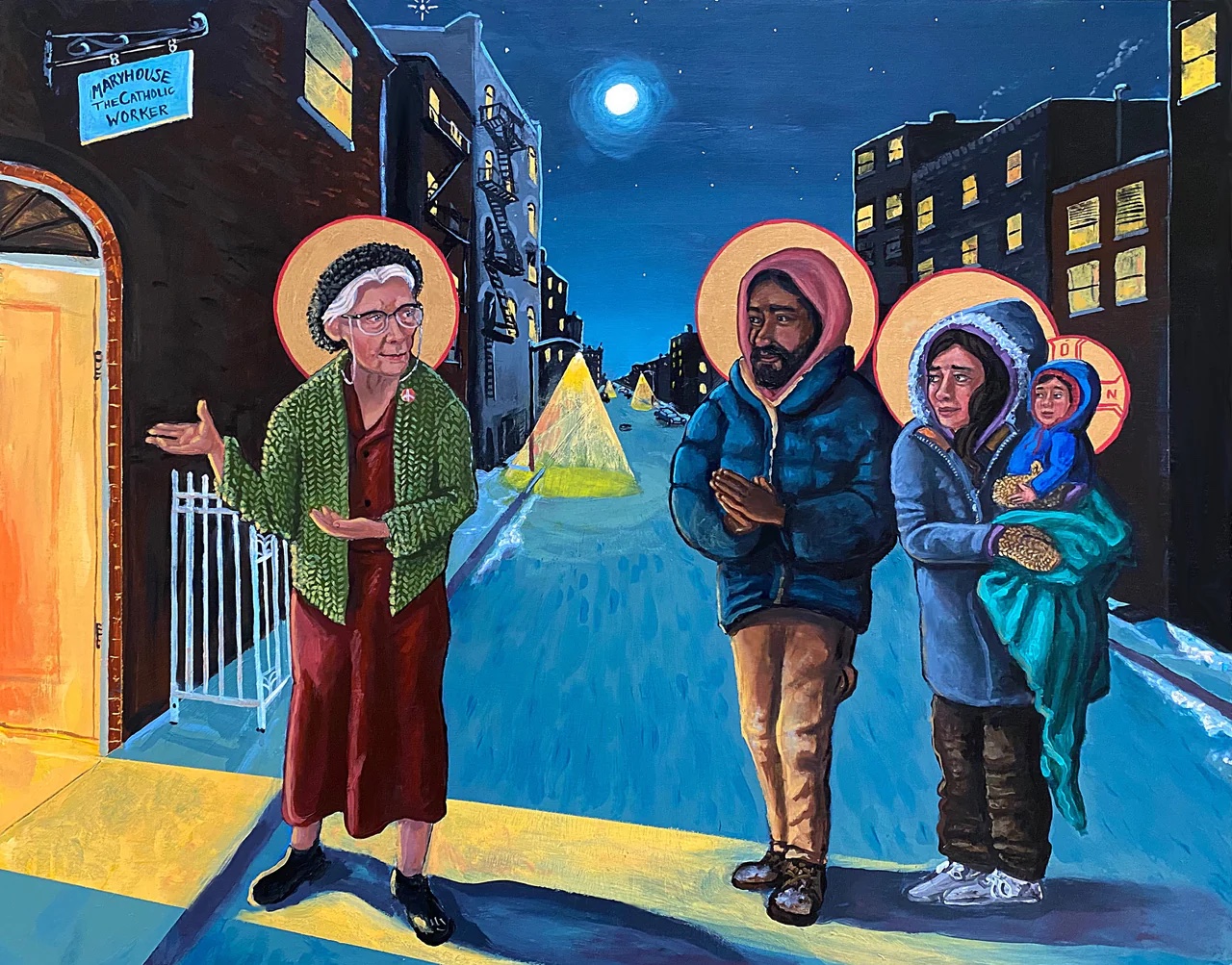
“Dorothy Day and The Holy Family of the Streets,” Kelly Latimore

As we’ve been exploring throughout the Build Anew Series, Catholic Social Justice principles call us to uphold the dignity of each person as an equally valuable member of the global family. Because dignity refers to what people deserve by virtue of their humanity, upholding dignity means ensuring that each person has what they need to live well. Stable, affordable housing — a shelter, a home — is among the most basic of these necessities.

The pervasiveness of houselessness and housing insecurity stands in stark contradiction to the Catholic call to uphold the dignity of each person. The Vatican II encyclical Gaudium et spes reads, “All offenses against human dignity, such as subhuman living conditions… all these and the like are criminal: they poison civilization; and they debase the perpetrators more than the victims and militate against the honor of the creator.” In other words, failing to ensure safe living conditions for all people is an offense against God!

Widespread houselessness is also where we see our social sin of racism and classism especially clearly. It is immoral that some people in this country have multiple houses, while so many have none. It is immoral that so many offices, hotel rooms, and other gathering spaces remain empty at night while our neighbors sleep out in the cold on the streets below. Whether or not you have shelter should not have anything to do with the color of your skin, or how much money is in your bank account. Yet, this is the reality in the U.S., an unconscionable affront to the equal dignity and worth of every single human being which our faith emphatically professes. We have an obligation to our siblings to redress this grave moral harm, as a matter of what it means to live a faith of justice, peace, and compassion.

We are all interconnected. When we all have the food, water, health care, and shelter that we deserve by virtue of our humanity, the whole community benefits. When we all have housing, our nation as a whole will be a healthier, safer, more stable, and more caring place to be for all of us.

When he visited a homeless shelter, Pope Francis asserted, “The home is a crucial place in life, where life grows and can be fulfilled, because it is a place in which every person learns to receive love and to give love.” Housing is a basic human right and the foundation of a person’s ability to meet their needs and care for themselves and their family. Each person deserves a stable shelter in which they can feel safe and at home. Together, we have the resources to make this a reality, and our faith calls us to do so.

Housing Justice and Federal Policy

Luckily, we know that good policy can significantly reduce houselessness. We saw this in the period from 2020-2022, when the rate of increasing houselessness slowed, due to strong (yet temporary) investments in human services programs during the pandemic.

The federal government must take action to promote lasting housing stability for all people. Congress must expand vouchers and increase funding for Section 8 rental assistance (including tenant-based assistance and project-based rental assistance), as well as invest in public housing repairs and rehabilitation (which need more than $26 million in major capital repairs). Additionally, federal lawmakers should pass legislation to provide a renter’s tax credit and expand the Low-Income Housing Tax Credit program.

In addition to ending houselessness and bolstering rental assistance programs, Congress must address the ongoing legacies of redlining, by investing in Black and Brown neighborhoods and creating sustainable pathways to homeownership for communities of color, who still face racial discrimination in housing and lending practices.

In rural America, homeownership is the principal form of housing. Yet, access to mortgage credit is limited, especially for Black households. Another challenge for rural households is clean water infrastructure. Hundreds of rural communities nationwide do not have access to clean residential drinking water and safe waste disposal systems. The government should support the fostering of sustainable, vibrant rural communities, including by increasing investment in Department of Agriculture housing grant and loan programs to ensure every rural household has the resources to repair, buy, or rent affordably.

Most urgently, as Congress appropriates funding for Housing and Urban Development (HUD), let your elected officials know that housing programs must be bolstered, not cut!

Join us again next week for our tenth and final installation of the Build Anew Series, looking ahead to 2024! And don’t forget to stay tuned on Instagram (@network_lobby) and Facebook for our Build Anew video series!

Black Catholic History Month Reflections: Sister Josita Colbert

Black Catholic History Month Reflections: Sister Josita Colbert, SNDdeN

Susan Dennin and Virginia Schilder
November 29, 2023

Sr. Josita’s involvement in Black Sisters’ organizing began in August 1968, when Sr. Martin de Porres Grey, a Mercy Sister in Pittsburgh, organized a weeklong conference for about 200 Black Sisters at Carlow College. This was the beginning of the National Black Sisters’ Conference.

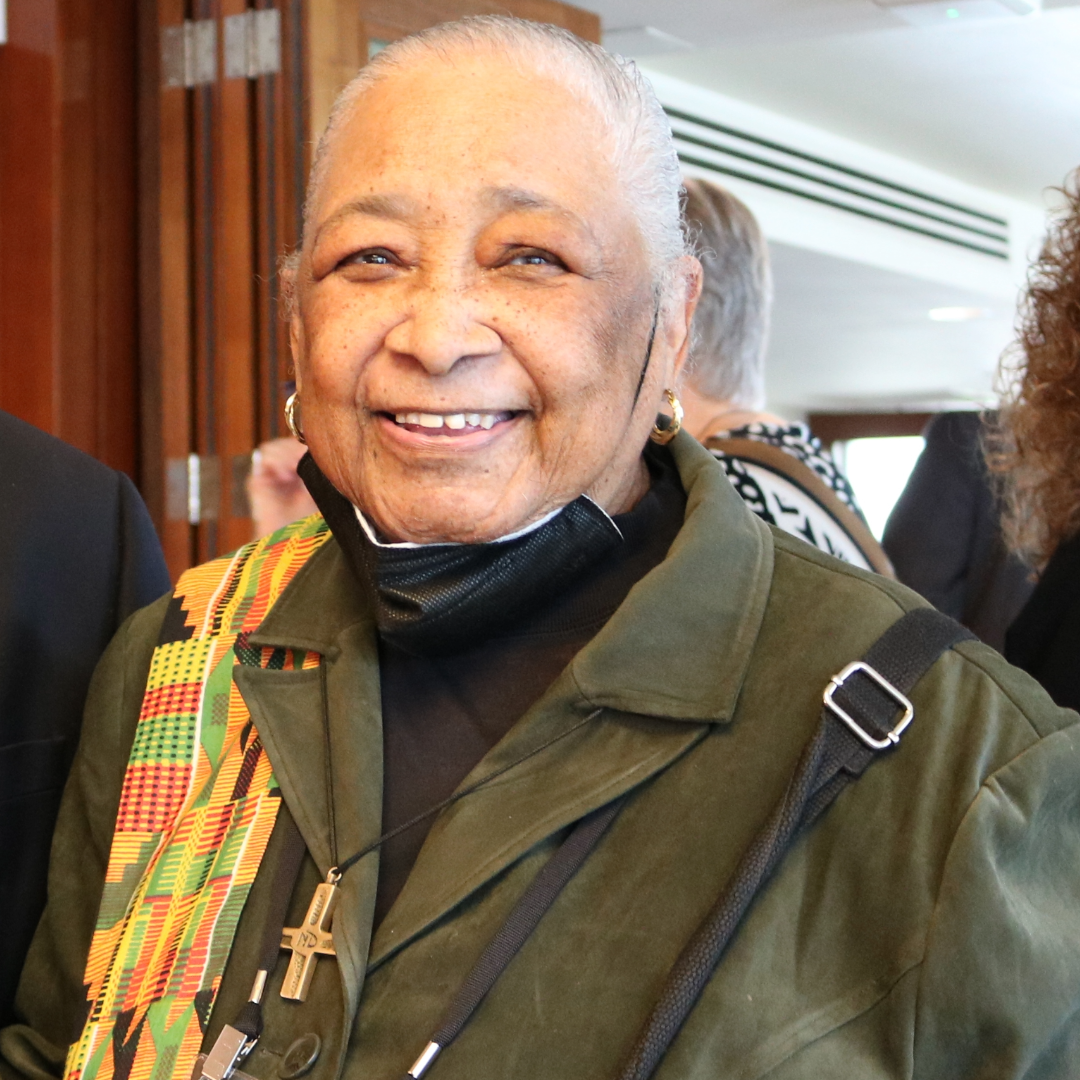
Sr. Josita Colbert, SNDdeN

“[At that conference,] there was a lot of education about what the Black Power movement meant. It was an educational and spiritual experience. There was singing and music that made liturgy much more meaningful. We had a Black priest there, and at the first Mass, Sister Teresita Weind, SNDdeN preached. It was so refreshing there, even though the meetings were long! And we had speakers who would come in. They were really trying to explain the whole system of the Black Power movement and Nguzo Saba principles. We had Jesse Jackson… a lot of famous speakers. It was a little over a week, the first time we met. We met a couple of times at Carlow, and then we moved marto Dayton.”

A central theme of those early meetings, according to Sr. Josita, was that coming to know and love oneself, especially as Black women religious, is critical for being able to teach and empower others.

“During that time, the organizers were trying to help us learn about ourselves and appreciate who we were as Black religious women — but also how to better empower those who we taught, because most of us were teachers. It was almost like a reeducation, in terms of how we could teach differently, especially about Africa. It was learning to respect our people, the way we look, our hair, our features… that they are all beautiful, and God made us. It was a whole learning of oneself, and respecting of oneself. The intent was that if you believe these things about yourself, and internalize them, then it’s reflected not just in what you tell other students, but what they see.

We had workshops that would empower you, whether it be in spiritual direction, or working in civic, political, or church activities. They taught us how to enhance those who you were responsible to, and how to build their leadership skills. I think my style of teaching was different as a result of going to the conference.

When I think back about it, my own family and the people in our church— lay people who led various activities—they also taught us these skills, and about taking on responsibilities. My family was very active in the church, and they were very open and accepting of people. When I came to the conference, they were telling us about being open and sharing with others the skills you have. That’s what the people in the church did. That connected with me, in terms of how I taught and interacted with others. I learned not to have rash judgments of people, and instead to try to accept them.”

Sr. Josita cited a few Christian principles of Nguzo Saba as central in her formation:

“One was Nia: having purpose in whatever you do. When I think about the life of Jesus, or some of the early saints, they focus on what they were called to do, and helping others learn more about God and themselves. Another one is Imani: faith, and believing in God. I look back to my family: they were faithful in what they did and how they treated other people. It’s believing in God, that God will see us through, and also believing in yourself. And certainly if you do that, then you have a belief in others and a respect for the personhood of other people.

And then the other is a long word, Kujichagulia: self-determination. That’s what the educational part of the conference was all about. You hear so many negative things about Black people; you hear about those orders of priests and nuns who would not readily take in Black women or Black men simply because of the pigmentation of their skin – blatant racism. Self-determination meant to me to be focused on what you’re supposed to be about, as a Black religious woman, as a Christian. Focus on that. Don’t dwell on the negative stuff, because it gets in the way of the mission, what we’re supposed to be doing.

Those are the three principles that I stuck with, all relating to God and to self.”

Sr. Josita shared about her experiences of Black Sisters working together, providing support to one another and to young people, as advocates and mentors. In particular, she spoke about supporting Black women in vocations to religious life.

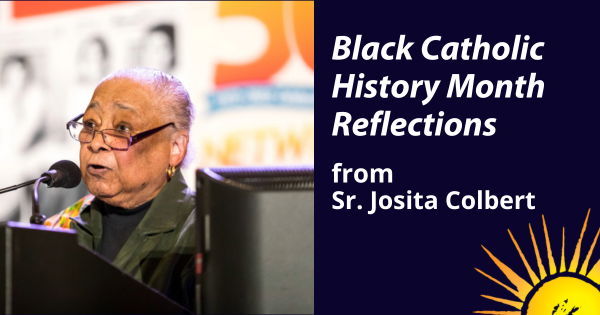
Sr. Josita Colbert, SNDdeN speaks at NETWORK's 50th anniversary celebration in Washington in April 2022.

Sr. Josita Colbert, SNDdeN speaks at NETWORK’s 50th anniversary celebration in Washington in April 2022.

“I try to tell younger ones today, when they talk about what they go through, to focus. … I have had opportunities to do workshops in various parishes. These have been learning opportunities for me, helping students and young people to be involved in their churches, to be active members of the church. There are a lot of African American youth that were so involved in their communities, but not in their Catholic Church because we didn’t provide them with opportunities. They have to be a part of the conversation.

In those days, we had a committee. If one of the younger sisters had a problem, we’d ask to speak with the superior, and work with them, to be advocates and mentors. We’d work with Black sisters and with the community.

We’d also have conversations with leadership of various communities, to talk about tips for working with and inviting African American women to religious life — and what to do when they’re there, visiting all-white communities. In the early days, we tried to educate white religious communities, but it didn’t seem to change the behavior. Most women would say, ‘We’ve never been around Black people.’ And then you point out, ‘What about sister so and so?!’ Were they invisible? They weren’t seen.

One sister called me and said, ‘Things in 2023 have not changed – what did we do back in the 60s and 70s?’ I said, I’m doing things differently. It may be through writing, talking, engaging, having meetings with LCWR, with the National Religious Vocations Conference… we need to get on those committees. Shirley Chisholm said, if you go to the table and there’s not a seat, take a chair up there! We were trying to explain that God calls Black people to the religious life as well. … And it was so important to know that there were others doing the same work. You could call people, you could write – you knew there were others out there doing the same thing.

Most of my life I did teaching and then I became a vocations director, listening to women’s stories. I worked with women who were white, Black, Latina. It made no difference: [they shared] what they felt God called them to do.”

Sr. Josita also spoke at length about the role Sr. Thea Bowman has played in her life, especially as a source of courage and grounding in clarity about “who and whose you are.”

“You are Black, you are Catholic, you are a religious woman. You bring yourself to the Church. sr. Thea’s thing was that, you don’t turn me off because I’m Black. At a conference, she sang a Gospel song and people would look at her strangely, not realizing she was a keynote speaker.

Her thing was that you had to be clear about who you were, and feel certain about that, so that you don’t let anyone tear you down because of who you are. [It’s about] doing the right thing, being like Jesus, and if you’re religious looking at your mission statement and constitutions that are written so very beautifully, being accepting and open…

We as humans sometimes do just the opposite of the things we’ve written. What is our mission statement trying to guide us to do, and what does that mean to me as a Black woman? Sr. Thea spoke truth. Trying not to hurt anyone; just trying to share. Sr. Thea was a humble woman. She loved life. Do what it is the Spirit moves you to do – that’s always the right thing to do.

When I think about Sr. Thea, it’s about remembering who and whose you are, so that you can then go out and do the mission, do what you have to do, as long as you aren’t hurting anyone violently or tearing anyone’s personhood down. We try to respect others as human beings. That’s what Sr. Thea did.”

Sr. Josita cited Angela Davis’ “I’m changing the things I cannot accept” as a point of guidance for her prayer and justice actions. Through her teaching, vocational mentorship, and service on various committees, Sr. Josita shares her voice in service of a more just future for Black Catholics.

“We place ourselves in situations in which we can strive to effect the changes that can be made. We look at how we can invite members of leadership teams, vocation directors, and organizations to be a part of conversations and education. It’s not just us being educated, but trying to work with other people.  We’re trying to get people to read Subversive Habits by Shannon Dee Williams!

[At the Black Sisters conferences,] we learned that it’s important that you’re a part of the decision-making. Bring the chair with you! I was on a bishop’s advisory board. If something was not inclusive, I tried to make sure that whatever the documents and mission statement and goals are, they are inclusive to all, not just one group of people.

A seventh grader asked me, “Why do people hate Black people? What’s wrong with me?” I’m saying, Oh God, how do I answer this question? I said, there’s nothing wrong with you. God made you, God made all of us. We need to learn how to accept and respect the differences that exist among us. We’re supposed to be like Jesus, and Jesus didn’t reject anyone. I fight the fight so that those behind me don’t have to do it, so that they won’t have to endure hatred, so that they’ll be accepted for who they are and their contributions.

Sr. Thea had a way of getting across to others, speaking on behalf of Black people and on behalf of what was just and right. It’s not easy! You have to have a relationship with God, otherwise it’s not gonna work. How do we do this with others not so much in words, but in deeds and actions in our churches, schools, work and ministries?”

Build Anew Series – Health Care

Build Anew Series — Part 8
Health Care

Virginia Schilder
November 17, 2023
Welcome back to our Build Anew Series, with weekly posts covering the people, policies, and values at the heart of the issues we work on. This week, we’re talking about health care, and the dangerous Medicaid “unwinding” going on in many states.   

In 1966, Rev. Dr. Martin Luther King Jr. said, “Of all the forms of inequality, injustice in health is the most shocking and the most inhuman because it often results in physical death.” These words still ring true in the United States, where many die each year because of a lack of access to health care. Millions of people in the U.S. are uninsured — a number that is rising with the ongoing Medicaid “unwinding” (more on this below) — and even more cannot afford the cost of needed medicine or health services. This “injustice in health” is felt most strongly by people of color, low-income families, immigrants, disabled people, and members of the LGBTQ+ community who, because of structural barriers to health, face lower life expectancy, higher mortality rates (especially maternal mortality rates), and higher rates of chronic diseases.

Access to health care is a fundamental human right that all people deserve as a function of their dignity. The Catholic tradition is emphatic that no person’s life is of greater worth or value than another’s — meaning that it is a grave moral wrong when people with wealth have privileged access to needed health care, medications, and treatments. Our families should not have to choose between life-saving medical care, and putting food on the table or paying the rent.

The COVID-19 pandemic made acutely clear the reality that our health is tied together. By building anew our health care system, we can improve the wellbeing of our society as a whole.

Present Realities

We have seen too many family members, friends, and neighbors die from a lack of care and critical medicines. Before the COVID-19 pandemic, more than one out of 10 adults in the U.S. knew at least one friend or family member who had died without needed medical treatment because they were unable to pay for it. For people of color, that number is one out of five. Let that sink in.

This is unconscionable — especially in a nation as wealthy as the U.S. Everyone deserves access to health care and prescription medications, but our sinful lack of affordable, comprehensive health insurance and the pharmaceutical industry’s exploitative behavior blocks access to needed medicines and care. It’s no surprise that the leading cause of bankruptcy in the U.S. is medical bills. The soaring costs of health insurance and medical bills, and the egregious raising of prices on needed everyday medicines, reflect an immoral effort to profit from our universal need to be taken care of when we are sick—or to simply live with chronic conditions.

We also deserve the time to heal from illness and to care for sick loved ones and children without risk of losing our jobs or critical income — which means that paid sick days and medical leave are indispensable. According to the Center for American Progress, the U.S. is the only “industrialized” nation that does not guarantee paid sick days and family and medical leave. This failure to guarantee paid medical leave most acutely impacts lower-income families and the communities who are already most vulnerable in our society.

The U.S. suffers from immoral health disparities, which the COVID-19 pandemic made worse. Black, Latinx, and Native Americans became sick with COVID and died at higher rates than white people across the U.S. But even before the pandemic, because of systemic racism, people of color in this country have long suffered higher rates of mortality and disease (including heart disease) and lower life expectancy than white Americans. A particularly urgent example of these disparities is the Black maternal mortality crisis. Adverse health outcomes are also closely tied to poverty, which is one of the most significant social determinants of physical and mental health.

In addition to one’s ability to access health care, socioeconomic factors like housing, employment status, incarceration, food security, environmental safety, and education all determine a person’s health. This underscores how health care justice is a comprehensive issue that requires accessible and affordable health care, but also justice and transformation across multiple racial, social, and economic dimensions.

Racial and class health disparities are not only unjust and immoral, but they harm everyone. The pandemic made even clearer how our health is tied together: we are all put at risk when any of us is without insurance, access to affordable care, or the ability to take off work when sick or caring for a sick loved one. To end health inequities and promote our common well-being, we must build our unjust healthcare system anew, and ensure that each of us has what we need to best care for our bodies.

Facts and Figures on Health Care in the U.S.
Lived Experience

Maura, the second daughter of Joe and Rita McGrath of Lafayette Hill, Pennsylvania, was born with Down syndrome. Now 17 years old, Maura continues to be the blessing her parents have always known her to be. In addition to Down syndrome, Maura is nonverbal and has been diagnosed with autism. As a minor living with disabilities, Maura qualifies for Medicaid benefits. Even though Joe and Rita both work, the cost of Maura’s healthcare is too expensive for their family to afford on their own.

An integral part of Maura’s wellbeing is the care Maura receives from her beloved home health aide Williamina. Taking care of Maura is a full-time job and looking after her became more difficult for Rita after fighting cancer. Additionally, Joe has Parkinson’s disease. Medicaid provided the necessary funds for the McGraths to hire assistance.

In addition to a home health aide, Maura needs eight different medications, medical equipment and supplies (such as her wheelchair and diapers), and frequent doctor appointments. Medicaid covers the cost of these needs. Without Medicaid, the McGrath family would be in financial ruin. The cost of Maura’s medicine alone would be several hundred dollars every month. These are expenses that the McGraths, and many families in similar situations, would be unable to afford without the help of Medicaid.

The principles of Catholic Social Justice teach us that all human life has value. Cutting Medicaid benefits would take away critical healthcare that Maura and many other people deserve. Healthcare is a human right, not a privilege. Medicaid caps or any cut in Medicaid benefits would prevent people from accessing healthcare that is critical to their survival. The McGrath family deserves the peace of mind that comes with knowing they can provide care for their daughters. We are one another’s keeper and Medicaid provides access to care every human is entitled to.

Adapted from text written by Emma Tacke, NETWORK Grassroots Mobilization Associate  

Our Values

The Catholic tradition affirms that each person has a right to the care their bodies need to thrive. The right to access care when you get sick, the medicine and support you need to live with chronic conditions, and the preventative care to keep you healthy, are human rights that we all need and deserve.

Pope Francis says, “Health is not a consumer good, but rather a universal right, and therefore access to healthcare services cannot be a privilege.” The Catholic faith proclaims the ultimate worth of life as infinitely more important than profit—thereby condemning the egregious immorality of over-pricing and profiting off of life-giving medicines and health care. Access to medical services should never be contingent on a person’s ability to pay. At the center of the Catholic faith is the belief that all lives are of equal and immeasurable value. Therefore, allowing those with fewer means suffer or even die while those with wealth access the treatments they need to live is an affront to the Catholic view of the human person.

Throughout the Build Anew Series, we’ve explored how the Catholic tradition is clear that resources are to be shared and used to meet needs — especially the needs of our most vulnerable neighbors. Funds raised to pay for health care through our tax system should help promote public health by expanding health care access. Moreover, the price of health care should not rest on those who have the least — those who are able to pay more, must contribute more.

To love our neighbors means to care for their bodies — ensuring that we all have food, water, clothing, safe shelter, and good health care. Health care services provided through insurance must be comprehensive, and include preventative, primary, acute, mental health and long-term care services. Compassionate and affordable health care that meets needs and tends to the whole person serves to nurture the dignity of everyone in our communities.

Take Action: Why Medicaid Should be Expanding, Not “Unwinding”

Medicaid is our country’s main system of health care coverage for low-income individuals, children, and families, as well as older and disabled adults. Under the Affordable Care Act (ACA), families and individuals earning less than a certain percentage of the federal poverty level are eligible for Medicaid. Today, there are still state governments refusing to opt-in to this expanded coverage for people on the brink of poverty. Lawmakers in those states who deny access to health care for families and individuals struggling in poverty are responsible for keeping their states’ residents from life-saving care.

As a new report from UNIDOS explains, many COVID-19-related Medicaid protections expired on April 1, 2023, allowing states to redetermine eligibility and begin terminating families’ Medicaid. In many states, this has enabled a devastating process of Medicaid “unwinding,” with unprecedented numbers of people losing coverage. The most frustrating part is that most people losing Medicaid are still eligible. They have only lost coverage because of simply missing paperwork or other red tape barriers. This unwinding is particularly affecting Black and Brown communities, as it is estimated that over half of the people losing Medicaid are people of color.

If this unwinding continues, we will be facing an ever-growing and unconscionable health care disaster. Medicaid must be available to all who are eligible, without work requirements or other burdensome restrictions. Investing in our health is critical and benefits all of us. Our elected officials should expand this vital health care program immediately, so that all of us can access the health care we need and deserve.

TAKE ACTION: learn more by reading the full report here: Six Months into Unwinding: History’s Deepest Medicaid Losses Demand State Action.

Join us again next week for part eight of the Build Anew Series on housing. And don’t forget to stay tuned on Instagram (@network_lobby) and Facebook for our Build Anew video series!