
Category Archives: Build Anew

2023 Voting Record

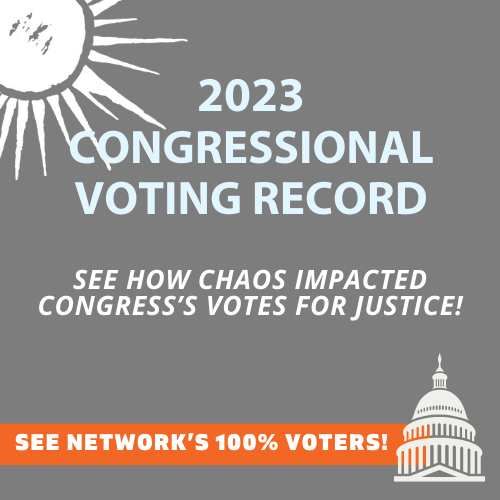
2023 Congressional Voting Record
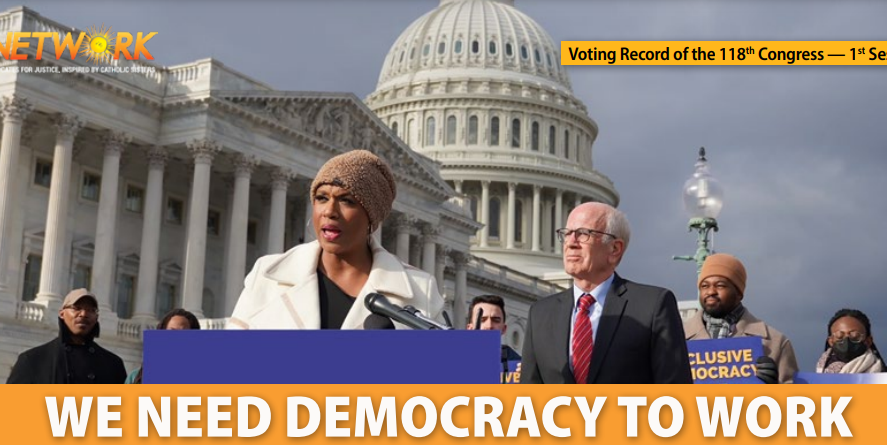
At the start of each new year, NETWORK compiles an assessment of Congress’s voting record. The 2023 Voting Record is our Government Relations Team’s evaluation of Members of Congress based on the votes they cast to advance just policy in the U.S. The first session of the 118th Congress stands out as a year of abject legislative failure. It was a year of squandered opportunity, petty infighting, and deep frustration. The norms of the system — civility and goodwill at minimum to members of one’s own party — have vanished. The problem did not start this year; rather, institutional norms have slowly eroded dating back to the speakership of Newt Gingrich and the government shutdowns of 1995 and 1996. The Trump administration accelerated this decay in Washington leading directly to the insurrection of January 6 and an attempted overthrow of the 2020 election.

Congress, due to inaction in the House, has pushed all decisions on major legislation into 2024, making this the most non-productive, dysfunctional Congress in the modern era. The House of Representatives completely failed in their responsibility to the American people. As always, the high cost of inaction falls hardest on the most vulnerable among us.

100% Voters

Senators who voted with NETWORK 100% of the time.
CA Feinstein, Butler
CT Murphy
DE Carper
GA Warnock
HI Hirono
IL Duckworth, Durbin
MD Cardin, Van Hollen
NJ Booker
RI Reed, Whitehouse
VT Leahy

To see the list of House of Representatives with 100% records, please download the 2023 Voting Record.
Keep Up with NETWORK

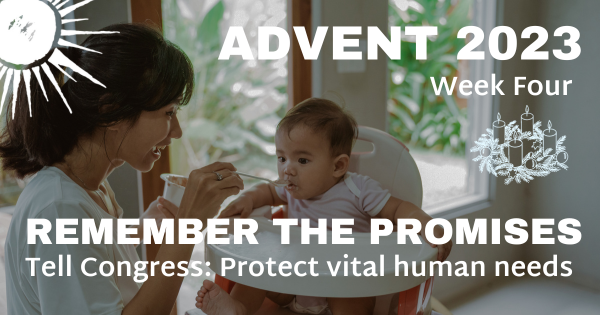
This Advent, Remember the Promises

This Advent, Remember the Promises

Mary J. Novak
December 20, 2023

Read NETWORK’s Advent 2023 reflections here!

Readings for the Fourth Sunday of Advent, December 24.

2 Sm 7:1-5, 8b-12, 14a, 16
Ps 89:2-3, 4-5, 27, 29
Rom 16:25-27
Lk 1:26-28

The Readings for the Fourth Sunday of Advent speak beautifully of God’s promises. Time and again, God delivers great things, and people rejoice at these wonders. God is good, and God is faithful. 

This year, NETWORK had experience with keeping promises and remaining faithful.  

Too often, this has taken the form of making sure Congress did not slash funding to vital human needs programs including SNAP and WIC, even after promising not to in the deal averting a government shutdown.  

A few but powerful extremist Members of Congress called for cuts that would have harmed millions of people in the U.S. by jeopardizing their access to food, housing, and healthcare. And worse, they proposed these cuts as part of their demands to avert a government shutdown. Shutting down the government would have harmed millions more across the U.S. and disproportionately harmed Black and Brown communities. 

We lament the sin of indifference toward our neighbors and communities these cuts would harm. We also lament the dangerous brinkmanship that sees shutting down the government as an acceptable bargaining tool. This approach is corrosive to the very fabric of our democracy, and worse, those who engage in this practice seem to know it. 

Amidst these trials, we also saw beautiful reminders of the faithfulness of God, in our own NETWORK Advocates. Justice-seekers from across the country gathered throughout this year as part of NETWORK’s Thriving Communities campaign to call on Congress to pass a moral budget. Rallies in Erie, Pennsylvania and Youngstown, Ohio, as well as on Long Island and Capitol Hill made the appeal for “Care Not Cuts.”  You joined together and spoke out, and you continue to beautifully model your faithful commitment to the common good. 

The ultimate fulfillment of God’s promise is Jesus, and the Gospel reading this Sunday finds the angel announcing to Mary that she would bear a son. Just as God’s faithfulness resulted in the creation of a family, the Holy Family, so the faithfulness of NETWORK Advocates has allowed countless families to flourish with the assistance they urgently need.  

Call to Action 

So far, the dedication of NETWORK Advocates has paid off in protecting vital human needs programming. But we must stay alert because the human needs programs we are called to care about are still very much at risk. Funding for the Supplemental Nutrition Program for Women, Infants, and Children (WIC) is not finalized till January. 

TAKE ACTION: Tell Congress to keep their promise and fund this vital program. 


Advent 2023 Week 3 Calls Us to Bring Rejoicing

This Advent Calls us to Bring Rejoicing

Jarrett Smith
December 12, 2023

Readings for the Third Sunday of Advent, December 17.

Is 61:1-2A, 10-11
Lk 1:46-48, 19-50, 53-54
1 Thes 5:16-24
Jn 1:6-8, 19-28

The readings on the Third Sunday of Advent are meant to be a time of rejoicing and gladness amidst solemn anticipation. This spirit could readily apply to expanding the Child Tax Credit (CTC). The prophet Isaiah speaks of God bringing glad tidings to people in poverty, healing the brokenhearted, proclaiming liberty, and giving freedom to imprisoned people. A “year of favor” is one way to describe the year that Congress passed the expanded CTC and lifted a record number of children out of poverty. Across the U.S. millions of families were able to flourish where they had previously been held back or held down by lack of basic resources. This was a resounding victory for justice-seekers who envision a world in which all people have what they need.

Read NETWORK’s Advent 2023 reflections here!

When Congress allowed the expanded CTC to expire at the end of 2021, child poverty rose from 5.2 percent in 2021 to 12.4 percent in 2022. This hit Black, Brown, and Indigenous families especially hard, and this staggering setback was about one thing: the choices of Congress.

It is reckless policy, and morally repugnant, to extend tax breaks to corporations without also enacting robust expansion of the CTC. Congress must pass a Child Tax Credit that allows the 19 million who do not qualify for the entire credit to get the entire credit phased in faster. And it must apply to all children in the household.

In recent years, NETWORK has sought to tell this story and spread it far and wide. In doing so, we have centered two justice-seekers — Fr. Bryan Massingale and Dr. Robert P. Jones — whose voices cry out in the desert of white supremacy as it manifests itself in U.S. Christianity. In October, we hosted the third of our White Supremacy and American Christianity dialogues with them, this time focusing on how “a consistent ethic of hate threatens our democracy.”

Read NETWORK’s Advent 2023 reflections here!

For people of faith, especially Christians, it should be especially clear that a policy that helps so many children out of poverty should receive enthusiastic support and not be allowed to expire. In the Gospel this Sunday, John the Baptist refers to Jesus as “one among you who you do not recognize.” Similar to the judgment account in Matthew 25, we so often fail in our policy choices to recognize Jesus in those who are marginalized and harmed.

As we look to the Third Sunday of Advent, the church also celebrates the feast of Our Lady of Guadalupe on December 12. This feast celebrates the love that Our Lady has for all of her children. What better way to translate that love into concrete action in the world than for Congress to pass a CTC that supports the most vulnerable?

Call to Action:

Send a message to your Members of Congress. Tell them to pass a fully refundable, monthly Child Tax Credit so all of us have what we need to take care of ourselves, and our families.

Build Anew Series – Looking Ahead

Build Anew Series — Part 10
Looking Ahead

Virginia Schilder
December 5, 2023
Welcome back to our Build Anew Series, with weekly posts covering the people, policies, and values at the heart of the issues we work on. This final post wraps up the Series and looks ahead to more work together in 2024, including the launch of Y.A.L.L.: Young Advocates Leadership Lab. Thank you to everyone who has joined us in reading, watching, and taking action!    

Well friends, here we are: our TENTH and final part of the Build Anew Series!

Thank you to everyone who has been with us on the Build Anew Series journey. Over the past few months, we dove into each issue of NETWORK’s Build Anew Agenda. We learned from the some of the people most directly impacted by these policy issues, we confronted some tough policy facts, and, rooted in the Catholic Social Justice tradition, we reflected on the moral dimensions of these social realities.

Equipped with that knowledge, reflection, and compassion, we took action — from urging President Biden to establish an H.R. 40 Reparations study commission; to calling our Representatives in Congress to protect and expand SNAP; to learning more about Medicaid unwinding; and to watching White Supremacy and American Christianity part 3.

The Franciscan Sisters of Perpetual Adoration (FSPA) and NETWORK work together in political ministry for climate justice advocacyYou may have noticed that one of our key issue areas was missing from the series posts: climate justice. Earlier this year, NETWORK added climate justice to our work, thanks to an extremely generous gift from the Franciscan Sisters of Perpetual Adoration. Climate justice is connected to all of the issues in the Build Anew agenda, like food, health care, immigration, taxes, the economy, and more. As we move into the new year, join us in integrating climate justice more deeply into our advocacy!

2024 will also bring the launch of our exciting new initiative, Y.A.L.L.: Young Advocates Leadership Lab. Y.A.L.L. will equip and resource emerging Catholic and other faithful justice seekers to be leaders in working for a multiracial democracy. If you’re a young person (like me!) and found that even just one of these issues touched you or spoke to you or your community’s lived experience, we invite you to reach out to NETWORK’s Grassroots Mobilization and Education Specialist Chelsea Puckett to learn more about Y.A.L.L.

The Build Anew Series brought us back again and again to our foundational Catholic social teaching: that every single person has dignity and our flourishing is intertwined — meaning no one can be left out of our circle of care! To build anew, our society and communities to be more life-giving for all of us means cultivating solidarity, a daily conversion to loving our neighbor by working for their wellbeing. We are called to join in the Spirit’s liberating action all around us, and together, we have the power to build anew!

Thank you so much for joining us! Continue to be part of our community of justice-seekers by following NETWORK on social media (like Instagram (@network_lobby) and Facebook) and becoming a NETWORK member.

Build Anew Series – Housing

Build Anew Series — Part 9
Housing

Virginia Schilder
November 30, 2023
Welcome back to our Build Anew Series, with weekly posts covering the people, policies, and values at the heart of the issues we work on. This week, we’re talking about housing.   

Everyone can agree that food, water, shelter, and health care are the most fundamental necessities of life. Yet, the United States, the wealthiest country in the world, is facing a long-term trend of increasing houselessness. From 2015-2022, the unsheltered population increased by 35 percent — which means an additional 60,560 people in this country are without shelter. In 2022, the numbers of unhoused persons (over 420,000) and chronically unhoused persons (nearly 128,000) reached record highs.

Leaving so many of our neighbors out on the street is a policy choice. A structural refusal to control rent prices and designate and maintain affordable housing is a moral issue. The housing crisis most affects the people already made vulnerable by unjust systems, including the elderly, children, Black and Brown communities, LGBTQ+ persons, Native Americans, and families in poverty. The COVID-19 pandemic only worsened these disparities.

We know that housing is an essential part of the wellbeing of ourselves and our families. Access to affordable housing creates stability and unlocks a greater ability to get and keep a job, to pursue education, to stay out of the criminal legal system, to tend to one’s health, and to care for oneself and loved ones. We all deserve the basic security of a safe and stable place to live. This is why NETWORK supports a housing first model, and why we must engage federal policy to build anew our systems of ensuring housing security for all.

Present Realities

In our profit-driven housing market, millions of people experience housing insecurity every year. The largest problem renters and potential homeowners face today is a lack of affordable housing. In the United States, a record number of over 40 million renting and homeowning households are cost burdened, spending more than a third of their income on housing. When so much of a family’s income must go towards housing, they have to cut back in other areas. Cost-burdened renters or homeowners may experience hunger, struggle to pay for transportation, find it harder to pursue educational or professional opportunities, and experience higher rates of eviction and foreclosure. Rising rents and housing costs are worsened by stagnant wages, the decreasing public housing stock, and the poor condition of remaining units. (Since the 1990s, the U.S. has destroyed almost a quarter-million public housing units, and replaced only a fraction.) Meanwhile, rent prices for new privately developed housing are unattainable for low-income families.

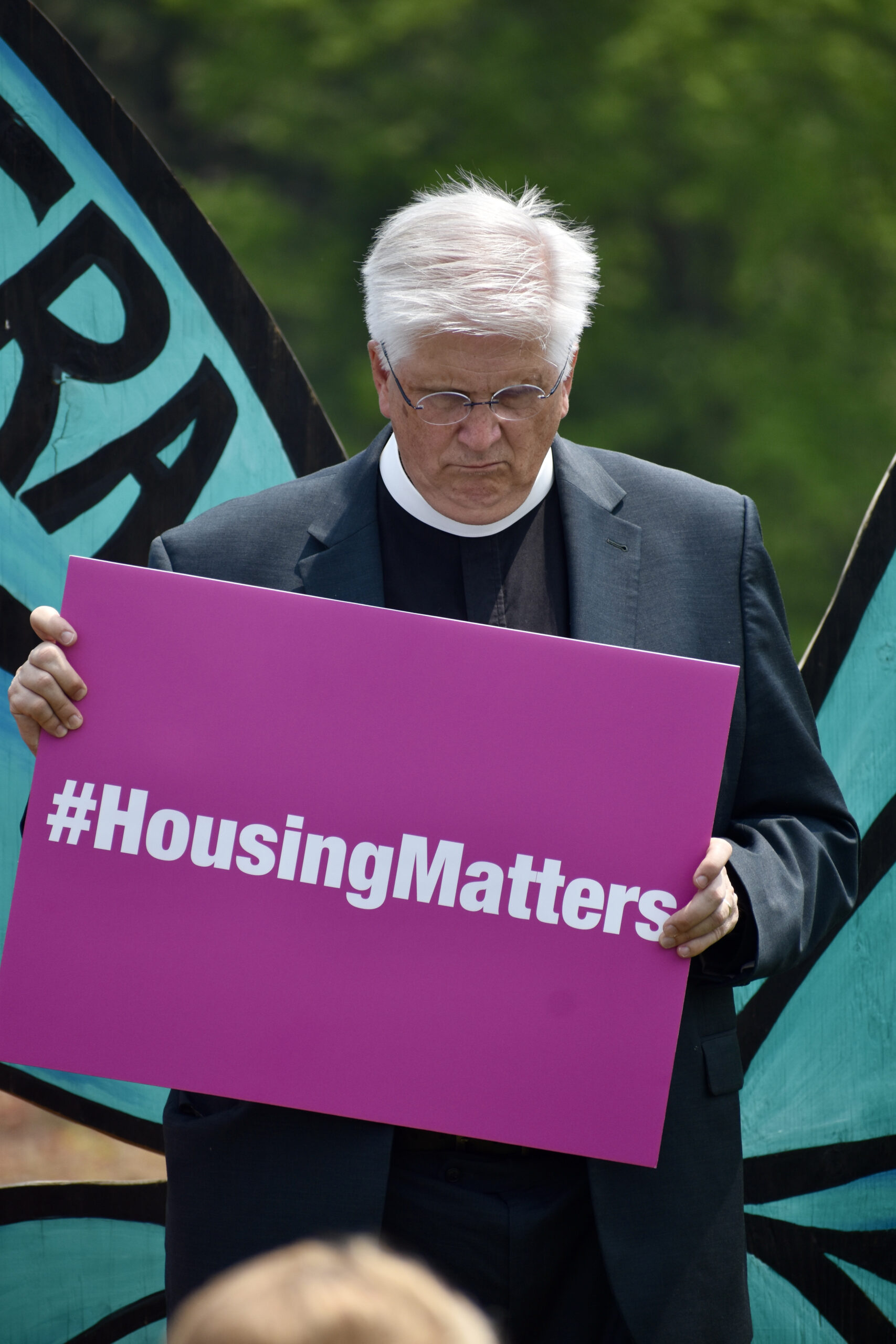
Peter Cook, executive director of the New York State Council of Churches, participates in a NETWORK “Care Not Cuts” rally NETWORK on Long Island on May 22.

For people of color in the U.S.—especially for Black families—banks, the real estate industry, and local, state, and federal policies have enforced centuries of legal segregation and housing discrimination. Practices such as forcing Black families into higher-cost and lower-quality segregated housing (often in neighborhoods near toxic waste sites or highways with poor air quality), denying federally backed mortgages, and preventing the racial integration of white neighborhoods, have had devastating impacts on economic, education, community safety, and health outcomes. The legacies of redlining, environmental racism, and exclusionary zoning persists. Today, more than 50 years after the Civil Rights Movement won the passage of the Fair Housing Act, the gap between white and Black homeownership (which exacerbates the racial wealth gap) is even larger than it was in 1960 before the legislation went into effect.

Even before the COVID-19 pandemic, more than half a million people in the U.S. were experiencing houselessness, disproportionately in Black, AAPI, and Native American communities. With housing costs already stressing families’ financial security, layoffs and other unexpected costs during the COVID-19 pandemic caused many to fall behind on rent and mortgage payments, leading to evictions and foreclosures where state or federal eviction moratoriums failed to protect vulnerable households. Before the national eviction moratorium went into effect (temporarily), the expiration of state eviction moratoriums in 27 states led to tens of thousands of additional COVID-19 cases and deaths.

Access to safe, affordable housing is absolutely critical for every person and supports our country’s overall health. Housing creates stability that helps people pursue education, employment, and health, as well as eliminate contact with the criminal legal system, comply with the terms of their probation, and reduce their risk of recidivism. By failing to ensure housing for all members of our society, we harm family development and deprive millions of the stability of a secure shelter. Lack of housing is a matter of life or death, and one disproportionately faced by communities of color. This is immoral. We must respond to this urgent need and build anew with housing policies that dismantle systemic racism in housing and ensure equitable access to safe and affordable housing for all.

Facts and Figures on Housing in the U.S.
Our Values

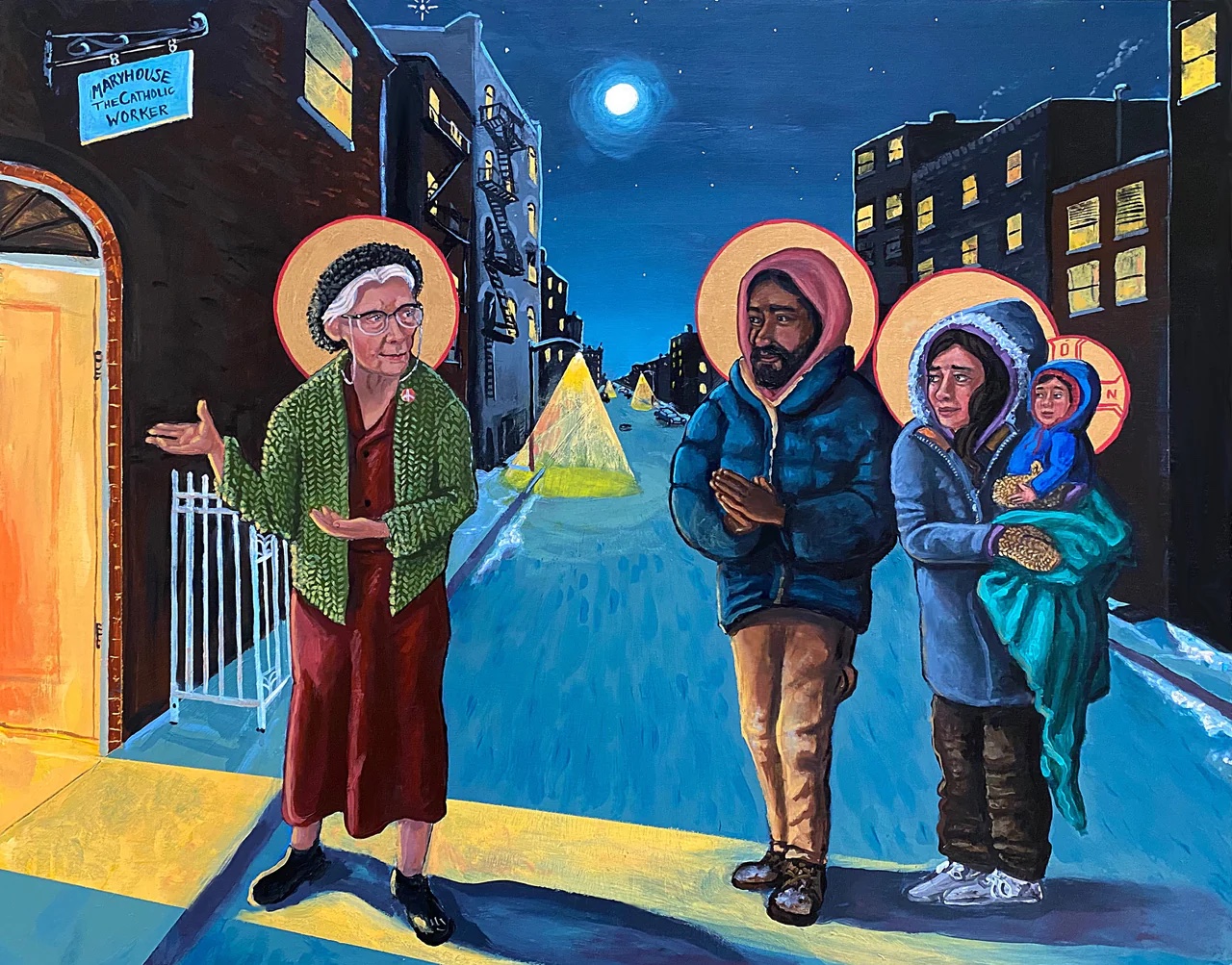
“Dorothy Day and The Holy Family of the Streets,” Kelly Latimore

As we’ve been exploring throughout the Build Anew Series, Catholic Social Justice principles call us to uphold the dignity of each person as an equally valuable member of the global family. Because dignity refers to what people deserve by virtue of their humanity, upholding dignity means ensuring that each person has what they need to live well. Stable, affordable housing — a shelter, a home — is among the most basic of these necessities.

The pervasiveness of houselessness and housing insecurity stands in stark contradiction to the Catholic call to uphold the dignity of each person. The Vatican II encyclical Gaudium et spes reads, “All offenses against human dignity, such as subhuman living conditions… all these and the like are criminal: they poison civilization; and they debase the perpetrators more than the victims and militate against the honor of the creator.” In other words, failing to ensure safe living conditions for all people is an offense against God!

Widespread houselessness is also where we see our social sin of racism and classism especially clearly. It is immoral that some people in this country have multiple houses, while so many have none. It is immoral that so many offices, hotel rooms, and other gathering spaces remain empty at night while our neighbors sleep out in the cold on the streets below. Whether or not you have shelter should not have anything to do with the color of your skin, or how much money is in your bank account. Yet, this is the reality in the U.S., an unconscionable affront to the equal dignity and worth of every single human being which our faith emphatically professes. We have an obligation to our siblings to redress this grave moral harm, as a matter of what it means to live a faith of justice, peace, and compassion.

We are all interconnected. When we all have the food, water, health care, and shelter that we deserve by virtue of our humanity, the whole community benefits. When we all have housing, our nation as a whole will be a healthier, safer, more stable, and more caring place to be for all of us.

When he visited a homeless shelter, Pope Francis asserted, “The home is a crucial place in life, where life grows and can be fulfilled, because it is a place in which every person learns to receive love and to give love.” Housing is a basic human right and the foundation of a person’s ability to meet their needs and care for themselves and their family. Each person deserves a stable shelter in which they can feel safe and at home. Together, we have the resources to make this a reality, and our faith calls us to do so.

Housing Justice and Federal Policy

Luckily, we know that good policy can significantly reduce houselessness. We saw this in the period from 2020-2022, when the rate of increasing houselessness slowed, due to strong (yet temporary) investments in human services programs during the pandemic.

The federal government must take action to promote lasting housing stability for all people. Congress must expand vouchers and increase funding for Section 8 rental assistance (including tenant-based assistance and project-based rental assistance), as well as invest in public housing repairs and rehabilitation (which need more than $26 million in major capital repairs). Additionally, federal lawmakers should pass legislation to provide a renter’s tax credit and expand the Low-Income Housing Tax Credit program.

In addition to ending houselessness and bolstering rental assistance programs, Congress must address the ongoing legacies of redlining, by investing in Black and Brown neighborhoods and creating sustainable pathways to homeownership for communities of color, who still face racial discrimination in housing and lending practices.

In rural America, homeownership is the principal form of housing. Yet, access to mortgage credit is limited, especially for Black households. Another challenge for rural households is clean water infrastructure. Hundreds of rural communities nationwide do not have access to clean residential drinking water and safe waste disposal systems. The government should support the fostering of sustainable, vibrant rural communities, including by increasing investment in Department of Agriculture housing grant and loan programs to ensure every rural household has the resources to repair, buy, or rent affordably.

Most urgently, as Congress appropriates funding for Housing and Urban Development (HUD), let your elected officials know that housing programs must be bolstered, not cut!

Join us again next week for our tenth and final installation of the Build Anew Series, looking ahead to 2024! And don’t forget to stay tuned on Instagram (@network_lobby) and Facebook for our Build Anew video series!

Build Anew Series – Health Care

Build Anew Series — Part 8
Health Care

Virginia Schilder
November 17, 2023
Welcome back to our Build Anew Series, with weekly posts covering the people, policies, and values at the heart of the issues we work on. This week, we’re talking about health care, and the dangerous Medicaid “unwinding” going on in many states.   

In 1966, Rev. Dr. Martin Luther King Jr. said, “Of all the forms of inequality, injustice in health is the most shocking and the most inhuman because it often results in physical death.” These words still ring true in the United States, where many die each year because of a lack of access to health care. Millions of people in the U.S. are uninsured — a number that is rising with the ongoing Medicaid “unwinding” (more on this below) — and even more cannot afford the cost of needed medicine or health services. This “injustice in health” is felt most strongly by people of color, low-income families, immigrants, disabled people, and members of the LGBTQ+ community who, because of structural barriers to health, face lower life expectancy, higher mortality rates (especially maternal mortality rates), and higher rates of chronic diseases.

Access to health care is a fundamental human right that all people deserve as a function of their dignity. The Catholic tradition is emphatic that no person’s life is of greater worth or value than another’s — meaning that it is a grave moral wrong when people with wealth have privileged access to needed health care, medications, and treatments. Our families should not have to choose between life-saving medical care, and putting food on the table or paying the rent.

The COVID-19 pandemic made acutely clear the reality that our health is tied together. By building anew our health care system, we can improve the wellbeing of our society as a whole.

Present Realities

We have seen too many family members, friends, and neighbors die from a lack of care and critical medicines. Before the COVID-19 pandemic, more than one out of 10 adults in the U.S. knew at least one friend or family member who had died without needed medical treatment because they were unable to pay for it. For people of color, that number is one out of five. Let that sink in.

This is unconscionable — especially in a nation as wealthy as the U.S. Everyone deserves access to health care and prescription medications, but our sinful lack of affordable, comprehensive health insurance and the pharmaceutical industry’s exploitative behavior blocks access to needed medicines and care. It’s no surprise that the leading cause of bankruptcy in the U.S. is medical bills. The soaring costs of health insurance and medical bills, and the egregious raising of prices on needed everyday medicines, reflect an immoral effort to profit from our universal need to be taken care of when we are sick—or to simply live with chronic conditions.

We also deserve the time to heal from illness and to care for sick loved ones and children without risk of losing our jobs or critical income — which means that paid sick days and medical leave are indispensable. According to the Center for American Progress, the U.S. is the only “industrialized” nation that does not guarantee paid sick days and family and medical leave. This failure to guarantee paid medical leave most acutely impacts lower-income families and the communities who are already most vulnerable in our society.

The U.S. suffers from immoral health disparities, which the COVID-19 pandemic made worse. Black, Latinx, and Native Americans became sick with COVID and died at higher rates than white people across the U.S. But even before the pandemic, because of systemic racism, people of color in this country have long suffered higher rates of mortality and disease (including heart disease) and lower life expectancy than white Americans. A particularly urgent example of these disparities is the Black maternal mortality crisis. Adverse health outcomes are also closely tied to poverty, which is one of the most significant social determinants of physical and mental health.

In addition to one’s ability to access health care, socioeconomic factors like housing, employment status, incarceration, food security, environmental safety, and education all determine a person’s health. This underscores how health care justice is a comprehensive issue that requires accessible and affordable health care, but also justice and transformation across multiple racial, social, and economic dimensions.

Racial and class health disparities are not only unjust and immoral, but they harm everyone. The pandemic made even clearer how our health is tied together: we are all put at risk when any of us is without insurance, access to affordable care, or the ability to take off work when sick or caring for a sick loved one. To end health inequities and promote our common well-being, we must build our unjust healthcare system anew, and ensure that each of us has what we need to best care for our bodies.

Facts and Figures on Health Care in the U.S.
Lived Experience

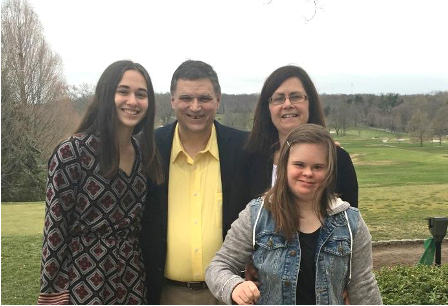
Maura, the second daughter of Joe and Rita McGrath of Lafayette Hill, Pennsylvania, was born with Down syndrome. Now 17 years old, Maura continues to be the blessing her parents have always known her to be. In addition to Down syndrome, Maura is nonverbal and has been diagnosed with autism. As a minor living with disabilities, Maura qualifies for Medicaid benefits. Even though Joe and Rita both work, the cost of Maura’s healthcare is too expensive for their family to afford on their own.

An integral part of Maura’s wellbeing is the care Maura receives from her beloved home health aide Williamina. Taking care of Maura is a full-time job and looking after her became more difficult for Rita after fighting cancer. Additionally, Joe has Parkinson’s disease. Medicaid provided the necessary funds for the McGraths to hire assistance.

In addition to a home health aide, Maura needs eight different medications, medical equipment and supplies (such as her wheelchair and diapers), and frequent doctor appointments. Medicaid covers the cost of these needs. Without Medicaid, the McGrath family would be in financial ruin. The cost of Maura’s medicine alone would be several hundred dollars every month. These are expenses that the McGraths, and many families in similar situations, would be unable to afford without the help of Medicaid.

The principles of Catholic Social Justice teach us that all human life has value. Cutting Medicaid benefits would take away critical healthcare that Maura and many other people deserve. Healthcare is a human right, not a privilege. Medicaid caps or any cut in Medicaid benefits would prevent people from accessing healthcare that is critical to their survival. The McGrath family deserves the peace of mind that comes with knowing they can provide care for their daughters. We are one another’s keeper and Medicaid provides access to care every human is entitled to.

Adapted from text written by Emma Tacke, NETWORK Grassroots Mobilization Associate  

Our Values

The Catholic tradition affirms that each person has a right to the care their bodies need to thrive. The right to access care when you get sick, the medicine and support you need to live with chronic conditions, and the preventative care to keep you healthy, are human rights that we all need and deserve.

Pope Francis says, “Health is not a consumer good, but rather a universal right, and therefore access to healthcare services cannot be a privilege.” The Catholic faith proclaims the ultimate worth of life as infinitely more important than profit—thereby condemning the egregious immorality of over-pricing and profiting off of life-giving medicines and health care. Access to medical services should never be contingent on a person’s ability to pay. At the center of the Catholic faith is the belief that all lives are of equal and immeasurable value. Therefore, allowing those with fewer means suffer or even die while those with wealth access the treatments they need to live is an affront to the Catholic view of the human person.

Throughout the Build Anew Series, we’ve explored how the Catholic tradition is clear that resources are to be shared and used to meet needs — especially the needs of our most vulnerable neighbors. Funds raised to pay for health care through our tax system should help promote public health by expanding health care access. Moreover, the price of health care should not rest on those who have the least — those who are able to pay more, must contribute more.

To love our neighbors means to care for their bodies — ensuring that we all have food, water, clothing, safe shelter, and good health care. Health care services provided through insurance must be comprehensive, and include preventative, primary, acute, mental health and long-term care services. Compassionate and affordable health care that meets needs and tends to the whole person serves to nurture the dignity of everyone in our communities.

Take Action: Why Medicaid Should be Expanding, Not “Unwinding”

Medicaid is our country’s main system of health care coverage for low-income individuals, children, and families, as well as older and disabled adults. Under the Affordable Care Act (ACA), families and individuals earning less than a certain percentage of the federal poverty level are eligible for Medicaid. Today, there are still state governments refusing to opt-in to this expanded coverage for people on the brink of poverty. Lawmakers in those states who deny access to health care for families and individuals struggling in poverty are responsible for keeping their states’ residents from life-saving care.

As a new report from UNIDOS explains, many COVID-19-related Medicaid protections expired on April 1, 2023, allowing states to redetermine eligibility and begin terminating families’ Medicaid. In many states, this has enabled a devastating process of Medicaid “unwinding,” with unprecedented numbers of people losing coverage. The most frustrating part is that most people losing Medicaid are still eligible. They have only lost coverage because of simply missing paperwork or other red tape barriers. This unwinding is particularly affecting Black and Brown communities, as it is estimated that over half of the people losing Medicaid are people of color.

If this unwinding continues, we will be facing an ever-growing and unconscionable health care disaster. Medicaid must be available to all who are eligible, without work requirements or other burdensome restrictions. Investing in our health is critical and benefits all of us. Our elected officials should expand this vital health care program immediately, so that all of us can access the health care we need and deserve.

TAKE ACTION: learn more by reading the full report here: Six Months into Unwinding: History’s Deepest Medicaid Losses Demand State Action.

Join us again next week for part eight of the Build Anew Series on housing. And don’t forget to stay tuned on Instagram (@network_lobby) and Facebook for our Build Anew video series!

Build Anew Series – Criminal Legal System

Build Anew Series — Part 7
Criminal Legal System

Virginia Schilder
November 3, 2023
Welcome back to our Build Anew Series, with weekly posts covering the people, policies, and values at the heart of the issues we work on. This week, we’re talking about the criminal legal system, and the urgent need for reparations.   

The United States incarcerates a greater percentage of its population than any other nation in the world. Stop and let that sink in. In a nation with this extreme incarceration rate, where migrants and refugees seeking safety are placed in cages, and where millions of people — especially people of color — are ripped from their communities and locked up for years or decades, we must ask if the U.S. is really “the land of the free.”

The U.S. criminal legal system targets impoverished, working-class, and Black and Brown communities — seen in who and how the system polices, arrests, prosecutes, sentences, and even executes. In reacting to real social need with surveillance and criminalization, the system fosters instability and insecurity, and furthers the cycles of crime, violence, and poverty. Under the 13th Amendment, incarcerated persons can still be forced into labor for little to no pay. As a result, mass incarceration, which disproportionately locks up Black and Brown Americans, is the primary system of racial segregation, oppression, and coerced labor of our time.

Prisons and cages are incongruous with the Gospel message of true community. No human is disposable. The prevailing ethic of punishment (including capital punishment), separation, and imprisonment is not justice. We are called to a fuller picture of true justice — one characterized by community accountability, integration, healing, and well-being for everyone in our country, with no exceptions.

Present Realities

Since the end of legal slavery, U.S. criminal legal policies have targeted people of color, especially Black Americans. Professor Michelle Alexander writes, “Like Jim Crow (and slavery), mass incarceration operates as a tightly networked system of laws, policies, customs, and institutions that operate collectively to ensure the subordinate status of a group defined largely by race.” The “tough on crime” movement of the 1980’s gave way to policies, like the The Violent Crime Control and Law Enforcement Act of 1994 (the “1994 Crime Bill”), which caused widespread over-criminalization, mass incarceration, and police militarization. Years of “tough on crime” policies and a focus on punishment rather than community healing have targeted already vulnerable communities, worsening racial inequality and creating cycles of poverty for many individuals, families, and neighborhoods. Financial incentives for drug arrests have encouraged over-policing in Black and Brown communities, who are left with disproportionate numbers of folks with criminal records (mostly for minor non-violent offenses) and face ongoing brutality from the police.

The U.S. has the highest percentage of incarcerated people in the world, largely a result of extreme sentencing measures such as mandatory minimums and “three strikes” laws. Even non-violent offenses can result in years in prison and continuing restrictions and penalties after release. Disparities in sentencing policies for comparable offenses, such as using powder cocaine vs. crack cocaine, have yielded vastly longer average sentences for people of color compared to white folks. The ongoing use of cash bail and barriers to accessing adequate legal defense trap low-income people in the system. And, the practice of referring kids (usually Black and Brown children) to the youth justice system for misbehavior at school has facilitated a “school to prison pipeline” that disrupts the lives of children and perpetuates cycles of incarceration.

Within U.S. prisons, the inhumane practice of solitary confinement, disproportionately used for people of color and people with mental illnesses, persists — along with other dangerous living conditions, especially during the COVID-19 pandemic. Moreover, the U.S. is the only Western nation that still implements the death penalty and ranks fifth in the world in executions.

Restore Act Leave BehindA person convicted of a crime in the U.S., whether or not they serve time in prison, suffers long-term discrimination in employment, education, and public services. Requirements to “check the box” on employment applications and prohibitions against licensing in certain fields cost formerly incarcerated people both the immediate income they need and their long-term earning potential, which hurts not only themselves but also their families and children. Returning citizens face restrictions in accessing federal student aid, health care, the right to vote, public housing (which impacts family reunification), and nutrition programs like SNAP. These policies all contribute to the cycle of poverty for families and communities.

Head to our recent Build Anew Series – Food Systems post to learn more about the SNAP ban for citizens returning from prison with felony drug convictions. Read a testimony from Serena Martin-Liguori about the need to pass the RESTORE Act, which would end the ban on SNAP for returning citizens in the upcoming Farm Bill.

Facts and Figures on the U.S. Criminal Legal System
  • 2 million people are currently in jail or prison in the U.S. The U.S. has over 25% of the world’s population of incarcerated persons despite accounting for only 4% of the world’s total population. The U.S. has the highest percentage of incarcerated people in the world, 655 per 100,000.
  • The U.S. prison population has increased by 500% over the past 40 years. People of color comprise nearly 78% of the prison population. These trends are explained by changes in policies and laws, not crime rates.
  • In 2013, the Sentencing Project reported that if incarceration rates continue to grow at the pace they have since the 1970’s, 33% of Black American males can expect to go to prison in their lifetime, as can 16% of Latino males, and 6% of white males.
  • The U.S. carceral system costs taxpayers $80 billion per year.
Our Values

The murders of George Floyd and countless others are examples of the systemic violence committed every day by our country’s “justice” system. Our people cry out for change. We cannot tolerate the loss of another generation to mass incarceration. Our legal system’s punitive, “tough-on-crime” mentality perpetuates poverty, instability, and a dehumanizing ethic that harms us all.  

A legal system predicated on control, alienation, and racial subjugation stands in complete affront to the restoration, inclusion, peace, and racial justice into which the Catholic faith calls us.  Throughout the Bible, God moves to set free the imprisoned: “The Lord has anointed me to bring good news to the poor; he has sent me to bind up the brokenhearted, to proclaim liberty to the captives, and the opening of the prison to those who are bound” (Isaiah 61:1).  In Matthew’s Gospel, Jesus says that when you visit people in prison, you visit him. 

Further, the Psalms proclaim that God looked at Earth to “hear the groans of the prisoners, to set free those who were doomed to die.” Pope Francis has clearly stated that the death penalty is “an attack on the inviolability and dignity of the person” that is “inadmissible” in all cases. The Catholic Church is unequivocal in opposition to capital punishment, which in the world today is needless, state-sanctioned murder that perpetuates vengeance, violence, and militarism. Moreover, the death penalty is a mechanism of white supremacy, disproportionately executing Black Americans and our siblings with mental illness.    

We are rooted in our faith in a God not of punition, retribution, and abandonment, but of healing, mercy, and transformation. We are called to extend these graces to one another. To be truly just, our legal system must affirm the human capacity for reconciliation, reintegration, and reconnection. Even further, we must recognize the ways in which racist constructions of “crime” and oppressive social conditions undergird the punitive carceral system.

During his lifetime, Jesus did not look away from social problems and the people they affected, but moved into encounter and was an agent of healing. In his example, we cannot cast away our neighbors behind cell doors. As Angela Davis articulates, 

“Prisons do not disappear social problems, they disappear human beings. Homelessness, unemployment, drug addiction, mental illness and illiteracy are only a few of the problems that disappear from public view when the human beings contending with them are relegated to cages.” 

The Catholic teaching of the immeasurable worth of each human being means that no one is disposable. We cannot let illusions of disconnection — “us vs. them” narratives — keep us from responding to the suffering in our prisons: Remember those who are in prison, as though in prison with them, and those who are mistreated, since you also are in the body (Hebrews 13:3). Salvation means wholeness, liberation, and communion. God does not leave a single person out of the circle of care, forgiveness, and restoration, no matter their past — and neither can we.  

Take Action: H.R.40 Reparations Study Commission

White text on a dark blue background reads, in capital letters, "IT'S TIME TO ADDRESS, REPENT, AND REPAIR." Throughout the Build Anew Series, we’ve been noting the operation of racism in and through our economy, our tax code, and our political, immigration, and even food systems. This week, we see that the legacy of enslavement is acutely visible in the system of mass incarceration. In conjunction with other social and economic barriers, our carceral system continues to chronically destabilize and tear apart Black and Brown families and communities.

All of this makes clear: we need reparations. The legacy of enslavement persists today. Structural racism keeps communities from accessing the housing, health care, food, economic stability, safety, and political participation we all deserve and need to thrive. As a country, we need reparations in order to move towards repair, transformation, and liberation for all of us.

Catholics are called to be agents of peace, healing, truth-telling, and justice. Take action here by telling President Biden to use his executive power to establish an H.R. 40 reparations study commission. Together, we can work for reparations and take a crucial step towards true healing, democracy, and flourishing in our country.

Join us again next week for part eight of the Build Anew Series on health care. And don’t forget to stay tuned on Instagram (@network_lobby) and Facebook for our Build Anew video series!

Build Anew Series – Democracy

Build Anew Series — Part 6
Democracy

Virginia Schilder
October 27, 2023
Welcome back to our Build Anew Series, with weekly posts covering the people, policies, and values at the heart of the issues we work on. This week, we’re talking about democracy.   

This past weekend, NETWORK held the third iteration of our White Supremacy and American Christianity event series, with Fr. Bryan Massingale, Dr. Robert P. Jones of the Public Religion Research Institute, and NETWORK’s Joan F. Neal — this time joined by Darcy Hirsh from Interfaith Alliance and Laura Peralta-Schulte, NETWORK Senior Director of Public Policy and Government Relations.

Fr. Massingale and Dr. Jones articulated how Christian nationalism and white supremacy (we cannot talk about one without the other) suppose that America belongs to white Christians, who are therefore entitled to its control and its resources — and justified in achieving that control through violent means. Our speakers explained that white supremacist Christian nationalism is a “consistent ethic of hatred” that benefits only a specific subset — “the right kind” — of white folks. This hostile ethic, predicated on exclusion and hierarchy, is fundamentally anti-democratic.

In seeking to concentrate power in the hands of a select few, Christian nationalism and white supremacy pose an urgent threat to democracy today. While this threat to democracy is growing, it isn’t new. Systemic racism has worked to disenfranchise Black and Brown voters for centuries. The restriction of voting rights, gerrymandering, the undermining of election integrity, and the unchecked role of corporate money in politics all weaken democracy and threaten free and inclusive political participation.

The weakening of democracy in the U.S. is part of a larger trend of marked decline of democracies worldwide. Pope Francis has lamented this decline with urgency, affirming that “Universal participation is something essential; not simply to attain shared goals, but also because it corresponds to what we are: social beings, at once unique and interdependent.” Catholic Social Justice emphasizes the sociality and the dignity of each human being, which means that each person has a right to a say in the decision-making processes that affect their lives. What could it mean for our democracy to be oriented towards participation, encounter, the common good, and truly collective decision-making?

Facts and Figures on Democracy in the U.S.
  • Between 2016-2018, after the Shelby County v. Holder Supreme Court decision, at least 17 million voters were purged from voter rolls. Counties with a history of voter discrimination continue to purge voters at a much higher rate than other counties.
  • Research demonstrates that strict voter ID laws significantly increase the turnout gap between white voters and Latinx, Black, and multiracial voters.
  • As of 2020, 5.17 million people — one out of 44 adults, and 2.27% of the total U.S. voting-eligible population — are disenfranchised due to a current or previous felony conviction. Over 6.2 percent of the adult Black American population is disenfranchised, compared to 1.7 percent of the non-Black population. It is estimated that over 560,000 Latinx Americans are disenfranchised, and approximately 1.2 million women are disenfranchised, comprising over one-fifth of the total disenfranchised population.
Present Realities

While democracy is much more than what happens on election day, even the right to vote, our most basic method of democratic participation, is not fully realized. Voting rights in the U.S. are under assault at the state and federal levels.

In particular, election policies continue to deliberately undermine Black and Brown voter participation. Since the 15th Amendment codified the right to vote for Black American men in 1870, state and local governments have continued to pass discriminatory laws to disenfranchise voters. One in 16 Black Americans of voting age is disenfranchised, a rate 3.7 times greater than that of non-Black Americans. Today, voter ID laws and restrictive voting rules disproportionately affect people of color, low-income and disabled voters, elderly and young voters, and voters who are unhoused.

The 2013 Shelby County v. Holder Supreme Court ruling gutted Section 4(b) of the Voting Rights Act of 1965, dismantling protections that prevented states from disenfranchising voters based on race. Since then, Congress has failed to pass legislation to restore that oversight provided in Section 4(b), meaning that states are still able to enact racist restrictions without accountability. As a result of the Shelby decision, over 1,000 polling places have closed — again, disproportionately harming voters of color, rural voters, and voters with disabilities. According to the White House, since January 2021, 18 states have enacted 30 separate laws that will make it more difficult to vote. What’s more, over 400 bills that would make voting less accessible, including restrictions to voting by mail and early voting, as well as voter roll purges, have been considered in various state legislatures in recent years.

Varied methods of voter suppression, in addition to the undue influence of corporate money in politics, gerrymandering, felon disenfranchisement, and other anti-democracy tactics limit political participation, particularly for our most marginalized community members. States that make voting harder or redraw districts unfairly strip their neighbors of access to involvement in our collective political life. These efforts are serious threats to our democracy, that not only harm our communities’ well-being but harm our ability to politically engage in the pursuit of our communities’ well-being at all.

Lived Experience

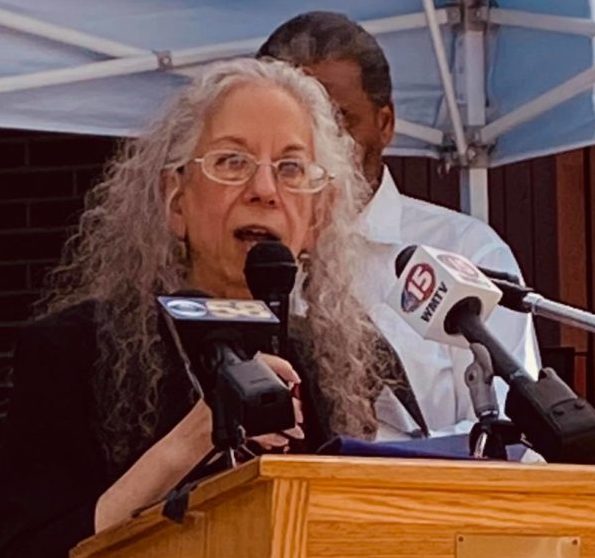
Rabbi Bonnie Margulis, with Wisconsin Faith Voices for Justice, spoke about the 2020 Wisconsin primary at a Faithful Democracy Town Hall in April 2020.

Rabbi Bonnie Margulis. Photo from Madison365

“Our election on April 7th was a morass… The Thursday before the election, a federal court judge said that our absentee ballots did not need witness signatures, so people were sending in their absentee ballots without signatures because they were safer at home [during the pandemic] and didn’t have any way to get their ballots witnessed. 24 hours later, that decision by the federal court was overturned by an appellate court, and so all of those ballots were invalidated. At least 750 ballots in Milwaukee alone were invalidated for lack of signature.”

Rabbi Margulis explained that in Dane County, where Madison is, the county clerk said that if you requested an absentee ballot online you didn’t need an ID. However, “That also was declared to be illegal, so people who didn’t submit an ID couldn’t get an absentee ballot.” At the same time, “A federal court judge had said that absentee ballots could be postmarked as late as April 13th, and on April 6th (the day before the election) the United States Supreme Court overturned that and said no, ballots have to be postmarked by April 7th, the day of the election.”

Further, in part due to a shortage of polling workers during the pandemic, “In Dane County, the number of polling places was reduced from 95 to 63. In Waukesha, a suburb of Milwaukee, the polling places were reduced from 13 to 1. But the most egregious was Milwaukee, which usually has 180 polling places, and it was reduced to 5.” Rabbi Margulis emphasized that this was a blatant attempt to suppress the votes of people of color because Milwaukee has the greatest percentage population of people of color anywhere in the state.

Our Values

A core principle of Catholic Social Justice is that we all have both a right and moral responsibility to participate in our shared public life and political processes, as a matter of our dignity and agency. As the Leadership Conference of Women Religious states, “As women religious and believers in the abundant love of God for all, we are called to bring our faith and our voices to the public square.”

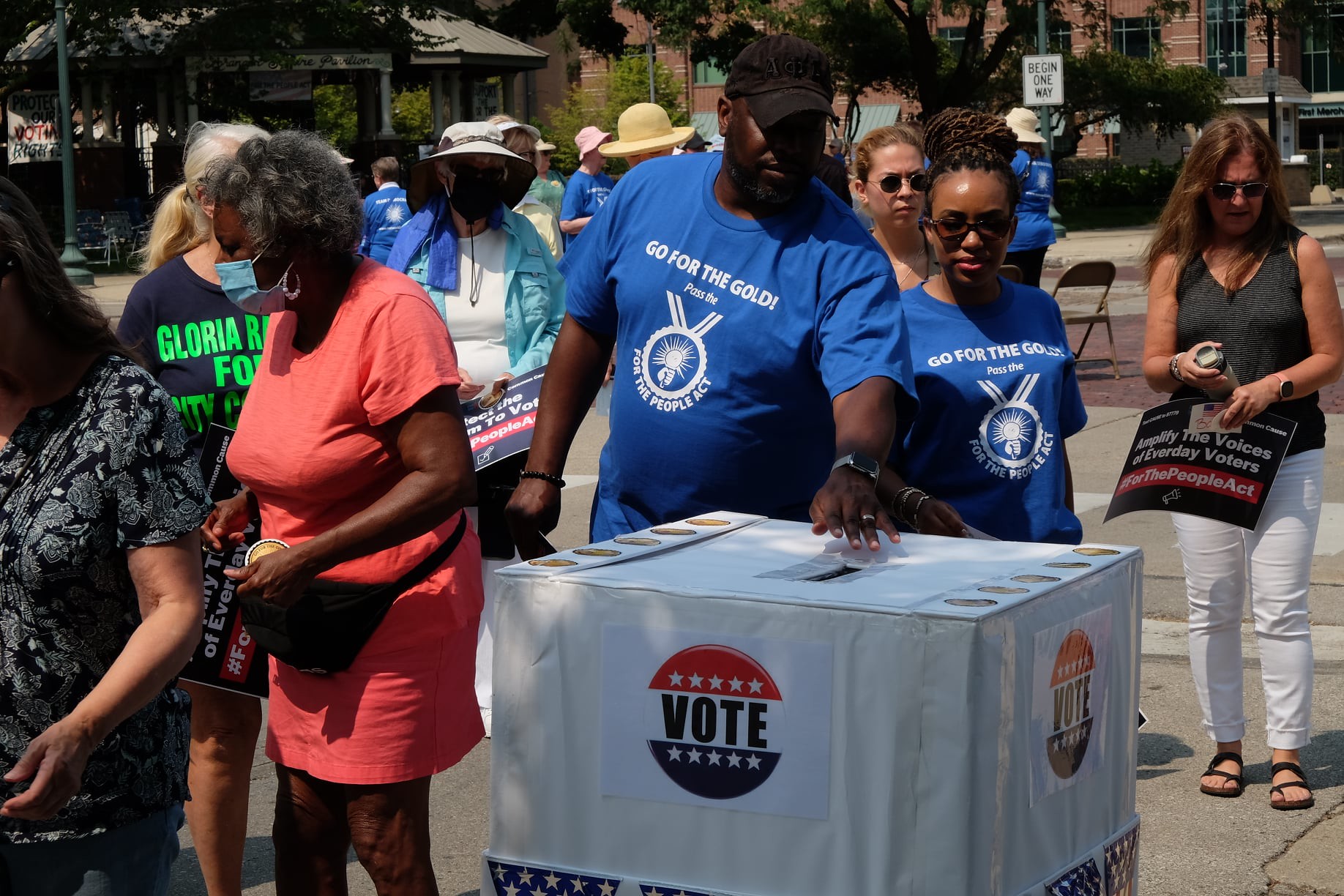
People cast their votes for federal democracy reform as part of NETWORK’s “Team Democracy” events across the country in 2021. Voting rights, which have come under threat at the state level since the U.S. Supreme Court gutted the Voting Rights Act in 2013, are a key component of NETWORK’s efforts to defend democracy.

People cast their votes for federal democracy reform as part of NETWORK’s “Team Democracy” events across the country in 2021.

This responsibility to participate means each person also has a fundamental right to participate and must be equipped with the resources needed to do so. The intentional curtailing of political participation by restricting voting, gerrymandering, and undermining elections is a serious moral failure and a threat to the free society we are called to build. We have a responsibility not only to participate in the democratic process ourselves but also to protect our most vulnerable neighbors’ right to join in shaping our society.

But participation alone is not enough: political participation must be aimed at and committed to advancing the common good. The Catholic Catechism states, “It is necessary that all participate, each according to his position and role, in promoting the common good. This obligation is inherent in the dignity of the human person.” The Catholic tradition also calls us to move beyond partisan politics in our pursuit of justice and social transformation. The US Council of Catholic Bishops writes,

“As citizens, we should be guided more by our moral convictions than by our attachment to a political party or interest group. When necessary, our participation should help transform the party to which we belong; we should not let the party transform us in such a way that we neglect or deny fundamental moral truths or approve intrinsically evil acts. We are called to bring together our principles and our political choices, our values and our votes, to help build a civilization of truth and love.”

Our democratic processes are a vehicle of participation in the public realm, which is where our Catholic obligation to cast our nets wide in cultivating social solidarity, loving one another, and working for the good of others happens. Scriptures tell us, There should be no division in the body, but that its parts should have equal concern for each other. If one part suffers, every part suffers with it; if one part is honored, every part rejoices with it (1 Corinthians 12:25-27), and So in Christ we, though many, form one body, and each member belongs to all the others (Romans 12:5). The political arena is where we are called to act as the body of Christ, honoring each of its parts, alleviating suffering anywhere. And just as Jesus did not lead by force or concentrated power but spoke of casting down mighty rulers, we are called to assert the strength and needs of our communities, always opposing the imposition of authoritarian, unilateral rule — the kind of government to which Christian nationalism points.

The Catholic tradition affirms that public service is a noble vocation, but only when it serves justice and the flourishing of life. Elected officials must be accountable to all our people, especially the most vulnerable among us, and center the needs of real communities—not the interests of wealthy donors and corporations. In Fratelli Tutti (66), Pope Francis reminds us that we are called to direct society to the pursuit of the common good, and policies and laws that allow unlimited money in politics threaten this democratic and moral obligation. We are called to uncover these workings of wealth and power (Take no part in the unfruitful works of darkness, but instead expose them (Ephesians 5:11)) and institute justice in their place.

We know that there are alternatives. Catholic sisters, for example, have long modeled “contemplative dialogue, deep listening, and mutual respect” in consensus-based, collective decision-making processes that serve as an example for our political life at large. A democracy is not a democracy unless it is a culture of participation, encounter, and solidarity with those on the margins, in which our communities can work together to solve problems and meet needs. Transforming our politics and working for a multi-racial, multi-faith, and anti-hierarchical society in which all our communities can thrive is the real meaning of democratic participation — our right and responsibility.

Take Action

WATCH: Watch “White Supremacy and American Christianity: A Consistent Ethic of Hate Threatens Our Democracy” to learn more about the threats that Christian nationalism and white supremacy pose to democracy, how it shows up in current policies and legislation, and what we can do protect our democracy.

SIGN: Tell President Biden that the U.S. needs an H.R. 40 reparations commission. In this installation of the Build Anew Series, we’ve talked about how systemic racism operates through our political system. Support a reparations commission to help transform our politics into a multiracial, multifaith democracy.

LISTEN: Listen to a recent episode of the Just Politics podcast, “Actual strategies for saving democracy,” in which Rachel Kleinfeld reflects on why democracy in the U.S. is in decline and names some steps we can take to protect it.

READ: And, check out this reflection by NETWORK Advocate Bob Kloos on his experience as a poll worker.

Join us again next week for part 7 of the Build Anew Series on our criminal legal system. And don’t forget to stay tuned on Instagram (@network_lobby) and Facebook for our Build Anew video series!

Build Anew Series – Tax Justice

Build Anew Series — Part 5
Tax Justice

Virginia Schilder
October 20, 2023
Welcome back to our Build Anew Series, with weekly posts covering the people, policies, and values at the heart of the issues we work on. This week, we’re talking about tax justice, and specifically, the need to bring back the expanded Child Tax Credit.   


It’s budget time in Congress, and many of our representatives are pretending that we have a scarcity of funds with which to fund our government. But that’s patently untrue. There is a simple reality: If the wealthiest Americans and corporations paid their fair share of taxes, we would have more than enough to pay for all the public programs our communities not only need, but deserve. To visualize this, I invite you to try out NETWORK’s tax justice calculator tool, in which you can build your own federal budget with programs you care about and see how equitable tax policies can fund them. The United States has one of the greatest — and

most dangerous — degrees of wealth inequality in the world. The concentration of wealth into the hands of an ultra-wealthy few is facilitated and maintained, in large part, by our tax system. For example, consider Jeff Bezos, Amazon’s Founder and Executive Chairman, who enjoys a net worth of $155 billion, but did not pay a single cent in federal income taxes in 2007 or 2011.

A just tax system is a foundation of a just society, and a multi-faith, multi. In our past Build Anew Series piece on Economic Justice, we talked about how we as a collective have enough resources to ensure that everyone has what they need to thrive — it is only a matter of distributing those resources justly. Taxes can help us do that.

Congress now has less than 30 days to pass a FY24 federal budget. As part of NETWORK’s Congress, Keep Your Promise! Campaign, we’ve been urging our leaders to ensure that vital human needs programs like food, housing, and health care assistance are fully funded in the budget, and that the necessary policies are enacted to ensure that the wealthiest individuals and corporations contribute their fair shares.

A central part of a just tax system in the current budget process is the expanded Child Tax Credit (CTC). An expanded CTC combats child poverty, supporting families as they provide necessary care and resources for their children. The expired, temporary expanded CTC in 2021 (the American Rescue Plan increased the child tax credit for one year) was a resounding success. The child poverty rate was dramatically reduced to a record low 5.2%. It kept roughly 2.1 million children above the poverty line ― including an estimated 752,000 Latino children, 649,000 white children, 524,000 Black children, 89,000 American Indian and Alaska Native children, and 56,000 Asian children ― and lessened differences in poverty rates between children of all races and ethnicities (Center on Budget and Policy Priorities). Our children need it back!

In this week’s installment of the Build Anew Series, we’ll learn more about the CTC and the urgency of strengthening it in the ongoing appropriations process. First, let’s learn more about tax policy in the U.S., and why a just tax system is critical for a ju st nation.

Facts and Figures on Taxes in the U.S.
  • Refundable tax credits moved 7.5 million people out of poverty in 2019, according to the Supplemental Poverty Measure.
  • A 2019 Congressional Research Service report calculated that the 2017 Tax Revision law reduced federal revenue by about $170 billion in FY 2018, with corporations benefiting most from the tax cuts.
  • According to the U.S. Treasury Department, the wealthiest 1% of Americans may be evading as much as $163 billion in income taxes each year — many doing so legally via our unjust tax laws.
Present Realities

Our unjust tax code is directly related to the economic instability experienced by individuals and families across the U.S., and it affects the wellbeing of our country overall. Taxes enable us to have the public services we all want and benefit from, and to make the investments in people and neighborhoods that are needed for our communities to thrive. If we want good schools and accessible higher education, safe and efficient transportation infrastructure, a strong health care system, and healthy communities with affordable housing, clean water, and food security, we need to collectively contribute to funding them.

Decades of tax cuts for the wealthiest people and corporations have harmed our communities. Our tax code actively creates economic inequality — one of the most pressing problems in the United States. Our tax code treats income from capital more favorably than income from labor, which means that those at the very top — whose income largely relies on investments rather than work — end up paying a lower effective rate. This tax structure enables the wealthiest people and corporations to pay little to no taxes at all, hoarding resources that they gained off the labor of everyone else. The 2017 Republican Tax Law benefitted corporations by substantially lowering effective corporate tax rates and by generating a flood of stock buybacks and dividends for corporate shareholders. Meanwhile, the law reduced federal revenue by about $170 billion in FY 2018.

Most nefariously, our tax system maintains the racial wealth gap. In 2016, the median income of white households was $117,000, while Black households had only $17,000. This vast racial inequity is not incidental, but is a direct result of the Trans-Atlantic slave trade, Jim Crow, and centuries of racist federal policies — particularly policies that shaped our tax code. Our tax system continues today to maintain the wealth of the white ruling class. For example, our tax code privileges white couples in the structure of the married joint filing bonus; it rewards how wealthier white folks spend money (with tax incentives for buying a home, but not renting); and it facilitates the largely un-taxed intergenerational transfer of wealth in white families across history. The outcome is what we see today: our nation’s wealth concentrated in the hands of a tiny minority of white folks.

Tax justice means ensuring that wealthy individuals and corporations contribute a fair share, so that we can support the public services that help our communities to thrive. It hurts everyone in our country when we have insufficient funding for public programs, assistance for families experiencing homelessness or hunger, or the infrastructure we all rely on every day. A just system of taxation recognizes that we are one community with responsibilities to one another, and our wellbeing is tied together.

Learn more at NETWORK’s Tax Justice For All page.  

Our Values

“The obligations of justice and love are fulfilled only if each person, contributing to the common good, according to his own abilities and the needs of others, also promotes and assists the public and private institutions dedicated to bettering the conditions of human life.” —Gaudium et spes

One of the key principles of Catholic Social Justice Teaching is, “Rise above individualism for the good of the whole community.” This means rejecting an ethic that places individual gain above collective flourishing, and instead taking seriously our call and responsibility to promote the wellbeing of our neighbors. Taxes are a key way in which we can do this.

A just tax structure affirms the moral responsibility of each person to contribute to the community according to their ability. Material prosperity never arises in a vacuum. The resources that wealthy individuals and corporations have accumulated are generated by the labor of workers and supported by social goods like roads, bridges, schools, and fire departments that we collectively fund. Therefore, paying taxes is a serious ethical responsibility for those with abundance. It is also the responsibility of governments to use tax dollars in ways that meet the real needs and goals of our communities.

A just tax code can be a structure through which the values of sharing, reciprocity, and participation are lived out. These values were modeled by the community of Jesus’ early followers, of whom it is written:

“No one claimed that any of their possessions was their own, but they shared everything they had… And God’s grace was so powerfully at work in them all that there were no needy persons among them. For from time to time those who owned land or houses sold them, brought the money from the sales and put it at the apostles’ feet, and it was distributed to anyone who had need.” —Acts 4:32-35

As a community, the apostles model the Catholic notion of “the universal destination of goods:” the deep conviction that resources are to be shared — used to respond to need and to better the community. Scripture emphasizes the moral responsibility for those with means to share: “Anyone who has two shirts should share with the one who has none, and anyone who has food should do the same” (Luke 3:10-11). Yet, it is important to remember that in today’s society, in which unjust economic structures enable the accumulation of wealth often through the exploitation of workers, paying taxes is not just a matter of charity and sharing. Rather, it is a matter of justice — returning to communities what has been unjustly extracted.

This is why a just tax code is a moral obligation. Tax structures can serve to widen the gap between the ultra-wealthy and the rest of us, or they can work as a mechanism of justice. In the U.S. Bishops’ pastoral Economic Justice for All, the bishops insist that, “The tax system should be continually evaluated in terms of its impact on the poor.” This also means that families below the poverty line should not bear the burden of paying income taxes. Pope John XXIII put it plainly: “In a system of taxation based on justice and equity it is fundamental that the burdens be proportioned to the capacity of the people contributing.”

The Catholic tradition teaches that paying taxes is part of one’s responsibility to contribute to the common good. We are called to equitably share resources so that each person has what they need to live well, and that our society as a whole has the structures and programs that help all of our communities flourish.

The Child Tax Credit

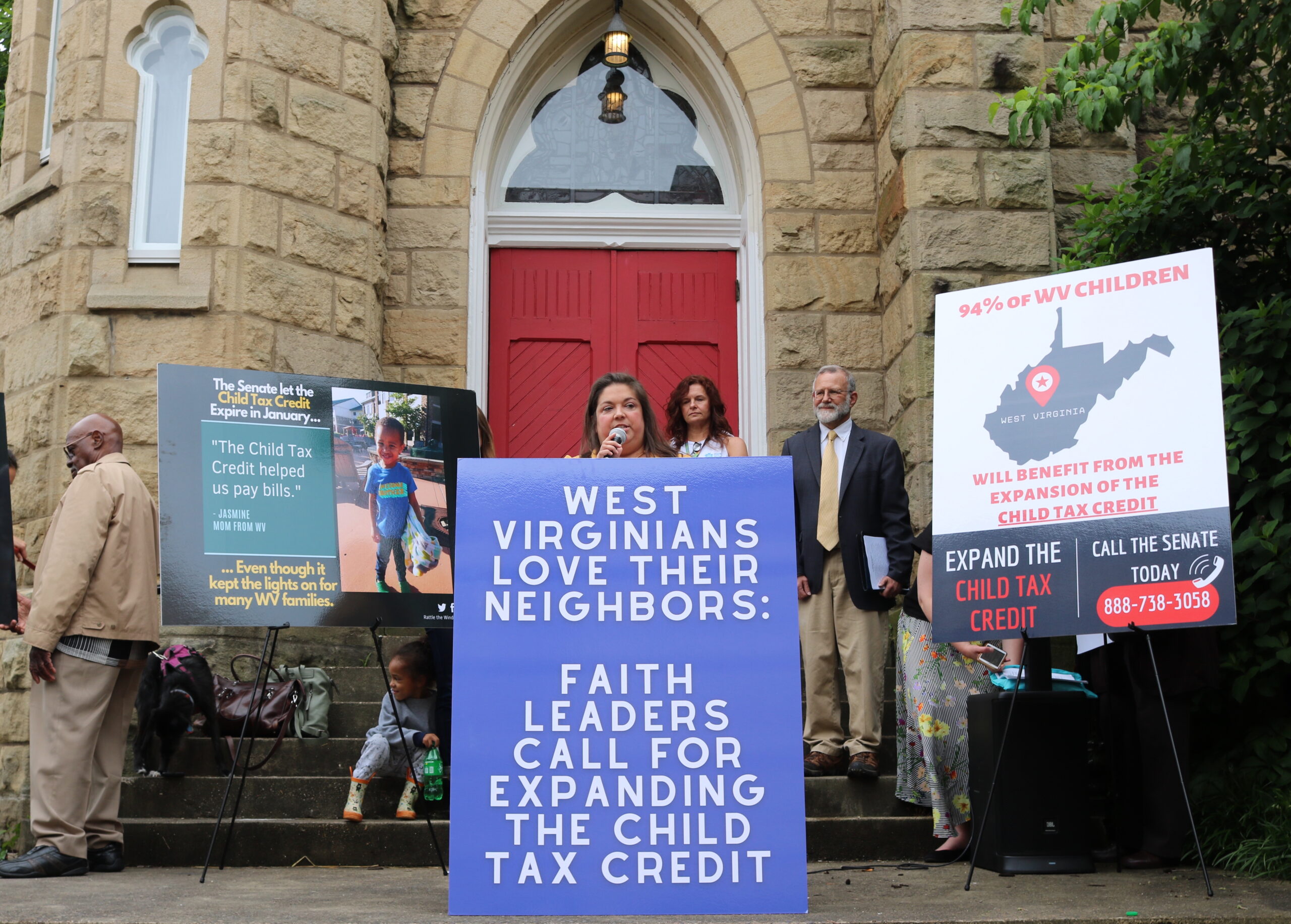
Advocates and faith leaders in West Virginia gather in May 2022 to call for a continuation of the expanded child tax credit.

The Child Tax Credit (CTC) was enacted in 1997 and currently provides a tax credit of up to $2,000 per child. Studies overwhelmingly demonstrate that the CTC directly reduces child and family poverty. In 2018, the CTC lifted 4.3 million people, including 2.3 million children, out of poverty. However, the current CTC law provides the greatest benefits to higher income families, in effect penalizing the lowest wage workers in our communities.

In 2021, as part of the American Rescue Plan, the CTC was increased to up to $3000, and penalties on low-income families were removed. This expansion finally allowed all families to benefit from the full CTC, regardless of their income. The 2021 expansion was an incredible success: it extended the CTC to the families of 27 million children who previously did not have access, and it reduced the national child poverty rate from an anticipated 8.1% down to 5.2%(!).

Lived Experience

Nakkita Long is a mom in Winston-Salem, NC with a master’s degree in criminal justice. She shares,

This past year (2020) has been devastating for my family in ways that I cant even explain…. Giving $300 to families may not seem like a lot, but when you’re working minimum wage or you’re underpaid, it’s everything. It’s the difference between where you live, what you eat, and how your family enjoys leisure.   

For my family, the child tax credit has benefited me because my daughter started college in the middle of the pandemic, and my son is starting kindergarten. I was able to buy my daughter a laptop so she could do her studies at home. I was able to do things with my family that I wasn’t able to do before because my income was low, I was living paycheck to paycheck. 

Look at the cost of living, and look at what people actually need to sustain themselves on a daily basis. For my family, just the basic needs of bread, lights, water, having a car to get back and forth to work, have been a challenge for me. And the benefits of incentives such as the child tax credit, extended unemployment, free child care, free college, is astounding, and it takes my family to a different place as far as what we can do successfully and how we can grow. It’s important to understand that giving people what they deserve… empowers those families to build businesses, become homeowners, invest in their communities, attend great schools, become great leaders, and do great things in society.”  

From the Domestic Human Needs Story Bank

Despite this success, Congress decided to allow the 2021 CTC expansion to expire – with detrimental impact to our most vulnerable children. Child poverty has risen, and an estimated 19 million children are deprived of all or part of the CTC simply because of their families’ low wages. This has had a disproportionate impact on Black and Brown families, affecting approximately 45% of Black children and 39% of Latine children. It has also hurt rural communities, as 33% of children in rural areas have been negatively impacted by the expiration of the CTC expansion.

This is why we need to bring back the expanded CTC. A strong CTC helps provide essential resources for child care and other support services, and thus enables parents to work. It also promotes healthy children, as lifting children out of poverty is directly related to improved health and education outcomes. We know how well the expanded CTC works! To support flourishing families and protect the youngest and most vulnerable members of society, Congress must expand the CTC to its 2021 levels. Our children need and deserve it.

Click here to learn about how you can take action to demand that Congress enact a strong, expanded Child Tax Credit. And to learn more about the CTC, check out NETWORK’s CTC leave-behind.

Join us again next week for part 6 of the Build Anew Series on democracy, a follow-up to the third installation of our White Supremacy and American Christianity series this Saturday. And don’t forget to stay tuned on Instagram (@network_lobby) and Facebook for our Build Anew video series!

Louisville, KY Rally for a Better Federal Government

Get Beyond ‘Bandage’ Work in the Federal Budget

David J. Dutschke,
Guest Contributor from the Kentucky NETWORK Advocates Team
October 13, 2023
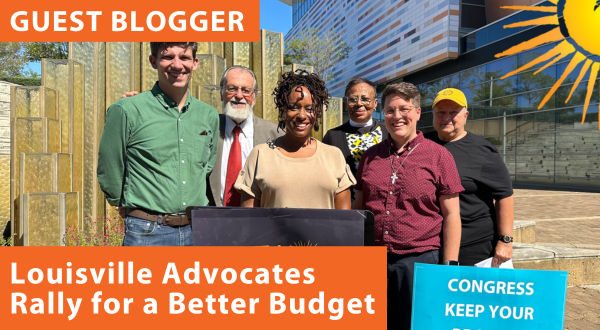
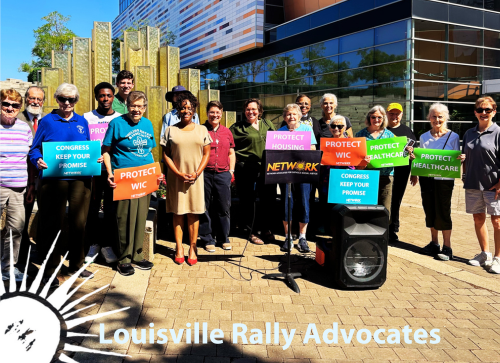
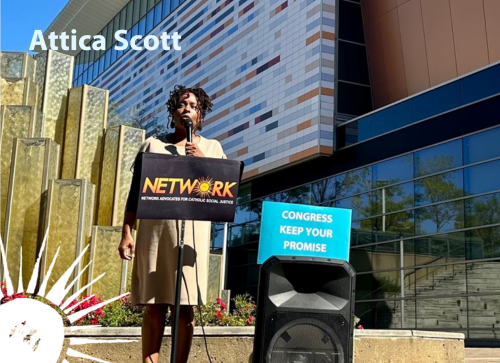
Oct 2, 2023, Louisville Rally Speakers Speak Out for a Better Federal Budget at the Ali Plaza in Louisville, KY

Louisville, KY advocates spoke out for a better federal budget at the Ali Center Plaza

We often talk about a “living wage.” Now it’s time to talk about a “living budget.” A

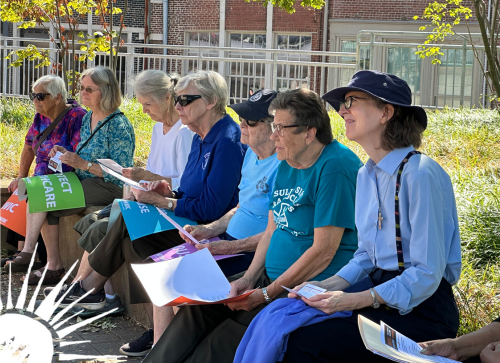
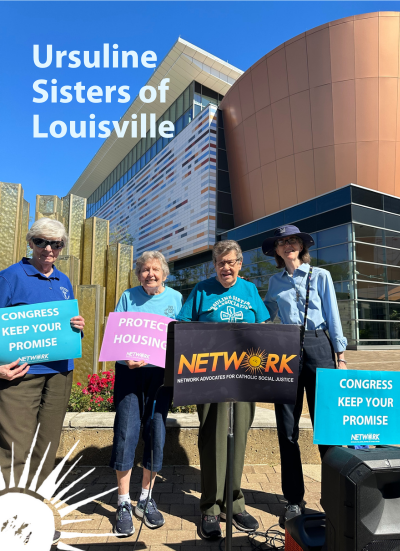
On Monday, October 2, 2023, a group of about 15 persons of faith and action gathered under the NETWORK umbrella at the Mohammed Ali Center Plaza in Louisville, Kentucky to challenge our elected officials to pass a budget that includes those on the margins struggling to afford housing, meals, health care, and more.

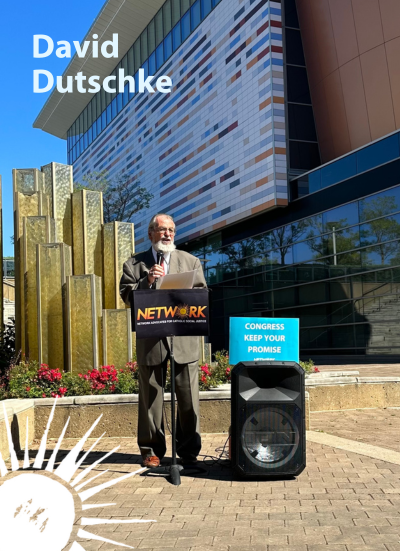
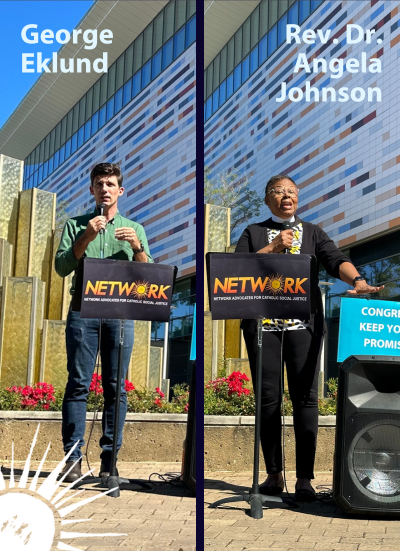
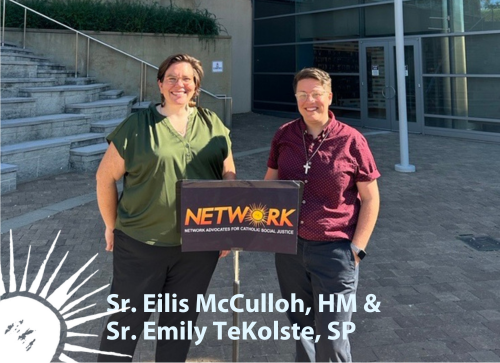
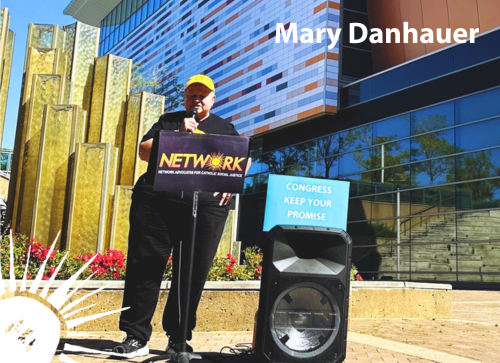
David Dutschke was the Oct. 2 Louisville Rally emceeSpeakers at our gathering included George Eklund, Director of Education and Advocacy, Coalition for the Homeless; Mary Danhauer, a retired nurse practitioner from Owensboro working in low-income clinics; the Honorable Attica Scott, former state Representative and Director of Special Projects at the Forward Justice Action Network; and the Rev. Dr. Angela Johnson, pastor of Grace Hope Presbyterian Church. They all spoke from different perspectives, but highlighted the fundamental role that you, me, and our government must take to provide for people in the margins. All of the speakers shared stories of the “bandage” work, or what I’d call charity or direct service work, that they do–myself included at St. Vincent DePaul. But all of us also emphasized the need for work to transform structures. The systemic change work that I do is with NETWORK and Clout (Citizens of Louisville Organized and United Together). And to start that systemic change work, Sr. Emily TeKolste, SP, an organizer with NETWORK, and leader of the Kentucky Team, provided very specific actionable items.

So here are some of my takeaways from our gathering: first, the largest provider of assistance to those on the margins is the U.S. people, at the direction of the federal government, in the form of rent assistance, housing programs like Section 8, SNAP, and Medicare assistance. We have to support these programs and ensure that Congress bolsters them, not slashes them.

George Eckland, Coalition for the Homeless and Rev. Angela Johnson, Grace Hope Presbyterian Church

George Eckland, Coalition for the Homeless and Rev. Angela Johnson, Grace Hope Presbyterian Church

Second, we don’t have a living wage mandate. In Louisville, a family of 3 needs at least $66,893 per year of income. Translated to wages, they need one job that pays at least $32.16 per hour. We can talk about food pantries, shelters, assisted living spaces, assisting our neighbors with paying rent and utilities, but eventually one comes down to the question: how many jobs do you have to have to raise a family today? Third, we have to reject the myth of scarcity.
There are 5,671,005 Americans with a net worth of over $3 million. There is $381 billion in unpaid taxes. And there are 37.9 million persons in the U.S. who live in poverty.
Finally, we need to do both charity work and system change work. All together, we the people of the U.S., have the resources to pay our bills and to shrink the margins. Our federal budget is a moral document to help us move forward. Solutions require the change of the system. And to do that, we have to organize. In organizing work, we say that there are only 2 sources of power—organized money and organized people. We have the people.

David Dutschke, a member of the Kentucky NETWORK Advocates Team, is former director of Parish Social Ministry and Housing Development at Catholic Charities of Louisville.

Watch Video from Louisville, KY Rally for a Better Federal Government

We must act, always with others, to make the Good News of our communal action THE news. We are all challenged to make our policies, including our budget, a beacon of moving forward on this great shared cosmic journey on which the Cosmic God leads us. Peace be with you all.
                                                               ~David Dutschke